The call that changed everything was with a client I'd been trying to impress for three weeks. I was mid-sentence — the important part, the part where I explain why my price is worth it — when Milo launched himself at the window, barking like the apocalypse had arrived, because a cat had dared to walk across our garden wall. I muted myself, sprinted across the room in my socks, dragged a 22-kilo dog away from the window, and came back to find the client staring at me on video, trying very hard not to laugh. I got the job anyway. But I decided that day that working from home with a dog needed a system, not just good intentions.
I've worked from home for four years now, and Milo has been my colleague for three of them. He's the colleague who sleeps through meetings, steals my lunch, and has never once filed an expense report. Working from home with a dog is genuinely one of the best things about the arrangement — and also, if you're honest, one of the most disruptive, if you don't set it up properly. Here's what I learned, mostly by getting it wrong first.
The morning walk is non-negotiable (yes, even when it's raining)
This is the rule that underpins everything else. Milo gets a proper walk before I start work, every single day, no exceptions. Not a quick garden wee. A real walk — forty minutes, with sniffing time, ideally somewhere he can run off-lead for a bit. If I skip it, the whole day goes sideways. He paces, he stares at me, he brings me toys during calls, he sighs dramatically by the door at 10am. If I do it, he comes home, drinks a bowl of water, and sleeps for three solid hours while I do my best work of the day.
It took me an embarrassingly long time to connect those two facts. For the first month of working from home, I treated the morning walk as optional, something I'd squeeze in when I had time. I never had time. The dog got restless, I got annoyed, and then I felt guilty for being annoyed at a dog who was just bored. The morning walk isn't a favour I do for Milo. It's the foundation of my workday. I start at nine, so we walk at eight. In winter it's dark and cold and I'd rather stay in bed. I go anyway, because the alternative — a restless dog and a ruined morning — is worse than rain.
On days when the weather is truly awful, I swap the long walk for a shorter one plus ten minutes of training in the hallway — scent games, mostly. I'll hide treats around the living room and let him find them, which sounds silly and is, in fact, exhausting for a dog. A dog's brain burns more energy sniffing than their legs do running, and ten minutes of sniffing buys me nearly as much peace as a forty-minute walk.
The office door is a boundary, not a suggestion
My workspace is a corner of the spare room, and for the first six months Milo treated it as his second living room. He'd wander in, lie on my feet, sigh when I moved, and bring me a toy every forty-five minutes like clockwork. It was sweet. It was also destroying my concentration.
The fix was a baby gate. Not a closed door — I don't like shutting him out completely, and a closed door makes him whine — but a baby gate across the doorway. He can see me, I can see him, but there's a clear line: this side is work, that side is yours. It took about three days for him to accept it. On day one he stared at the gate like it had personally betrayed him. On day three he brought his bed over to the gate, flopped down on the other side of it, and fell asleep with his nose touching the bars.
That gate is the single best purchase I've made for working from home. It cost about twenty-five pounds and it bought me back my focus. The boundary works because it's consistent. If I let him in "just this once" during a boring afternoon, he learns that the gate is negotiable, and negotiable gates get tested every single day. He's allowed in during my lunch break and after five o'clock. The rest of the time, the gate is the gate. Dogs thrive on predictable rules, and honestly, so do I.
The call routine (or: how to stop your dog barking at the worst possible moment)
Video calls are the danger zone. Milo doesn't understand video calls, but he understands that when I put my headphones on and start talking to my screen, I am ignoring him. And being ignored is, in his opinion, completely unacceptable.

My system now is embarrassingly simple. Before any important call, I give him something to do. Usually it's a frozen Kong — peanut butter, a few bits of kibble, frozen overnight — or a long-lasting chew. I hand it to him two minutes before the call starts, he settles on his bed with it, and I get forty minutes of peace. For shorter calls, a snuffle mat with treats hidden in it works just as well. The principle is the same: a busy mouth is a quiet mouth.
I also mute myself when I'm not speaking. This is good call etiquette anyway, but with a dog it's essential. Milo once let out a single, enormous sneeze directly into my laptop microphone during a team meeting, and my manager's face did something I still think about. Mute is your friend. Use it constantly.
And the doorbell? The doorbell is the enemy of every work-from-home dog owner. Milo used to lose his mind at it. My solution is a bit ridiculous but it works: I put a note on the door asking delivery drivers to knock quietly or leave parcels by the step, and I trained Milo that the doorbell means "go to your mat" instead of "defend the house". That took about three weeks of someone ringing the bell while I sent him to his mat with a treat. It's not perfect — a really enthusiastic delivery driver can still set him off — but it's about eighty percent better, and eighty percent is enough to keep my calls intact.
The 3pm zoomies are real, and they're my fault
Every day at about three o'clock, Milo wakes up from his afternoon nap and has opinions. He wants to play. He wants to go out. He wants me to throw something, anything, right now. This is the moment when most work-from-home dog owners either give in and lose an hour, or ignore the dog and feel guilty for the rest of the day.
I built it into my schedule. Three o'clock is my break anyway — or it should be — so I take fifteen minutes: a quick walk around the block, a game of tug in the garden, five minutes of training. Then he goes back to sleep and I go back to work, and we both feel better. The trick is that it's scheduled, not reactive. If I wait until he's bouncing off the walls and then react, I'm rewarding the bouncing. If I take the break before he escalates, I'm just a person with a sensible routine and a dog who knows what's coming.
Lunch is the other anchor. We eat together — I mean, I eat my lunch and he gets his, usually in a puzzle feeder that makes him work for it — and then we go for a twenty-minute walk. That walk is the line between the morning and the afternoon. It clears my head, it empties his bladder, and it means neither of us has to sit still for more than three hours at a stretch.
What I feed him, and when (because timing matters)
Milo eats twice a day: breakfast at seven-thirty, dinner at five-thirty, right when I finish work. That schedule matters more than the food itself, because a dog who eats at predictable times is a dog whose body clock is predictable. He doesn't beg for food at eleven because he knows food comes at set times, and he doesn't wake me up at dawn because his stomach knows breakfast isn't for another hour.
I used to give him a midday snack "to keep him quiet" during calls. It worked for about ten minutes and then taught him that barking during calls gets snacks, which is the opposite of what I wanted. Now the only midday food he gets is inside a Kong or a puzzle feeder, which means he earns it by working for it instead of demanding it. Small change, big difference.
One more thing: water. Milo's water bowl lives outside my office, and I refill it every morning. A dog who can't reach water will come and tell you about it, usually during your most important call of the day. Keep the bowl full, keep it accessible, and you remove an entire category of interruptions.
The toys that actually buy you work time
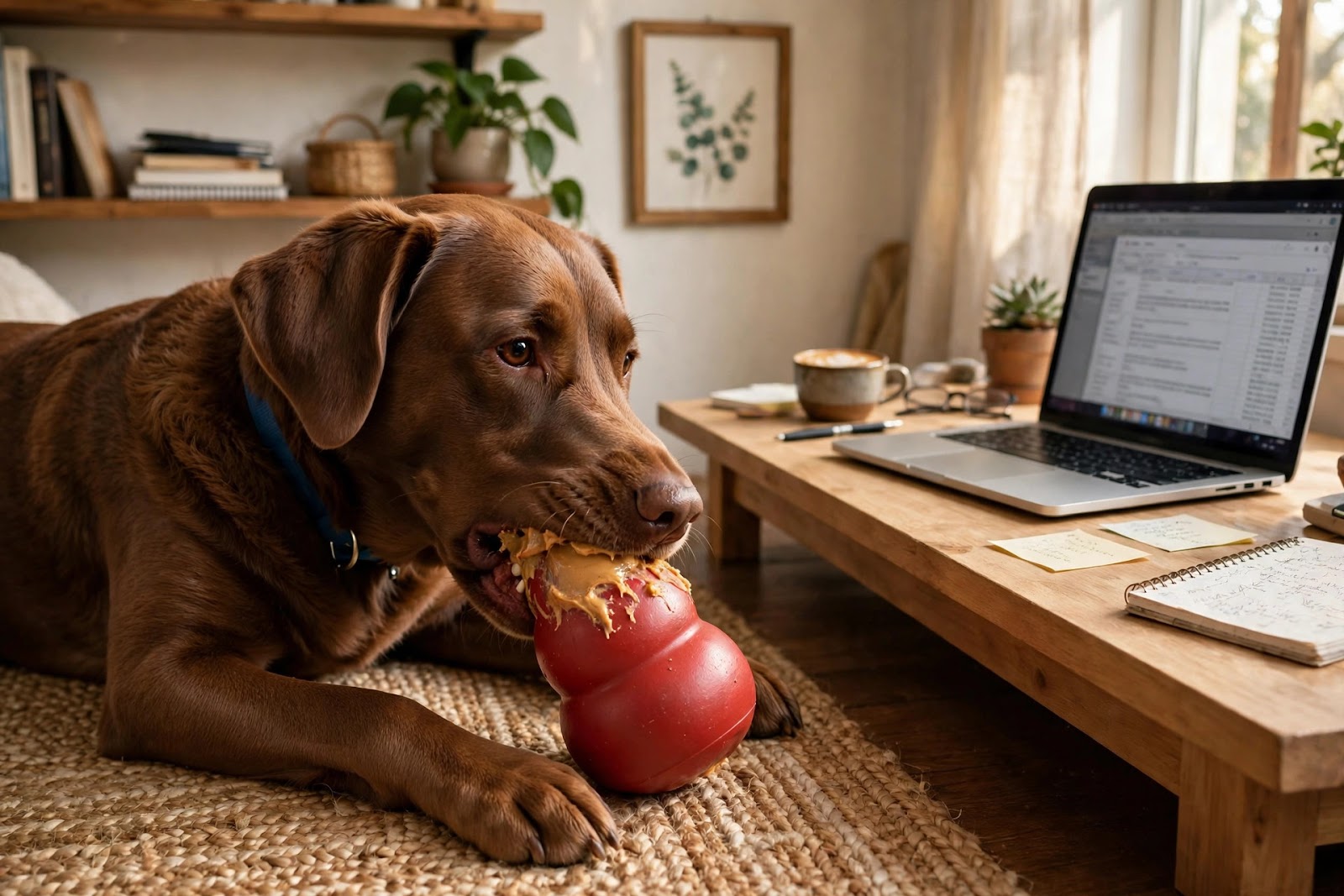
Not all toys are equal when you need an hour of quiet. The ones that work are the ones that make the dog think. Milo's top three: the frozen Kong, a snuffle mat, and a puzzle ball that drops kibble when he rolls it the right way. The ones that don't work: anything squeaky (obvious), anything that rolls under the sofa (he'll bark at the sofa until you rescue it), and rope toys (he brings them to me and drops them on my keyboard, which is a demand, not a game).
I rotate them. He gets one enrichment toy in the morning and a different one in the afternoon, and I put them away at the end of the day so they stay interesting. A toy that's always available is furniture. A toy that appears at nine o'clock and disappears at five is an event. This sounds like a small thing, and it is — but working from home with a dog is mostly small things, stacked up.
I also keep a "boredom box" by my desk: a cardboard box full of old towels with treats hidden in the folds. When Milo gets restless and I've got a deadline, I put the box down and he spends twenty minutes tearing towels apart looking for food. It costs nothing, it makes a mess, and it buys me a solid block of focus. Clean-up takes two minutes. Worth it every time.
Sick days and bad days (for either of us)
The routine falls apart sometimes, and that's fine. Milo had an upset stomach last month and needed the garden every hour, which meant my workday was chopped into pieces and I got about half my normal work done. I told my manager, moved two meetings, and spent the day in old clothes near the back door. Nobody died. The work waited.
The same applies when I'm the one who's ill. On days when I have a migraine, Milo gets a shorter walk and an extra Kong, and I work from the sofa with my laptop on my knees and the baby gate open, because a sick day with the dog next to me is better than a sick day feeling guilty about a closed gate. The routine is a tool, not a religion. It bends when it needs to. The trick is that it bends and comes back, instead of snapping and staying broken for a month.
What I got wrong, and what I'd tell a new work-from-home dog owner
My biggest mistake was feeling guilty. For the first year, every time Milo looked bored, I felt like a bad dog owner for working instead of playing with him. So I'd stop work, play for twenty minutes, and then work late to catch up, and then feel guilty about that too. It was a miserable loop, and it helped nobody.
The truth is that dogs sleep for most of the day. A healthy adult dog sleeps twelve to fourteen hours, and Milo is no exception. He's not suffering while I work. He's napping, dreaming about squirrels, completely content. What he needs from me is a good walk in the morning, a break in the afternoon, and my full attention when work ends. The rest of the time, he needs me to be calm and predictable, not entertaining.
If you're about to start working from home with a dog, here's my honest advice: set the routine before you need it, not after the first disastrous call. Walk first, gate the workspace, pre-make a week's worth of frozen Kongs on Sunday night, and accept that the first two weeks will be messy. Your dog will test every boundary. That's normal. Hold the line, stay boring about it, and one day you'll look over and realise your dog has been asleep for three hours, your calls went fine, and the only interruption was a single sneeze.
Milo is asleep on his bed by the gate right now as I write this, by the way. He's been there for two hours. My calls are done, my work is nearly done, and in about twenty minutes I'll open the gate, he'll stretch, and we'll go for our evening walk. That's the deal we've made: I work, he sleeps, and at five o'clock the day belongs to both of us. It took a while to get here. It was worth every bit of the mess along the way.


