The Morning I Actually Watched Him Do It
Every morning for about three weeks last spring, my dog Milo did the same thing. We'd get to the bottom of the garden, he'd sniff the air like he was checking the weather, and then he'd start grazing. Not a quick nibble. Proper grazing, head down, tearing at the long grass along the fence like a small, confused cow. I stood there with the lead in my hand feeling faintly embarrassed, because neighbours could see us, and also a bit worried, because every dog owner has heard the old line about dogs eating grass when they're sick. Was my dog sick? Was he trying to make himself throw up? Was I feeding him wrong?
I panicked quietly and changed nothing. Then I watched him for a week and kept notes on my phone, because guessing wasn't getting me anywhere. What I found surprised me. He only grazed in the morning, never in the evening. He only went for the long, soft blades along the fence, never the short lawn in the middle. And he almost never threw up afterwards. Out of fourteen mornings, he was sick exactly once, and that was the morning he'd also stolen half a bread roll off the kitchen counter the night before. The grass, I started to suspect, wasn't the problem. It was a symptom of something much more ordinary: boredom, habit, and a morning stomach that was emptier than I realised.
That week of watching changed how I handle it, and over the last year the grazing has dropped from an everyday thing to an occasional nibble. Not zero. I don't think zero is realistic, or even necessary. But it's no longer the first thing he does every single morning, and I'm no longer standing in the garden at 7am worrying that something is badly wrong. Here's what actually helped, what didn't, and the bits I wish someone had told me before I spent a tenner on a bottle of "grass-eating remedy" that did absolutely nothing.
First, the Question Everyone Asks: Is He Sick?
Let's get the scary part out of the way, because it's the part that kept me up at night. Dogs eat grass for lots of reasons, and most of them are boring. Some dogs like the taste and texture. Some do it when they're bored. Some do it because their stomach feels a bit empty and grass is there. A smaller number do it because their stomach actually is upset, and grass can trigger vomiting, which is probably why the old wives' tale exists. The trick is telling which dog you've got, and you do that by watching the pattern, not by panicking over a single mouthful.
What I learned to look for: does he graze and then carry on happily, tail up, ready for his walk? Or does he graze frantically, gulp, retch, and then go off his food? Milo was firmly in the first group. He'd eat his grass, look pleased with himself, and then drag me towards the park. His appetite at breakfast was normal. His energy was normal. His poos were normal (yes, I checked; dog ownership is glamorous like that). Once I had a week of notes showing a happy dog with a grass habit, I stopped treating it like an emergency and started treating it like a behaviour I could gently reshape.
That said, there's a line, and I want to be clear about it because I don't want anyone reading this to ignore a real problem. If your dog is eating grass obsessively, vomiting regularly, refusing food, lethargic, or has diarrhoea that won't settle, stop reading blog posts and ring your vet. I'm a dog owner sharing what worked for my healthy dog, not a vet, and a sudden change in any dog's habits deserves a professional look. The rest of this article is for the dog who is otherwise fine and just really, really likes salad.
The Empty-Stomach Theory (and the Biscuit That Proved It)
The first change I made was the simplest and it made the biggest difference. Milo's last meal was at 6pm and breakfast was at 8am. That's fourteen hours with nothing in his stomach, and he was waking up at 6:30am, going into the garden on an empty stomach, and eating the first green thing he could find. I felt a bit stupid when I worked that out, because the answer was sitting in my own kitchen: I get hungry in the morning too, and I don't have to wait ninety minutes for breakfast.

So I started giving him a small bedtime snack. Nothing fancy. A couple of plain dog biscuits, or a spoonful of his kibble, at about 9:30pm. Not a meal, just something to take the edge off. Within four days the morning grazing had dropped by more than half. On the mornings he still nibbled, it was two or three blades, not a full grazing session. That one change was worth more than every spray, supplement and stern "leave it" I tried in the first month.
I also moved breakfast earlier. Instead of garden first and breakfast after the walk, I flipped it: a small handful of kibble before we went out, the rest after the walk. Some trainers will tell you never to feed before exercise, and for a big meal right before a run they're right, but a small handful twenty minutes before a gentle walk is a different thing entirely. Check with your vet if your dog is a breed prone to bloat, obviously, because that changes the maths. For Milo, a medium-sized mixed breed with no bloat risk factors, it worked beautifully. The grass stopped being breakfast and went back to being background.
Why "Leave It" Didn't Work (and What Did)
My first instinct, like everyone's, was to train it out of him. I stood in the garden saying "leave it" every morning like a broken record. Milo would look at me, stop for two seconds, and then go straight back to the grass the moment I looked away. I was fighting a losing battle because I was asking him to ignore something he enjoyed, in the exact place he enjoyed it, with nothing better on offer. That's not training, that's nagging.
What worked was giving him something better to do with his mouth in the first minute outside. I started taking a carrot stick or a chew into the garden with us. He'd come out, I'd offer the carrot, and he'd spend the first two minutes crunching that instead of grazing. By the time he finished, the initial urge seemed to have passed. It sounds too simple, and honestly it annoyed me how simple it was after a month of failed "leave it" battles. But dogs are practical creatures. If the grass is the most interesting thing in the garden at 7am, they'll eat the grass. Change what's interesting and the grass loses.
I also stopped making it a big deal. Every time I lunged towards him shouting "no", I was turning grass into the most exciting thing in the garden. Attention is a reward, even grumpy attention. When he did graze, I calmly called him over with a treat and moved on. No drama, no chase. The less interesting I made it, the less interesting it became. That took about three weeks to show, and I nearly gave up in week two, but I'm glad I stuck with it.
The Garden Itself Was Part of the Problem
Here's the bit nobody told me: the long grass along the fence was the problem as much as Milo was. The middle of the lawn, which I mowed every week, he ignored completely. The edges, where the grass grew long and soft and seed-headed, were the salad bar. So I changed the garden. I strimmed the edges properly, mowed a strip along the fence, and pulled up the long tufts that grew through the gaps in the fence panels. Boring garden maintenance, but it removed the temptation at the source.
I also planted a small patch of herbs at the far end of the garden, because I'd read that some dogs graze partly because they want something green and fibrous, and giving them a safe, deliberate option beats letting them choose their own. I put in a clump of wheatgrass in a pot, the kind you can buy for a couple of pounds at a garden centre, and a pot of mint. Milo sniffed the wheatgrass, ate a bit, and seemed satisfied. Was it the wheatgrass or the coincidence of timing? I genuinely don't know. But the pot cost £2.50 and it gave him a legal salad bar, so it stays.
One warning from experience: if you go the planting route, check that everything you plant is dog-safe before it goes in the ground. I spent an evening cross-checking a list because some common garden plants are genuinely toxic to dogs, and the last thing you want is to solve a grass habit by introducing something worse. The garden centre staff were helpful, and there are good lists online from animal charities. Don't guess. And never let your dog graze on grass that's been treated with weedkiller or fertiliser, or on grass at the edge of a road where cars and other dogs have been. If I wouldn't eat a salad grown there, Milo doesn't graze there either.
The Boredom Link I Didn't Want to Admit
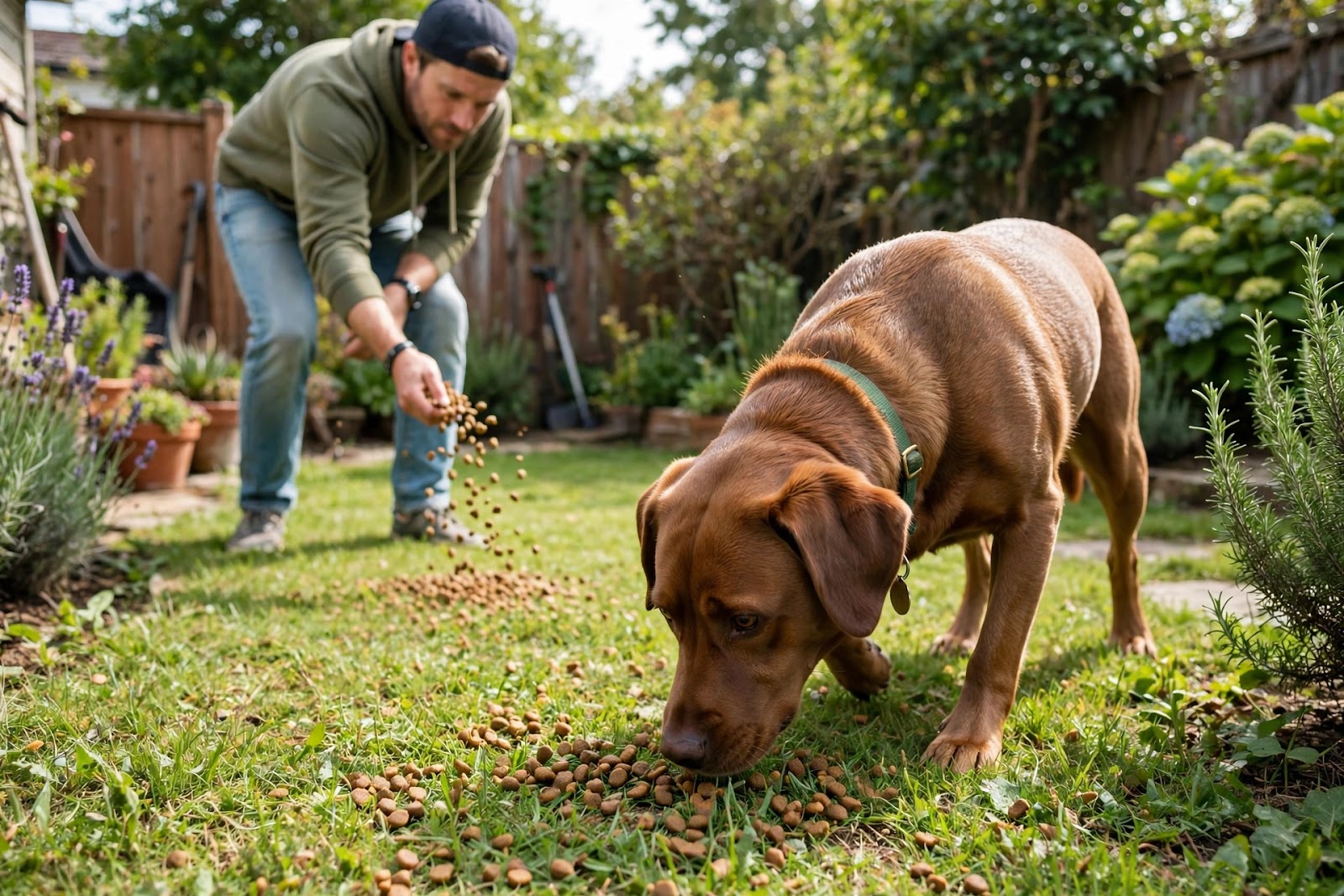
This is the part where I have to be honest about my own routine, because the grass habit got worse in a particular month and I knew why. I'd started working longer hours, the morning walk had shrunk from forty minutes to twenty, and the evening play session had quietly disappeared. Milo was spending more time in the garden with less to do, and the grass was the most entertaining thing out there. He wasn't sick. He was bored, and I was the cause.
I fixed it by bringing back ten minutes of morning play before work. Not a full training session, just a quick game of fetch in the garden or a scatter of kibble in the grass for him to sniff out. Scatter feeding is brilliant for this, by the way: you take a handful of his breakfast kibble, throw it into the lawn, and let him hunt for it. It uses his nose, it takes ten minutes, and it turns the garden from a salad bar into a puzzle. On scatter-feed mornings, Milo barely looked at the grass. He was too busy working.
The other thing that helped was a proper sniff walk rather than a march around the block. I used to drag him past every interesting smell because I was in a hurry. Now I let him stop and sniff for as long as he wants on the first ten minutes of the walk. A dog that has had a good sniff is a calmer, more satisfied dog, and a satisfied dog grazes less. I know that sounds like one of those vague tips people throw around, but I watched it happen day after day. Sniffy walk, no grazing. Rushed walk, grazing. The pattern was too consistent to ignore.
What I Tried That Didn't Work (So You Don't Have To)
Let me save you some money. The "anti-grass-eating" supplement I bought online did nothing except make his poo slightly greener, The bitter spray on the grass washed off in the first rain and made the garden smell like a chemistry lab. The special "digestive" kibble the pet shop recommended cost twice as much and changed nothing, because his digestion was never the problem. And the muzzle idea, which someone suggested in a Facebook group, was a hard no from me. A muzzle for a dog who is otherwise happy and healthy, just because he eats grass, felt like using a sledgehammer to crack a nut, and it would have made every walk miserable.
When to Actually Worry (My Honest Checklist)
After a year of this, here's my personal checklist for when grass-eating goes from "my dog likes salad" to "I should ring the vet". I run through it whenever Milo has a grassy week, and it's kept me calm more than once. One, is he eating normally otherwise? Two, is his energy normal? Three, is he vomiting more than once in a week, or retching without bringing anything up? Four, has the grazing suddenly increased a lot, or is he eating grass frantically rather than casually? Five, is he eating other non-food things too, like stones or socks or soil? Any yes on three, four or five and I call the vet, no debate.
And a note on something I learned the hard way: grass can hide things. I once caught Milo eating grass near a patch where a neighbour had sprayed weedkiller over the fence line. I rinsed his mouth, watched him for the rest of the day, and rang the vet for advice. He was fine, but it scared me enough that I now check what's been sprayed anywhere he grazes, including my own garden. If you've treated your lawn recently, keep your dog off it until it's had a good rain and the product label says it's safe. Read the label. I know, nobody reads labels. Read this one.
Where We Are Now
A year on, Milo still eats grass sometimes. Maybe twice a week, a few blades, usually on mornings when I've been lazy about the bedtime snack. I don't stop him anymore. I let him have his nibble, we carry on with the walk, and life goes on. The difference is that it's a quirk now, not a daily ritual, and I understand it. Empty stomach plus boredom plus long soft grass equals grazing. Change any one of those three and the habit shrinks.
If your dog is doing the same thing, start with the notebook. Watch for a week before you change anything. Note the time, the place, what happened before, and whether he was sick after. You'll probably see a pattern within days, and the pattern will tell you what to fix. For us it was the fourteen-hour overnight fast. For your dog it might be boredom, or a patch of particularly delicious long grass, or just the fact that dogs are weird and grass tastes interesting. All of those are fixable, and none of them need a special supplement or a panicked vet visit at midnight. Just a bit of watching, a bedtime biscuit, and a garden that's a little less like a salad bar.


