The Trip That Taught Me Everything
We were two hours into a drive to my sister's house when Milo threw up in the back seat. Not a little. A lot. All over the blanket, the seatbelt cover, and my favourite jacket, which I had foolishly left on the seat next to him. I pulled over at a petrol station, cleaned up with half a pack of baby wipes, and stood in the rain feeling like the worst dog owner in the world. Milo looked up at me with sad, droopy eyes, and I knew exactly what I had done wrong. I had fed him his normal breakfast, a full bowl, twenty minutes before we left, then given him a big chewy treat in the car to keep him happy. A full stomach plus a winding road plus a rich treat was a recipe for exactly what happened.
That was three years ago. Since then we have done dozens of trips together — short drives to the coast, a six-hour drive to visit family, a weekend away in a cottage — and Milo has not been sick in the car once. The change was not a gadget or a special product. It was a routine: what I feed him, when I feed him, and what I never, ever do again. If you travel with your dog, this routine is worth stealing.
The Night Before: Pack Like You Mean It
Good travel days start the night before. I pack Milo's bag the same way I pack mine, and I do it early, because packing in a rush the next morning is how things get forgotten. His bag is a small duffel that lives by the back door. In it goes his food, measured out into a sealed tub, enough for the trip plus one extra meal, because delays happen. I measure it with his usual scoop, not by eye. On a travel day, guessing is how you end up overfeeding.
I also pack his water bottle, the one with the little bowl attached, his usual bowl, a spare lead, his blanket, a roll of poo bags, baby wipes, a couple of old towels, and a small bag of his normal treats. The towels are not optional. Even a dog who never gets sick can step in mud at a service station. I learned that on a trip to the coast, when Milo found the one muddy puddle in a whole car park and came back looking like a swamp creature. The towel saved my car seats. It did not save my dignity, but that was already gone.
The most important thing I pack is his regular food. Not a new brand, not a fancy travel pouch I found on offer, not the leftover tin of something different. His usual kibble, the same one he eats at home every day. Travel days are not the time to try new food. A dog's stomach likes routine, and a car journey is already strange enough without a surprise menu. I made that mistake once, buying a different brand at a service station because I had run out. He ate it happily and regretted it all evening. Never again.
Breakfast on a Travel Day: Smaller, Earlier, Blander
Here is the rule that changed everything for us: on a travel day, Milo eats a smaller breakfast, at least three hours before we leave. Not his full bowl. About two-thirds of it. He still gets his normal food, just less of it, and earlier than usual. If we leave at nine, he eats at six. That gives his stomach time to settle before the car starts moving. It sounds simple, and it is, but it took me a year of sick dogs and stressed journeys to actually do it consistently.
Why smaller? Because a full stomach and a moving car do not mix well for Milo. I am not a vet, and I am not going to pretend I know the science of it. I just know my dog. When he travels on a full belly, he drools, he pants, he looks miserable. When he travels on a lighter belly, he settles down and sleeps. Every dog is different, and if your dog gets travel sick a lot, that is a conversation for your vet, not a blog post. But for a dog like Milo, who is mostly fine in the car, the smaller, earlier breakfast was the difference between a sick dog and a sleeping one.
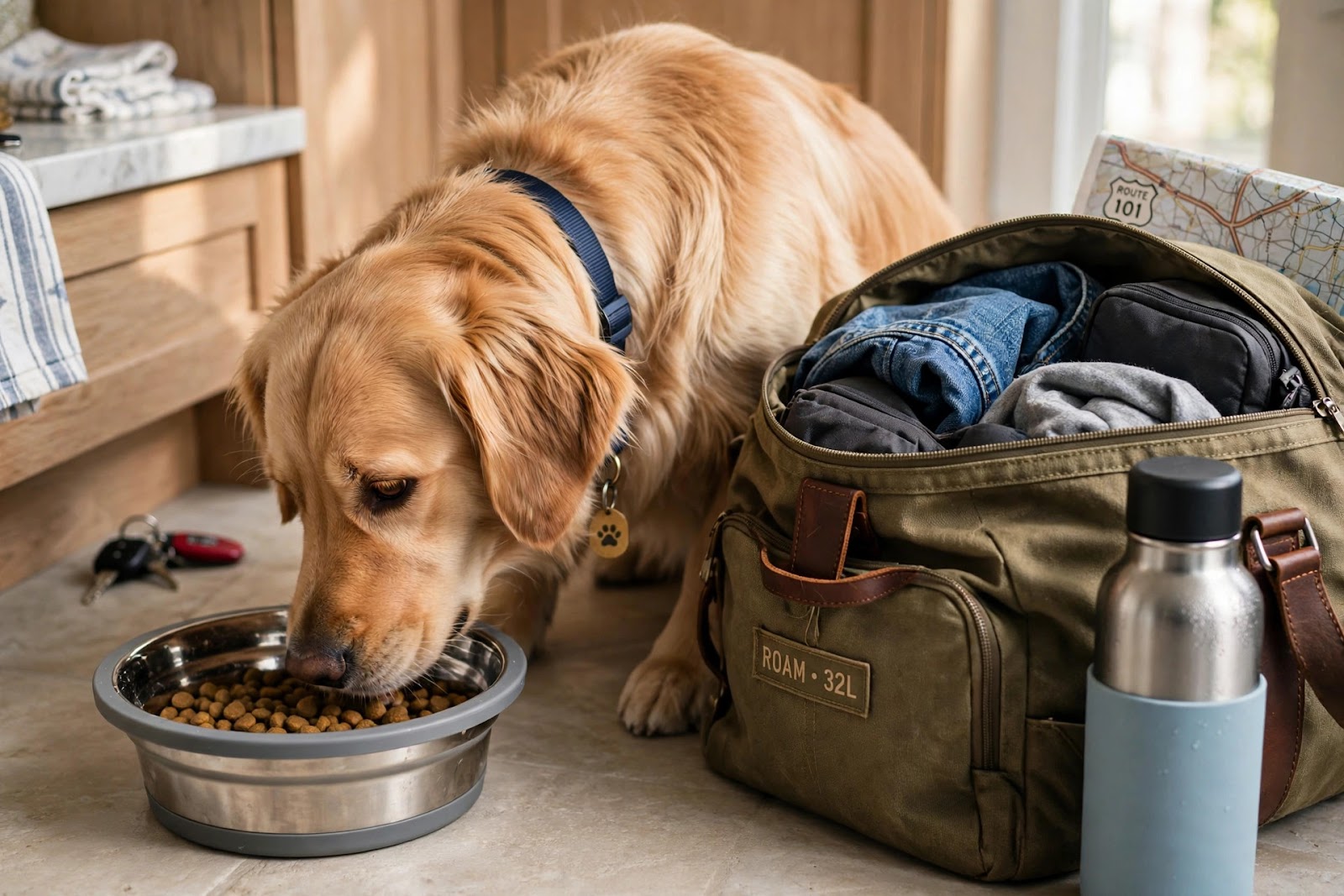
I also keep breakfast boring on travel days. No extras, no table scraps, no new treats mixed in to make it special. Just his kibble, a splash of water on it like usual, and that is it. The morning of a trip is exciting enough for a dog without adding new flavours to the mix. He does not know he is missing out. He just knows breakfast came early and the car is about to happen, and that is plenty of excitement for one morning.
The Treat Mistake (and What I Do Instead)
Let me be honest about the treat mistake, because it is the one I am most embarrassed about. On that first sick trip, I gave Milo a big rawhide-style chew in the car because I thought it would keep him busy and happy. He loved it for about ten minutes. Then the car went round a bend, then another, and his stomach made its feelings known all over the back seat. Rich, chewy treats and winding roads are a bad combination. I know that now. I wish I had known it then, preferably before I had to clean sick off my jacket in a petrol station car park.
Now, treats in the car are small, plain, and rare. I keep a handful of his normal training treats in a tub in the door pocket, the same tiny soft ones I use for mat training. If we stop for a break and he has been good, he gets two or three. That is it. No big chews in a moving car, no new biscuits, nothing rich or greasy. If he needs something to keep him busy, he gets a chew when we stop, not while we are driving. A chew at a rest stop, on the grass, with the car parked and the world standing still, is a completely different thing from a chew on a motorway.
The other thing I stopped doing was feeding him at service stations. I used to buy him a little something at every stop, because I was eating and I felt guilty. A sausage roll here, a bit of my sandwich there. His stomach did not thank me. Now, when we stop, he gets water, a short walk, a toilet break, and nothing to eat. He can wait until we arrive. Dogs are better at waiting for food than we think. It is us who struggle with the guilt.
Water: Little and Often Beats a Big Bowl
Water on travel days is a balancing act. Too little and he is thirsty and restless. Too much at once and you are stopping every twenty minutes for a toilet break, or worse, cleaning up a puddle in the footwell. What works for Milo is little and often. At every stop, I offer him water from his travel bottle, a few laps, not a full bowl. He drinks what he needs and we move on.
I keep his water bottle in the car all year, not just on trips. It is the kind with a bowl that flips out, and I fill it fresh every morning before we leave. In summer I add a couple of ice cubes, which he seems to enjoy, though I suspect he mostly enjoys the noise they make. I never let the bottle sit in a hot car all day. Warm, stale water is something no dog wants, and on a hot day I would rather stop and buy a fresh bottle than let him drink water that has been baking on the back seat.
One practical tip: put a towel under his water bowl at rest stops. Milo drinks like a man who has just crossed a desert, and half the water ends up on the ground, or on my shoes. A towel catches most of it. I keep a dedicated car towel for this, dark blue, already stained, and I do not care what it looks like. It has one job and it does it well.
The Arrival Meal: Wait, Then Feed Normally

Arriving is the moment most people get wrong, me included, for years. You pull up, the dog is excited, everyone is happy, and the first thing you do is feed him a big meal to celebrate. Do not do that. A dog who has just spent hours in a car needs time to settle before he eats. His stomach needs to catch up with the rest of him.
Our rule now is simple: arrive, walk, sniff, toilet, water, rest for an hour, then food. The walk matters most. Milo needs to stretch his legs, sniff the new garden, work out where he is. That sniffing is not dawdling, it is him reading the news of a new place. Give him twenty minutes of it. Then water, then a rest on his blanket, then his normal meal, the same food, the same amount as at home. Nothing special, nothing extra. The first night in a new place, boring food is kind food.
I also feed him in the same spot each time we arrive somewhere new, if I can. His bowl goes in a quiet corner, away from the door, away from people walking past. Dogs eat better when they feel safe, and a new house has enough strange noises without adding footsteps past his bowl. At my sister's house, his bowl goes in the utility room, on his mat, in the same corner every time. He walks straight there now when we arrive, like he owns the place. In a way, I suppose he does.
What I Pack for the Journey Home (and the One Thing I Always Forget)
The journey home needs the same routine as the journey there, and this is where I used to get lazy. We would have a lovely weekend, Milo would eat well, play in the garden, sleep like a log, and then on the morning we left I would feed him a full breakfast at eight and be on the road by half past. Guess what happened. Twice. The second time I finally wrote the routine down on a card and stuck it to the fridge at my sister's house. Smaller breakfast, three hours before we leave, no treats in the car, water little and often. It is still there, slightly faded, held up by a magnet shaped like a dog bone.
The one thing I always forget is the poo bags. I pack them, I swear I pack them, and then I find the roll is empty at the worst possible moment. I now keep a spare roll in the glove box, a spare roll in his bag, and a spare roll in my coat pocket. Three rolls. It sounds excessive until you need one and do not have it. Ask any dog owner. We have all been there, standing in a field, patting empty pockets, doing the maths on how far it is to the nearest shop.
The Routine, Written Down
If you want the short version, here it is, the whole thing on one card. Night before: pack his usual food, measured, plus one extra meal, water bottle, bowl, blanket, towels, wipes, poo bags, normal treats. Morning: smaller breakfast, about two-thirds, at least three hours before leaving, nothing new, nothing rich. In the car: no big chews, no food at stops, small plain treats only when parked, water little and often. Arriving: walk first, water, rest an hour, then a normal meal in a quiet corner. Going home: same routine, no shortcuts, even when you are tired and just want to get on the road.
It is not fancy. It is not clever. It is just a routine that respects the fact that travel is hard work for a dog, even a dog who loves the car. Milo loves the car now, by the way. He runs to it, jumps in, and settles on his blanket before I have even closed the door. He knows the routine as well as I do. He knows breakfast will be early and smaller, he knows the treats will be tiny, and he knows that when we arrive there will be a walk and a sniff and then food. He does not mind any of it. He minds being sick, and so do I. Three years, dozens of trips, no sick in the back seat. That, for us, is the whole point of the routine. It works, so we keep doing it, trip after trip, mile after mile.
One Last Thing: Keep Notes on What Works for Your Dog
Every dog is different, and that is worth remembering. Milo does best on a smaller, earlier breakfast, but your dog might be fine with a normal one, or might need an even lighter meal. The only way to know is to pay attention and keep notes. I keep a little notebook in Milo's bag now, nothing fancy, just dates, times, what he ate, and how the journey went. After three or four trips you can see the pattern plainly. The trips where he ate early and light were calm. The trips where I rushed breakfast were not. Notes turn guesswork into a routine you can trust, and a routine you can trust is the best thing you can pack for any journey with your dog.


