The first thunderstorm Milo ever heard properly sent him straight under our bed, and he stayed there for four hours. Not under the bed in a cute, tucked-away way. Wedged so far back against the wall that I had to lie flat on the floor with a torch to see him, panting, shaking, his eyes wide and fixed on nothing. I remember sitting on the bedroom floor in the dark, rain hammering the window, thinking I had somehow failed him. He was two years old, a golden retriever who wasn't scared of anything — not the vacuum cleaner, not the bin lorry, not the neighbour's enormous German shepherd — and a bit of weather had reduced him to a trembling heap behind the bed frame.
That night was the start of about eighteen months of trial and error. I tried most of the obvious things first, and most of them didn't work, or worked once and then stopped working. What finally helped wasn't one clever trick. It was a routine — a boring, repeatable set of steps we now do every single time the sky turns that particular shade of grey-green and the air goes heavy. Milo still doesn't love storms. He probably never will. But last month, during the worst storm of the summer, he walked to his spot by himself, lay down, and fell asleep before the rain even started properly. That felt like a small miracle, and it was entirely down to the routine.
What I did wrong at first
My first instinct was to comfort him. Obviously. My dog was terrified, so I got down on the floor, wrapped my arms around him, and told him over and over that it was okay, that he was safe, that the thunder couldn't hurt him. I stayed there for the whole storm, stroking his back, whispering to him like he was a frightened toddler.
Here's the thing nobody told me: all that fussing didn't calm him down. If anything, it made the storm a bigger event. Every time the thunder rolled, I tensed up and grabbed him tighter, and he could feel that. Dogs read your body before they read your words. I was telling him "it's fine" with my mouth while my shoulders were up around my ears and my breathing had gone shallow. He wasn't stupid. He took his cue from me, and my cue said: this is a crisis.
I also made the mistake of dragging him out from under the bed. I thought hiding was the problem, that if I could just get him out into the open and show him nothing bad was happening, he'd relax. He didn't relax. He bolted straight back under the bed the second I let go, and after that he started hiding earlier — at the first distant rumble, sometimes before I'd even noticed the sky changing. I'd taught him that his safe place wasn't safe, because I kept pulling him out of it.
The third mistake was the treats. During one storm I tried to cheer him up with a handful of his favourite biscuits, waving them under his nose while the thunder crashed. He wouldn't touch them. A terrified dog doesn't eat. I kept pushing the biscuits at him anyway, like a waiter who won't take no for an answer, until he finally snapped at my hand — not hard, just a warning — and I realised I was making everything worse by demanding he perform normal behaviour in the middle of a panic.
Letting him choose his hiding place
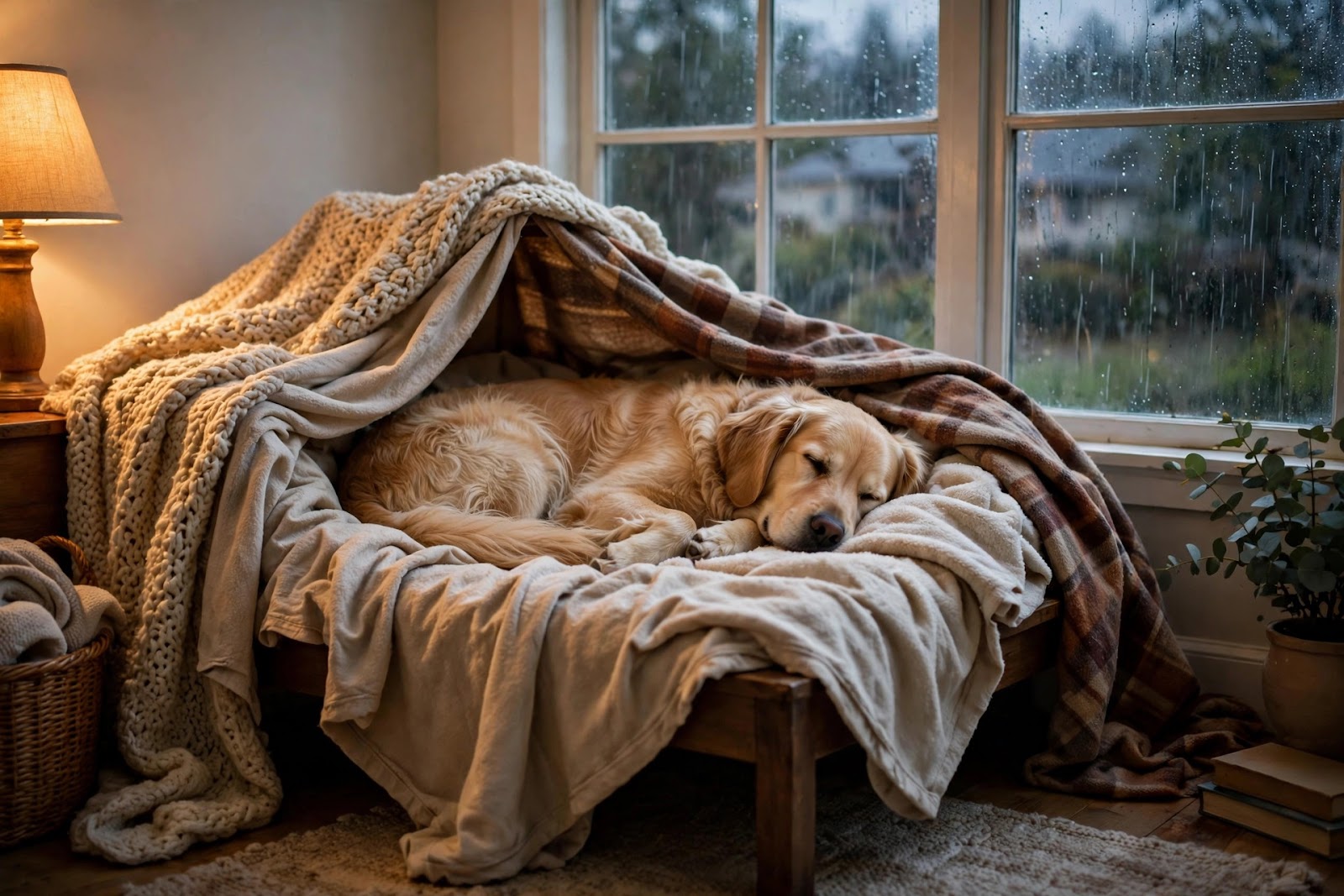
The first real change came when I stopped fighting the hiding. Instead of dragging Milo out, I made the hiding place better. Under our bed was awkward — low, dusty, and he had to squeeze in sideways. So I built him a den in the corner of the living room, behind the armchair, where he could see the room but feel enclosed. A big dog bed, two old blankets draped over the sides of a low table to make a little cave, and one of my old jumpers that smelled like me.
He ignored it for a week. Then one rainy evening, before the thunder even started, he walked over and curled up in it on his own. I nearly cried. The difference, I think, was that it was his choice. Nobody had put him there. He could walk in and out freely, and the entrance faced the room so he could watch me.
That den is now the centre of the whole storm routine. It's always there, all year round, not just in storm season. He sleeps in it on ordinary days too, which matters more than I expected — it's a familiar, boring place, not a special "storm bunker" that only appears when something scary is happening. If your dog only sees the safe spot when the thunder starts, the safe spot itself becomes a signal that something bad is coming.
If your dog's chosen hiding place is somewhere awkward — the bath, behind the toilet, the bottom of a wardrobe — don't fight it. Make it comfortable instead. Put a blanket there. Leave the door open. Let them have it. The goal isn't to stop the hiding. The goal is a dog who hides calmly instead of panicking.
The boring routine that actually works
Here's our routine, step by step, in the order we do it. The whole point is that it's the same every time, so Milo knows what's coming and nothing about a storm day feels chaotic.
First, I watch the weather. This sounds obvious, but it changed everything. I check the forecast every morning in summer, and when a storm is predicted for the afternoon, I plan the day around it. Milo gets his long walk in the morning, while the air is still calm. He gets a good run, a swim if we're near the river, and then lunch. A tired dog copes better with everything, and a dog who has already had his fun isn't also dealing with the frustration of a cancelled walk.
Second, about an hour before the storm is due, I close the curtains. This was a tip from a friend whose collie is terrified of lightning, and it works better than I expected. Milo reacts to the flashes almost as much as the noise. With the curtains drawn and the lamps on, the room stays evenly lit, and the lightning becomes a faint flicker at the edges instead of a white flash filling the room.
Third, I turn on the background noise. We use a cheap white noise machine we bought for about twenty-five pounds, set to a low, steady rain sound — which sounds ridiculous during an actual storm, but it smooths out the sudden cracks of thunder into something less startling. Some people use the radio or a fan. The exact sound doesn't matter much. What matters is that it's steady, it's already on before the thunder starts, and it doesn't stop.
Fourth, I give him something to do with his mouth. A frozen Kong stuffed with mashed banana and a spoonful of peanut butter, prepared the night before and kept in the freezer. Chewing and licking are calming for dogs — you can see it in their whole body, the way their shoulders drop. I put it in the den, not in the middle of the room. He can take it or leave it. Most of the time now, he takes it.
Fifth — and this is the hardest part — I act normal. I make a cup of tea. I read a book. I do not hover over the den, I do not keep checking on him, and I do not say "it's okay" every thirty seconds. If he comes to me, I give him a slow stroke and then go back to what I was doing. Calm is contagious, but so is panic, and I'd spent a year accidentally teaching him that thunder was an emergency. Acting bored was the hardest skill I had to learn, and the most important one.
The sound training that took six weeks
The routine handles the day of the storm. The sound training is what lowered Milo's fear over time, so the routine had less work to do.
We started in April, months before storm season, with a recording of thunder played on my phone speaker at the lowest volume — so quiet I could barely hear it myself. Milo was eating his dinner. He lifted his head once, looked at the phone, and went back to eating. That was the level we needed: he could notice the sound without caring about it.
Every three or four days, I turned it up one tiny notch. Not every day — dogs need time to get used to each step, and pushing too fast undoes the progress. Some weeks we stayed at the same volume for a full week because he seemed a bit wary at that level. The rule I set for myself was simple: if he stops eating, looks worried, or leaves the room, the volume is too high. Turn it down and try again in a few days.
It took about six weeks to get to a volume that sounded like a real, distant storm. Six weeks of the most boring training I've ever done. There were evenings when I sat there thinking this was pointless, that a phone speaker could never prepare a dog for real thunder, and that I was wasting my time. But by the time the first real storm of June arrived, Milo heard the first rumble, looked at me, and then walked to his den and lay down. He'd heard that sound a hundred times before. It wasn't new any more.

A few honest warnings about this. Don't play the recording at full volume on day one and hope he'll "get used to it" — that's how you make a fear worse. Don't do it when he's already stressed, tired, or unwell. And don't use it as a substitute for the routine. The sound training lowers the fear; the den, the curtains, the frozen Kong and the calm owner handle the actual storm.
What to do in the middle of a bad one
Some storms are worse than others. Last August we got a storm right overhead — thunder so loud the windows rattled, lightning every few seconds, rain like someone emptying buckets. All the preparation in the world doesn't make that easy, and Milo spent the worst twenty minutes pressed against my legs in the den, shaking.
Here's what I do when it's that bad, and what I don't do. I stay in the room. I don't leave him alone — that's the one thing I'm sure about, because the one time I popped out to the kitchen for two minutes during a bad storm, I came back to find he'd tried to squeeze behind the radiator and knocked a lamp over. I sit near the den, not in it. I keep my voice low and slow if I talk at all, and mostly I don't talk. I let him lean on me if he wants to, and I don't push him away to prove he can cope alone.
I don't try to feed him, I don't try to play with him, and I don't try to train him during a storm. A dog in the middle of a fear response isn't learning anything. That can wait for a calm day. During the storm, the only job is to get through it with as little drama as possible.
Afterwards, once the rain has eased and the gaps between thunderclaps get longer, I take him out into the garden on the lead for a quick wee and a sniff around. Nothing long, nothing exciting. Just proof that the world is still there and still normal. Then we come back inside, I give him his dinner if it's due, and the day goes back to normal as fast as possible. No big fuss, no celebration, no "well done for surviving." Just normal.
The small things that added up
I also learned to spot his early signs, the ones that show up before the shaking starts. About twenty minutes before a storm, Milo starts yawning, licking his lips, and following me from room to room. His ears go back a fraction. Once I learned to read that, I could start the routine early — curtains, noise machine, Kong in the freezer already waiting — instead of scrambling when the first thunderclap hit. Catching it early is half the battle. By the time a dog is shaking, you're managing a crisis. Twenty minutes earlier, you're just setting up a cosy afternoon.
One more thing worth saying: not every dog will respond to all of this. Some dogs are terrified of storms in a way that no amount of dens and frozen Kongs will fix, and if your dog is injuring himself, destroying the house, or panicking so badly he won't eat for hours afterwards, that's a conversation to have with your vet, not a blog post. There's no shame in that. Some fears need professional help, and getting it is part of looking after your dog properly, not a failure.
For us, though, the boring routine did it. No gadgets, no expensive equipment — the white noise machine was the only thing I bought, and a fan would have done the same job. Just a den he chose himself, curtains drawn before the flashes started, a frozen Kong, a calm owner pretending to read a book, and six weeks of quiet sound training back in the spring.
Last month's storm was the proof. The sky went that green-grey colour around four in the afternoon, the air went heavy, and Milo looked at me, yawned, and walked to his den. I drew the curtains, switched on the noise machine, and put his Kong down. He worked through it in about half an hour, sighed, put his head on his paws, and fell asleep while the thunder rolled overhead. I sat there with my tea going cold, watching him sleep through a storm that would have had him wedged behind the bed frame shaking two years ago. That's the whole point of the routine. Not a brave dog. Just a dog who knows where to go, what to expect, and that the storm will pass — because it always does, and now he knows that too.


