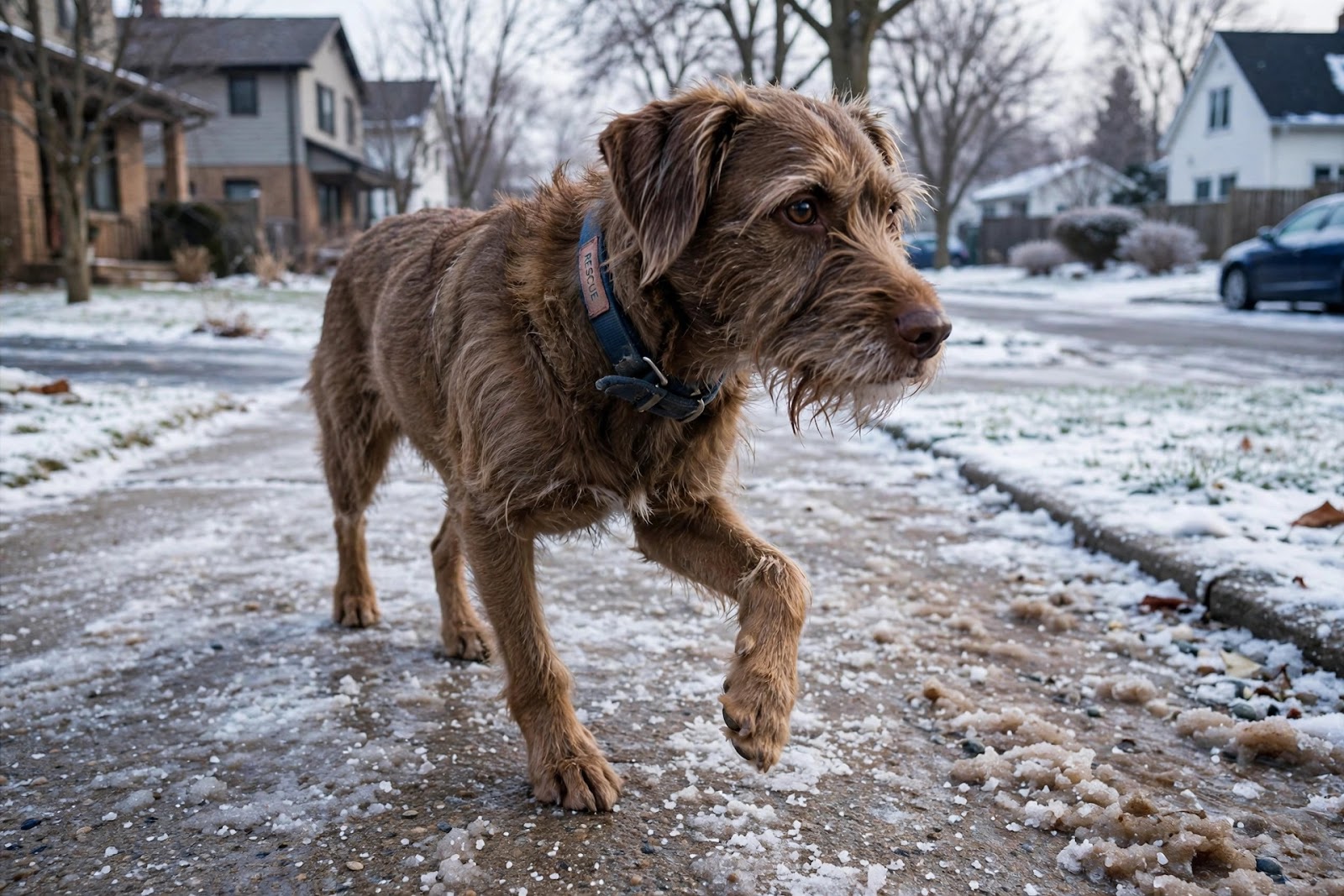
The first hard frost of last winter arrived on a Tuesday, and by Thursday morning Milo was hopping. Not the big dramatic kind of hopping. Just a small, careful lift of his front left paw every few steps, like the pavement had suddenly turned into something he didn't quite trust. I watched him from the kitchen window while he did his business in the garden, and I told myself it was probably a thorn, or a stone stuck between his toes, or nothing at all.
It wasn't nothing. By the time we got back from our usual loop around the block, he was licking his paws on the rug, and the skin between his toes looked pink and sore. I felt the top of his paw pads and they were dry and rough, almost papery at the edges, which was strange, because Milo's pads had always been smooth and springy. That evening he curled up on the sofa and kept nibbling at his feet, and I sat there feeling like a terrible owner, because I had no idea what I'd done wrong.
What I'd done wrong was nothing, exactly, and also everything. The council had gritted the pavements that week. Every path, every side street, every crossing was dusted white with road salt, and I'd walked Milo straight through it twice a day without a second thought. Road salt melts ice, which is exactly what you want on a pavement. It also dries out a dog's paw pads, cracks the skin between the toes, and stings on any tiny cut. And when a dog licks it off his own feet — which Milo did, thoroughly, for about an hour — he swallows a mouthful of the stuff, and it upsets his stomach on top of everything else.
That week taught me more about winter dog care than the previous three winters put together. The fix turned out to be embarrassingly simple: a bowl of lukewarm water by the back door, a towel, and a five-pound pot of paw balm. No special gear, no drama. But getting there took me a week of fumbling, one failed pair of dog boots, and a lesson in reading the pavement the way I used to read the weather forecast.
Milo is a scruffy brown rescue mix, about 22 kilos, with the kind of paws that have carried him through three winters already without a single complaint. He's not a delicate dog. He'll charge through a frozen puddle, sleep on a cold kitchen floor in January, and wade into a stream in February like it's a spa day. So when he started flinching at the pavement, I knew something real was going on. Dogs like Milo don't make a fuss about nothing. If your dog is suddenly careful about where he puts his feet, believe him.
The walk that gave it away
The walk that gave it away was nothing special. Ten minutes around the block, the same route we'd done a thousand times. It was about minus two, the kind of cold that makes your own nose sting, and the pavements were white. Not frost-white. Grit-white. I remember noticing it and thinking, good, the council's been out, nobody's going to slip today.
Milo noticed it too, just differently. About halfway round he stopped, lifted his front paw, and stared at it like it had betrayed him. Then he did the same with the other one. I checked for a stone. Nothing. I checked for a cut. Nothing I could see. We carried on, slower now, and he kept doing this little skip-step every ten metres or so, the way you do when you've stepped on something sharp and you're trying to work out whether it's still there.
By the time we got home he was licking his feet like they were covered in gravy. I got down on the floor and had a proper look. The pads looked dry and pale at the edges, and the skin between his toes was pink. Not bleeding, not raw, just pink and irritated, like a mild sunburn. That's the thing about salt damage — it doesn't look dramatic. It looks like almost nothing, which is why it's so easy to miss until your dog is limping.
I did what I always do when I'm out of my depth, which is ring my friend Sarah, who has kept Labradors for fifteen years. She listened for about ten seconds and said, "Salt. Wash his feet. Every time. Starting now." Her old Lab got the same thing every January, and the answer was boring: water, towel, balm, repeat. I wanted a clever fix. There isn't one.
What road salt actually does to a dog's paws
I went down a rabbit hole that evening, because that's what I do, and the picture is pretty simple once you strip away the jargon. Road salt — grit, rock salt, whatever your council calls it — works by pulling moisture out of ice. It does the same thing to skin. It dries the pads out, and dry pads crack. Cracked pads sting. And the skin between the toes is thin and soft, so it gets irritated first.
Then there's the licking. Dogs lick their feet because they hurt, and salt tastes awful, and a bellyful of salty water is a recipe for a queasy dog. Milo was sick once that week, about two hours after a walk, and I'm fairly convinced it was the salt he'd licked off his own paws.
The other thing I learned is that not all gritted surfaces are equal. The main road outside our house gets the heaviest gritting, reapplied every night when it's freezing. The side streets get less. The little footpath through the park gets none at all, because the council doesn't grit paths. And grass, obviously, has no salt on it at all.
The two-minute rinse that changed everything
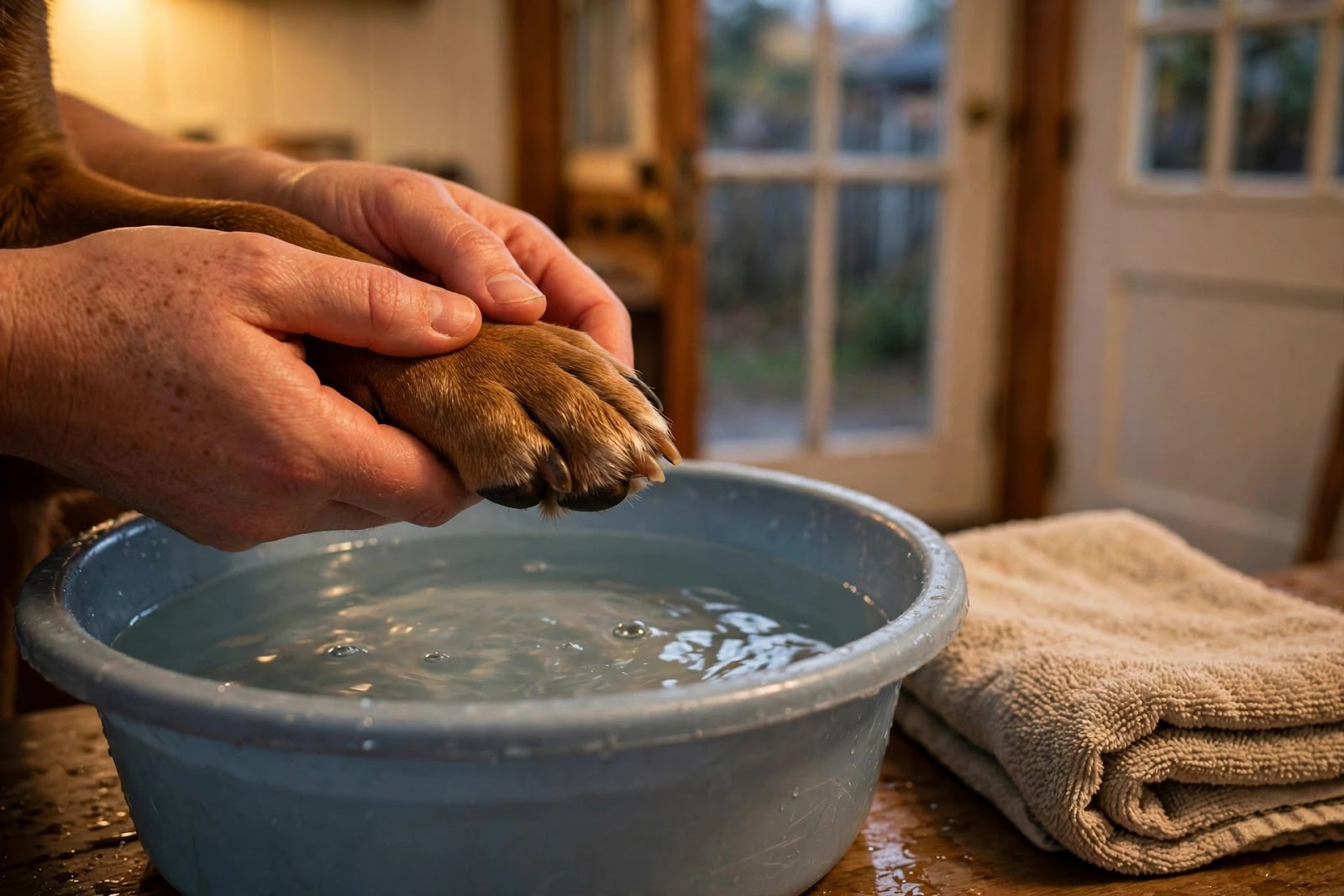
The routine I use now takes about two minutes, and honestly, the hardest part was remembering to do it. The first three days I forgot half the time, because twenty years of walking through the front door without washing a dog's feet is a hard habit to break. So I made it impossible to forget. I put a wide plastic bowl by the back door, a jug next to it, and a stack of old towels on the radiator beside the door.
The routine goes like this. We come in from a walk. Milo knows the drill now, and he stands on the doormat while I fill the bowl with lukewarm water — not hot, not cold, the temperature you'd wash your hands in. I lift each paw in turn and dip it in the bowl, swishing it around for a few seconds. Front paws first, because they're the ones that take the most salt, then the back ones. I pay attention to the skin between the toes, rubbing it gently with my thumb, because that's where the grit hides.
Then I dry each paw properly with a towel. Properly matters. A damp paw on a cold floor is just a different kind of miserable, and wet skin between the toes is a recipe for soreness all of its own. I dry between the toes too, which Milo hates — he pulls his foot away like I'm trying to steal it — but he's learned that it ends with a treat, and dogs will put up with a surprising amount for a bit of cheese.
The whole thing takes two minutes. Two minutes, twice a day, for the three or four months of the year when the roads are gritted. That's maybe four hours of my life across an entire winter. The first week I did it, Milo stopped licking his feet in the evenings. By the second week his pads were smooth again. It felt like a miracle, but it wasn't. It was just water.
Balm: the five-pound pot that lives by the back door
The second half of the routine is paw balm, and I was sceptical about it for far too long. It sounded like a gimmick — expensive doggy lip balm in a fancy tin, sold to people like me who worry too much. Then Sarah lent me her tin, and I tried it, and I stopped being sceptical within about four days.
Paw balm is basically a thick, waxy moisturiser. You rub a pea-sized blob into each pad before a walk, and it puts a thin protective layer between the pad and the salt. Then you rub a little more in after the rinse, when the pads are clean and dry, and it soaks in and keeps the skin supple. It's not magic. It's just barrier and moisture, the same reason I put hand cream on before doing the washing up.
If you don't want to buy a branded balm, plain coconut oil does a similar job in a pinch, though it's greasier and Milo tried to lick it off, which defeats the purpose. The proper balm sets into a waxy layer and he leaves it alone.
Boots: the experiment that failed twice before it worked
Everyone's first suggestion, when I told them about Milo's paws, was boots. Dog boots. Four little shoes, Velcro straps, problem solved. I bought a set for eighteen pounds, feeling very clever, and brought them home like I'd invented winter.
Milo took one look at them and decided they were the worst thing that had ever happened to him. Getting the first boot on took five minutes and most of my dignity. The moment all four were on he walked like a cartoon character — high-stepping, legs going everywhere — made it six steps down the garden path, lay down on his side, and refused to move. I took them off.
I tried again a week later, one boot at a time, indoors, with treats. He'd wear one boot around the living room for a biscuit, then two, then three. But four boots on a wet pavement was still a step too far. I gave up after the third attempt and put them in the cupboard, where they still live.
Here's what I think now, with a year of hindsight. Boots are a brilliant answer for some dogs, and a pointless one for others. Short-haired dogs with thin pads, dogs who walk mostly on gritted city pavements — boots can be great for them. Milo is none of those things. He's a big, opinionated rescue with thick pads and strong views about footwear, and the rinse-and-balm routine does the job for him without the daily wrestling match.
Reading the pavements before you walk on them
The cheapest trick I learned all winter costs nothing at all: look at the pavement before you put a dog on it. I know that sounds obvious. I did it for years without thinking. But once I started paying attention, I realised how much the surface changes from street to street, and how easy it is to pick the kinder route.
White, crunchy grit is the worst. If the pavement looks like someone's spilled a bag of sugar on it, that's a heavy salt day, and I'll take Milo through the park instead, or along the grass verge beside the pavement. Freshly gritted roads are worse than roads that were gritted yesterday, because the salt is sitting on top in crystals instead of being ground into the slush. And slush itself — that grey, salty porridge at the edge of the road — is the worst of all. It's salt and water mixed together, and it gets right between the toes.
Timing matters too. The council grits in the late evening, before the frost sets in, which means the morning walk is the worst one. By the afternoon, the salt has been walked on, rained on, and spread thin. So in the coldest weeks, I flip our routine: a short morning walk on the grass in the park, and the longer walk in the afternoon, when the pavements are kinder.
What I do on the worst days
Some winter days are just bad for paws. Minus five, fresh grit, wind like a knife — those are the days when even a perfect routine feels like a losing battle. On those days I cheat, and I don't feel guilty about it, because a short walk is better than a miserable one.
The short walk is exactly what it sounds like. Out the door, around the block, ten minutes, home. Milo does his business, gets a sniff of the cold air, and comes back in for the rinse and the balm and a warm spot by the radiator. Then we play indoors instead. A game of find-the-treat in the living room, a frozen Kong stuffed with peanut butter, a bit of training practice — sit, stay, spin, the silly tricks he knows. Twenty minutes of that tires him out almost as much as a proper walk, and his feet never touch a single grain of salt.
I used to feel guilty about short walks, like I was short-changing him. I'm over that now. A dog who comes home with sore paws and spends the evening licking his feet is not a dog who had a good day. A dog who had a ten-minute walk and an hour of games on the rug is a dog who had a great day. The walk is not the point. The dog is the point.
What I'd tell anyone starting their first salted winter
If you're reading this in November, with your first frost on the way and a dog who has never walked on salted roads, here's the short version of everything I learned the hard way. Start the rinse routine before the salt arrives, not after your dog starts limping. Buy the balm now, while it's still in stock and you're not in a panic. Put the bowl by the door today, so the habit is already there when the first grit lorry rolls past.
Check your dog's paws after every winter walk, the way you'd check your own hands for cracks. You're looking for dryness, pinkness between the toes, and any sign that he's licking more than usual. Catch it early and it's a two-minute rinse. Catch it late and it's a week of sore feet and a dog who dreads going out.
And don't beat yourself up if you get it wrong the first time. I did. Milo limped for a week because I didn't know what road salt could do. But he forgave me, his paws healed, and now winter is just a season with a slightly longer door routine. When Milo comes in from a frosty walk, he gets his feet washed, gets his balm, gets his cheese, and flops down by the radiator like a dog who has never had a single worry in his life.


