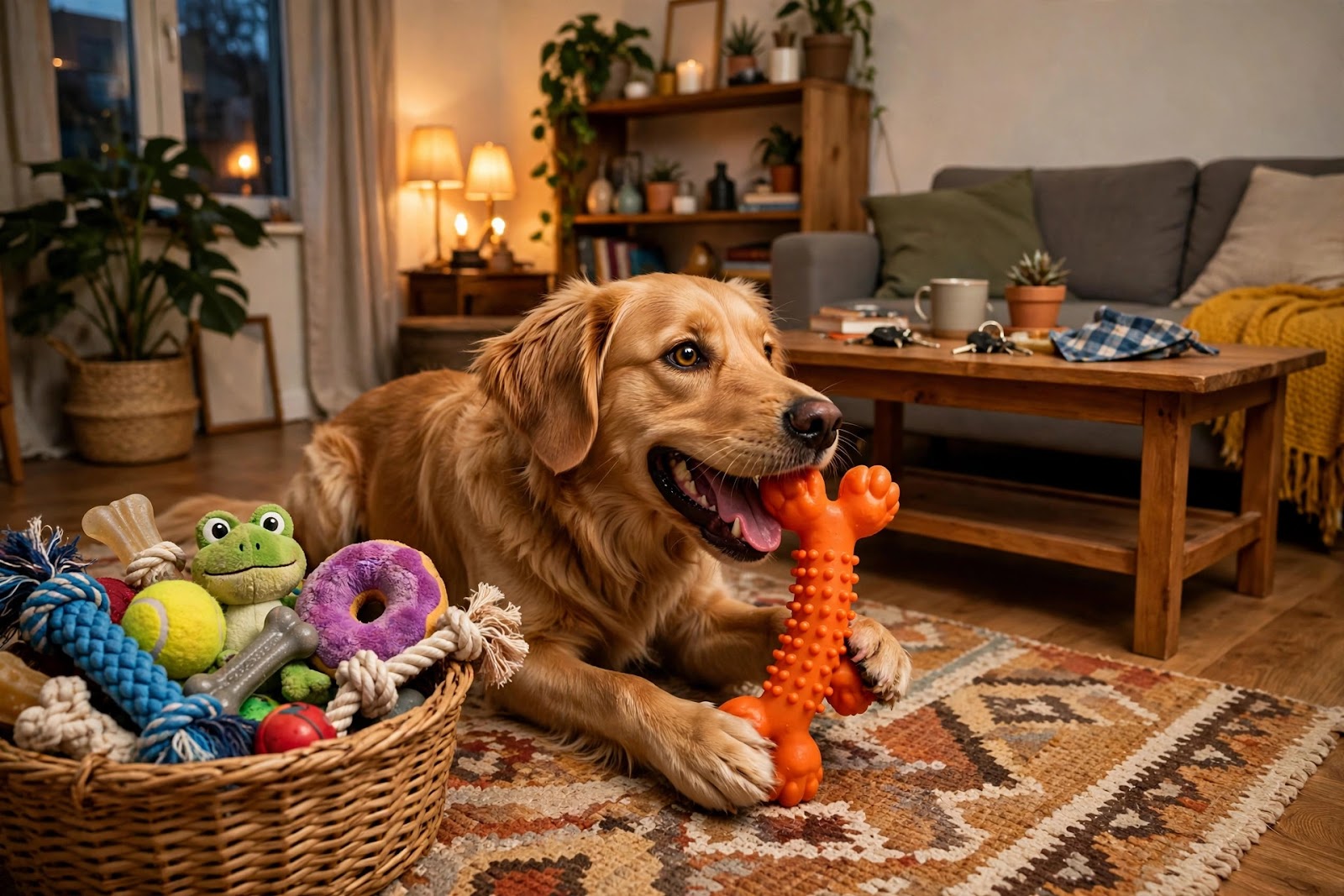
I work from home in a one-bedroom flat, and for a while my dog Biscuit treated my working hours as his personal demolition shift. I'd settle in with my laptop at nine, and by ten he'd have shredded a cushion corner, by eleven he'd be barking at the postman through the letterbox, and by lunchtime he'd have moved on to chewing the rug fringe. I bought him more toys. That was my first instinct, and it was completely wrong — because the flat was already full of toys. They were just all out, all the time, and he'd gone bored of every single one of them.
That's the thing nobody tells you about dog toys: a toy that's always available stops being a toy and becomes furniture. Biscuit had a basket overflowing with squeakers, ropes, balls, and chews, and he ignored the lot of it in favour of my shoes. The fix cost me nothing and took about ten minutes to set up. It's called toy rotation, and once I stopped being sceptical about something so simple, it changed our days completely.
Why a full toy basket bores a dog stiff
Think about it from the dog's side. If every toy is on the floor all day, there's nothing new to investigate, nothing to choose, nothing to get excited about. Novelty is a huge part of what makes a toy interesting — the same reason a dog will go mad for a cardboard box while ignoring the expensive puzzle feeder you bought. Biscuit's basket was the equivalent of a child having every present on Christmas morning dumped in a pile: overwhelming at first, boring within a day.
I proved this to myself by accident. I tidied the flat one Sunday, threw all the toys in a cupboard because guests were coming, and forgot to put them back out. The next morning I gave Biscuit one old rope toy he'd ignored for weeks. He played with it for forty minutes straight, shaking it, tossing it, carrying it round the flat like a trophy. Same toy. Different context. It had been gone for a day, and absence had done what no amount of money could: made it interesting again.
That's the whole principle of rotation in one story. You don't need more toys. You need fewer toys out at once, swapped regularly, so each one keeps a bit of its novelty. It works especially well in a small flat, because you don't have space for a mountain of toys anyway, and because a bored dog in a small space finds trouble faster than a bored dog with a garden to roam in.
Setting up the rotation: my actual system
Here's exactly what I do, because vague advice like "rotate your dog's toys" is useless without the details. I went through Biscuit's whole collection and sorted it into three groups of roughly equal size. Group A has a rope tug, a squeaky duck, and a rubber chew. Group B has a ball, a plush fox with a squeaker, and a treat-dispensing ball. Group C has a different rope toy, a crinkly plush, and a sturdy chew bone. Each group lives in its own fabric bag in the cupboard — I used old tote bags, nothing fancy.
One group is out at a time, for three to four days. Then it goes back in its bag and the next group comes out. That's it. The whole swap takes about two minutes, and I do it on Sunday evening and Wednesday evening so it becomes a habit rather than something I have to remember. Biscuit now recognises the bag coming out of the cupboard and gets excited before he even sees what's in it, which tells me the system is working on a level beyond the individual toys.
A few rules I learned by trial and error. First, don't put all the favourites in one group — spread the best toys across the groups so every rotation has at least one winner. I made this mistake in the first month and had one brilliant week followed by one dull week where Biscuit just stared at me. Second, wash the plush toys before they go back in the bag; a toy that smells like last week's drool is less appealing, and honestly, the bag smells better too. Third, retire toys that are falling apart. A rotation system is not an excuse to keep a shredded plush with stuffing coming out — that's a choking risk, and it goes in the bin, not back in the bag.
The morning puzzle: making breakfast work harder
Rotation alone fixed about half of Biscuit's boredom. The other half got fixed when I stopped feeding him from a bowl. This sounds like a gimmick, but hear me out: a dog who eats from a bowl finishes in ninety seconds and then has the whole day to be bored. A dog who has to work for the same food gets twenty minutes of brain work before nine in the morning, and a tired brain is a calm dog.
My weekday system is simple. On rotation days, one of Biscuit's meals goes into whatever food toy matches the group that's out — the treat ball for group B, a snuffle mat on group C days, a stuffed rubber toy smeared with a little peanut butter (the xylitol-free kind, always check the label) and frozen overnight for group A days. I prep the frozen one the night before, so it takes no extra time in the morning. Biscuit spends twenty to thirty minutes working at it, and by the time he's done, he's genuinely settled. Not exhausted, not wired — just content, the way a dog looks after a good walk.
I want to flag one thing clearly here, because I got it wrong at first: food puzzles are not a substitute for walks or for you. Biscuit still gets his morning walk and his evening walk, and I still play with him properly at lunchtime. The puzzle just covers the hours when I'm working and can't be his entertainment. Anyone who tells you a puzzle feeder replaces exercise is selling you something, and your dog will tell you the same thing by chewing your sofa.
The lunchtime reset that saved my afternoons
The other piece of the puzzle — and I mean that literally, because it involves a puzzle — is my lunchtime routine. At about one o'clock, I take a ten-minute break from work and do a focused play session with whatever group is out that week. Not just throwing a ball while I check my phone, but actual play: tug with the rope, a short game of hide-and-seek where I hide a treat under a cushion and let him find it, or a quick round of "find it" where I scatter a handful of kibble in the snuffle mat.
Ten minutes doesn't sound like much, but it splits Biscuit's day in half. Before the reset, he'd start getting restless around midday and escalate through the afternoon. After the reset, he naps for most of the afternoon, wakes up for his evening walk, and the flat survives. I think of it like a coffee break for a dog: a short, sharp burst of attention that carries him through the long stretch afterward. If you work from home, this is the single highest-value ten minutes of your day.
Here's a game that costs nothing and works brilliantly in a small flat: the muffin tin game. Take a muffin tin, put a treat in a few of the cups, and cover all the cups with tennis balls. Your dog has to nose the balls off to find the treats. Biscuit worked it out in about three minutes the first time, and it still entertains him because I vary which cups have treats and how many balls I use. A cardboard box with scrunched-up paper and treats hidden inside does the same job. Dogs don't care about price tags. They care about the search.
Small flat, big brain: enrichment without the space
People assume a small flat means a bored dog, but I've come to think the opposite: a small space forces you to be creative, and creativity is what dogs actually want. Biscuit's favourite game costs me nothing and uses about two square metres. I take three cardboard boxes, put a treat in one, and shuffle them while he watches. He has to pick the right box. It started as a joke — a canine version of a street con — and it became his favourite evening game. He gets it right most of the time now, and he celebrates like he's won something every single time.
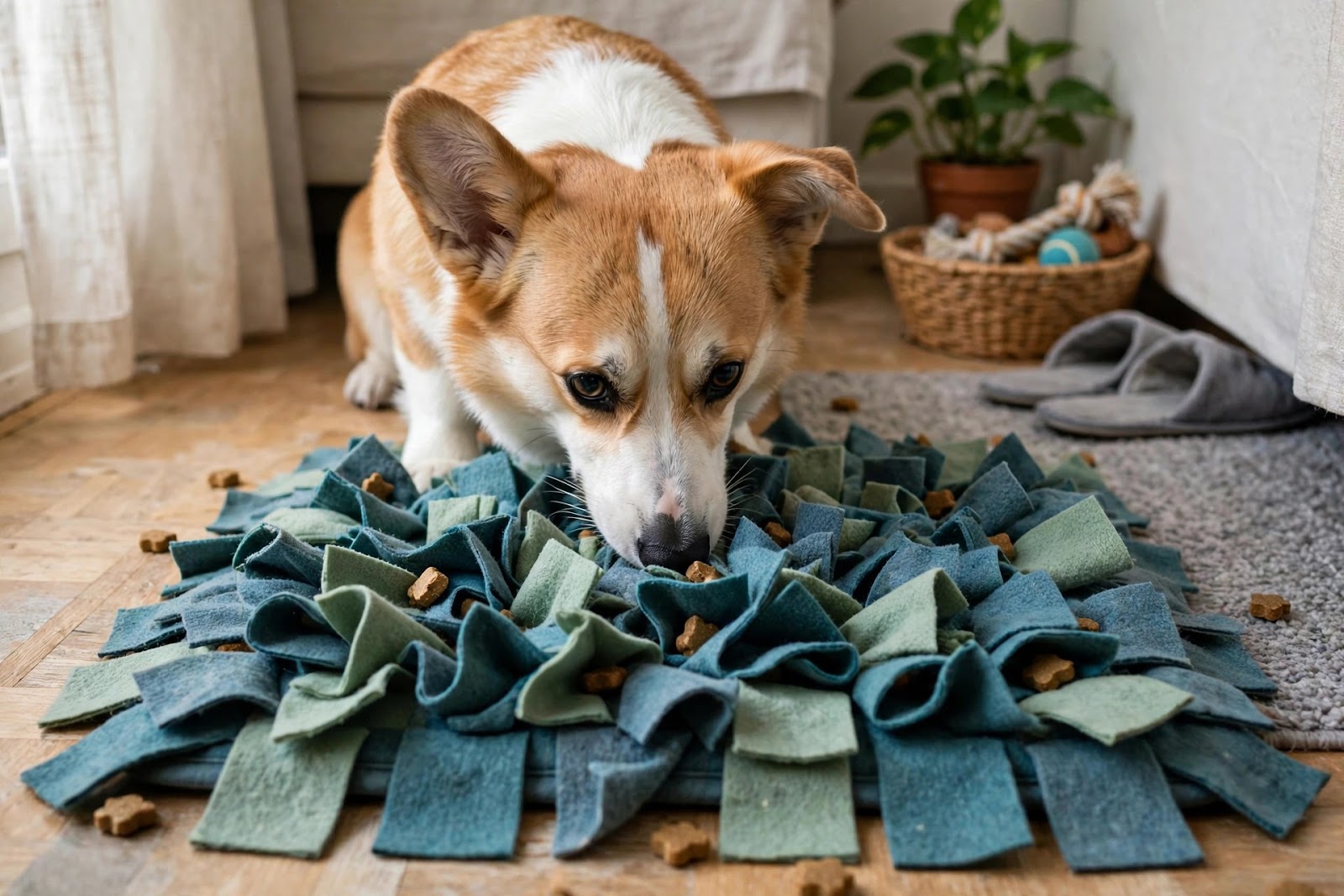
Another small-space winner: scatter feeding. Instead of a bowl, I scatter a handful of his kibble across the living room rug and let him snuffle it up. It takes him five minutes instead of ninety seconds, it uses his nose (which is his most powerful sense and the one most underused indoors), and it costs nothing. I do it on days when I haven't had time to prep a frozen toy. On wet days when walks are short, I do it twice — once for breakfast, once for dinner — and it genuinely takes the edge off his energy.
One caution from experience: don't leave your dog unsupervised with a new toy or puzzle for the first few times. I left Biscuit with a new treat ball while I took a phone call, came back to find he'd chewed a chunk off the opening and was working on swallowing it. He was fine — I got it off him in time — but it taught me to supervise anything new until I know how he interacts with it. A toy that's safe for one dog can be a hazard for a power chewer, and you only learn which kind your dog is by watching.
What changed, and what didn't
Three months into the rotation system, here's the honest scorecard. The cushion shredding stopped completely. The rug fringe survived. The barking at the letterbox dropped from every delivery to about one in three (he's a collie; some instincts don't retire). Biscuit plays with his toys again — really plays, not just a half-hearted sniff — and he greets each new rotation like it's a delivery of new toys, which in a way it is.
What didn't change: Biscuit still wants my attention, still follows me to the kitchen, still sighs dramatically when I sit down to work. Rotation didn't turn him into an independent dog who entertains himself all day, and no system will. What it did was give him enough to do that my working hours stopped being his boredom hours. That's a realistic goal, and it's one worth aiming for.
If you're starting from scratch, here's the short version. Gather every toy your dog owns. Sort them into three groups, favourites spread evenly. One group out for three to four days, then swap. Add one food puzzle a day — a snuffle mat, a frozen stuffed toy, a scattered handful of kibble — and one ten-minute focused play session at lunchtime. Bin anything broken. Wash the plush ones. And give it two full weeks before you judge it, because the first rotation is just your dog meeting old toys again, and the magic shows up on the second and third rounds, when the toys start feeling new again. My flat is quieter, my cushions are intact, and Biscuit is a happier dog for it. All from a cupboard, three tote bags, and the decision to stop leaving everything out at once.
When rotation stops working: the troubleshooting list
Every system has an off week, and rotation is no exception. About two months in, Biscuit went through a patch where he ignored all three groups and went back to staring at me while I worked. My first thought was that the system had failed. My second thought — the correct one — was that I'd got lazy about it. I'd stopped swapping on schedule, so one group had been out for nearly two weeks, and I'd stopped doing the lunchtime play session because work got busy. The system hadn't failed. I'd stopped doing it.
So here's my troubleshooting list, earned the hard way. If your dog ignores the current group, check the calendar first: has it been out too long? Swap early, no guilt. If a whole group bores them, rebalance it — swap one toy from that group with a favourite from another group and see if the mix improves. If your dog destroys every toy in a day, the problem isn't the rotation, it's the toy choice: you need tougher chews and more food puzzles, not more plush toys to shred. And if your dog only plays when you're involved, that's normal, not a failure — build in that ten-minute session and stop expecting a toy to babysit your dog for eight hours.
One last idea that revived Biscuit's interest when a rotation felt stale: the mystery bag. Once a month, I put one brand-new cheap toy — a squeaker from the discount bin, a knotted rope, once even a rubber chicken that honked — into whichever group is coming out next. The new toy makes the whole group feel fresh, and it costs less than a coffee. I also rotate the location, not just the toys: sometimes the group goes in the living room, sometimes the toys live by his bed for a few days, sometimes I hide one toy under a blanket so he discovers it himself. Novelty doesn't have to come from a shop. It can come from a different corner of the same small flat, and for a dog with a good nose and a curious mind, that's more than enough.


