It was raining, again, and Milo was losing his mind. He'd paced the hallway, stared out of the window, brought me three different toys in a row, and then flopped down by the back door with a sigh so dramatic you'd think I'd personally cancelled the sun. We'd already walked that morning, but it wasn't enough. He needed something to do, and the weather had other ideas.
I'd heard people talk about scent games before, and I'd always dismissed them. Hiding treats in the garden sounded like something for other people's dogs, the clever ones, the ones who did agility at weekends. Milo was a dog who once got his head stuck in a cereal box. I wasn't sure he had the nose for it, or the patience.
But I was bored too, and it was Sunday, and the rain had stopped for ten minutes, so I grabbed a handful of his kibble, walked into the garden, and scattered it in the grass while he watched from the window. Then I opened the door and said "find it." What happened next changed our Sundays completely, and it changed how I think about tiring a dog out.
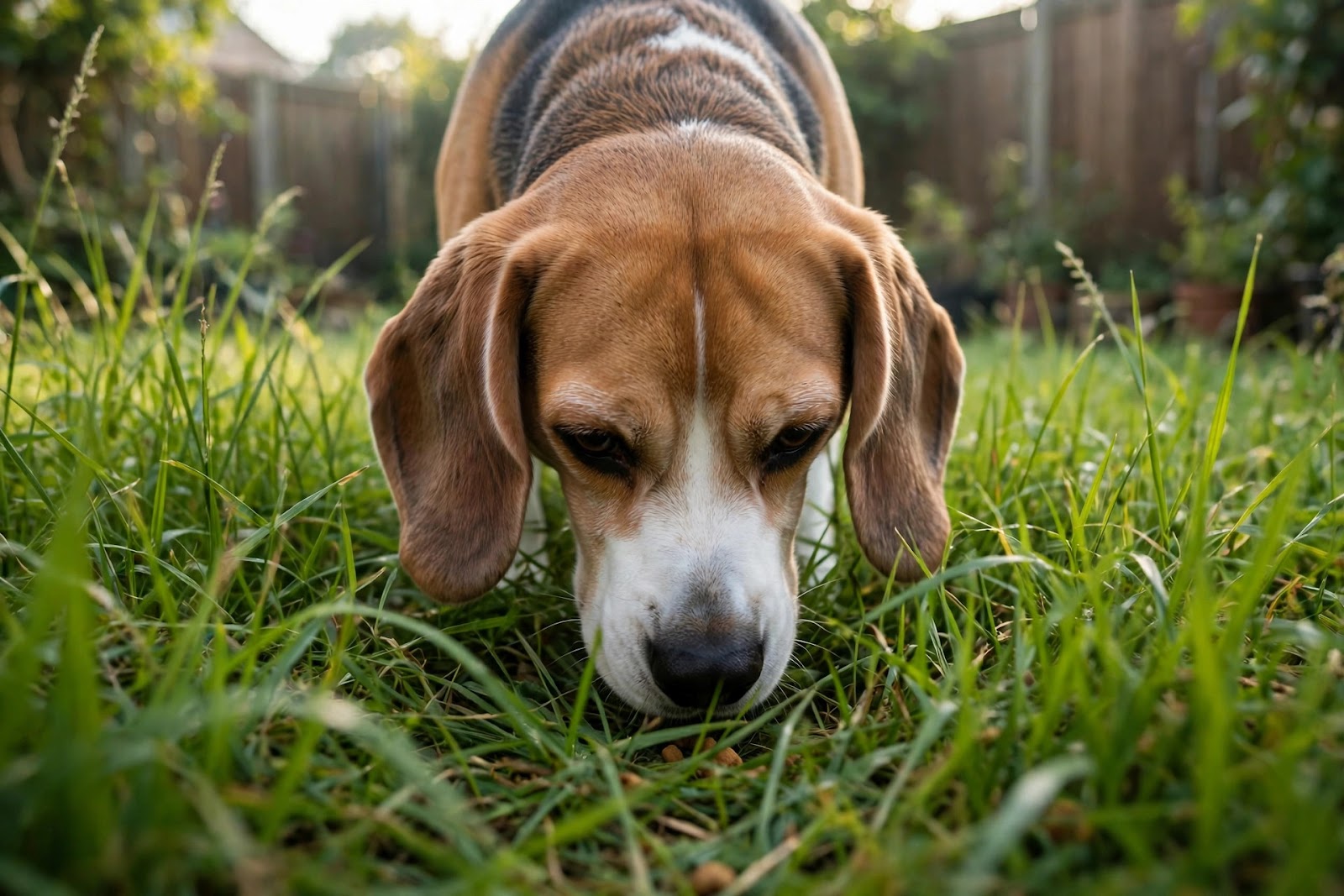
Milo put his nose to the ground and worked that garden like a professional. He moved slowly, carefully, from one patch of grass to the next, sniffing every blade. Ten minutes later every piece of kibble was gone, and Milo was lying on the kitchen floor, fast asleep, with his chin on his paws. A walk takes us forty minutes and leaves him buzzing. Ten minutes of sniffing left him flat out. I sat down, slightly stunned, and started planning next Sunday.
Why sniffing tires a dog out more than walking
It sounds backwards. How can standing in one spot sniffing grass tire a dog out more than a forty-minute walk? I asked myself the same question, and then I watched Milo's face while he worked. His brow furrowed. His ears moved. His whole brain was engaged in a way it never is on a walk, where his legs do the work and his brain mostly coasts along.
Think about it like this. A walk is mostly physical. The legs move, the heart works, and the dog gets fresh air. A scent game is mostly mental. The dog has to sort through hundreds of smells, pick out the one that matters, follow it, and remember where he's already checked. That's hard work for a brain, and a tired brain makes a tired dog.
I've seen it over and over now. Twenty minutes of scent games on a Sunday leaves Milo calmer for the rest of the day than an hour-long walk does. He's not bouncing off the walls in the evening. He's not bringing me toys at nine o'clock. He's asleep on his bed, and he stays asleep. The first time it happened, I actually checked on him twice because the quiet was so unusual.
None of this means walks don't matter. Milo still gets his walks every day, rain or shine, because he needs the exercise and the fresh air and the chance to see the world. But on days when the weather is awful, or I'm short on time, or he's already had his walk and still has energy to burn, the scent game is the thing that finishes the job. It's the difference between a dog who is physically tired and a dog who is properly, deeply, happily tired.
How I started: the easy version in the kitchen
I didn't start in the garden. I started in the kitchen, on a dry floor, with three pieces of kibble and zero hiding skills. The first game was so easy it barely counted as a game at all. I put three pieces of kibble on the floor in plain sight, pointed at them, and said "find it." Milo ate them. Brilliant. World-class detective work.
But that was the point. I wanted him to learn two things: that "find it" means there is food to look for, and that using his nose gets him paid. Those first easy rounds taught him the rules. The words, the sniffing, the reward. Everything after that was just making the hiding spots a little harder, one step at a time.
Round two: I put the kibble under the edge of the rug. He sniffed along the edge, found it, and looked at me like he'd just cracked a safe. Round three: behind the leg of the kitchen table. Round four: under a folded tea towel on the floor. Each time, the same words, the same excitement from me, the same reward.
I kept those first sessions to five minutes. Three or four hides, then done. I always ended with an easy one, so the game finished on a win. Dogs remember how things end, and I wanted the scent game to end with Milo feeling clever, not frustrated. To this day, I still finish every game with an easy hide, right out in the open, so he ends on a high.
Moving the game outside
After a week of kitchen games, I moved outside. The garden is a different world for a dog's nose. There's soil, grass, leaves, a fence that other dogs have sniffed, and about a thousand smells I can't even detect. It's harder, richer, and much more interesting to Milo. It's also where the game really came alive.
The first garden game was simple. Ten pieces of kibble, scattered in plain sight on the lawn, while Milo waited at the back door. I opened the door, said "find it," and he worked his way across the grass. It took him about five minutes, and he checked every patch twice, just to be sure. That thoroughness made me laugh. He wasn't just eating. He was searching.
The next Sunday, I hid the kibble properly. Under leaves. In the fork of a low branch. Tucked into the soil at the base of the fence. I kept a mental map of where I'd put everything, because the last thing I wanted was kibble rotting in the garden all week. I counted ten pieces in, and I counted ten pieces found. Milo found all ten, and then he went back and checked the spots again anyway, just in case.
One thing I learned quickly: wet grass makes the game harder, and harder is not always better. On a damp morning, the smells spread and mix, and Milo would wander in circles, confused. On a dry Sunday, he worked in a neat pattern, like he was mowing the lawn with his nose. I aim for dry days now, or I play the game on the patio where the surface stays drier.
The Sunday routine we have now
Sundays have a shape now, and the scent game is the best part of it. After breakfast, while the kettle boils, I fill a small tub with Milo's treats. I use his normal kibble, mostly, with a few higher-value treats mixed in, a bit of cheese here, a dried liver treat there, so the game has a few jackpots hidden in it.
Milo waits inside while I hide everything. This is the hardest part for him, and the funniest to watch. He sits by the back door, tail thumping, watching me through the glass. He knows what's happening. The tub in my hand gives it away. He's learned to wait, because waiting is part of the game, and the wait makes the finding sweeter.
I hide between fifteen and twenty treats around the garden. Some in easy spots, on top of the grass where he'll find them in the first minute. Some in medium spots, under leaves or behind pots. And two or three in hard spots, tucked into the bark of the tree or balanced on a low wall. The mix matters. Too many hard ones and he gets frustrated. Too many easy ones and he's done in three minutes.
Then I open the door and say "find it," and I sit on the garden step with a cup of tea and watch. He works the garden in a pattern now, starting at the left fence and sweeping across. It takes him fifteen to twenty minutes, and by the end of it he's calm, satisfied, and ready for a nap. I get twenty minutes of peace and a cup of tea in the garden. Everyone wins.
Making it harder without making it frustrating
Once Milo had the basic game down, I started adding little challenges. The first was height. I'd balance a treat on a low wall, or on top of a plant pot, so he had to sniff upwards as well as downwards. He figured it out in one session, stretching up on his back legs to reach the wall. I was proud and slightly worried about the plant pots, which have never been the same since.

The second challenge was containers. I put treats inside cardboard boxes with the flaps open, inside an old flowerpot turned on its side, and inside a muffin tin on the patio (yes, the same tin from his dinners, it's a busy little tin). He had to work out how to get his nose into each one. The flowerpot took him a full minute, and the victory dance afterwards was something to see.
The third challenge was wind. On a breezy day, the smell of a treat drifts, and Milo has to follow the scent trail back to the source instead of walking straight to it. The first windy game, he followed a treat's smell in completely the wrong direction and ended up sniffing the compost bin. I laughed so hard I nearly dropped my tea. He found it in the end, and he looked very pleased with himself, as he should have been.
The golden rule, the one I never break, is this: if he can't find one after a couple of minutes, I help him. I walk over, point at the spot, and make it easy. A game he can't win isn't a game, it's a chore, and I don't want him to associate the scent game with frustration. One hint, one easy find, and his confidence comes straight back.
Rainy days and small spaces
Not every day is a garden day. When it rains, we play inside, and the indoor version is just as good. I hide treats around the living room, under cushions, behind the sofa leg, in the folds of a blanket. Milo loves the blanket one best. He has to dig his nose into the folds and work his way through, and the rustling drives him wild with excitement.
The hallway works well too. It's long and narrow, and I can hide treats along its whole length. Milo works his way down it like a sniffer dog at an airport, checking each side as he goes. The neighbours must think we're mad, but the hallway game has saved many a rainy afternoon.
I've also used the game to settle Milo before visitors arrive. Ten minutes of indoor hiding before the doorbell rings, and he's calm instead of bouncing off the walls when people walk in. It's not magic, but a dog who has just used his brain for ten minutes is a much easier dog to live with for the next hour.
If you live in a flat, don't think this game isn't for you. A small space just means smaller hides and shorter games, and that's fine. Three rooms are plenty. I've played it in a friend's one-bedroom flat, hiding treats in six spots, and her spaniel was asleep within half an hour. The size of the space doesn't matter. The sniffing does.
What I'd tell anyone starting their own scent game
Start easy, in the kitchen, with treats in plain sight. Teach the words "find it" before you teach the hiding. Keep sessions short, five minutes at first, and always end on an easy win so your dog finishes feeling clever. Count your treats in and count them found, so nothing gets left behind in the garden.
Use his normal food for most of the hides, and save the good stuff for the hard spots. That way the game costs you nothing extra, and the jackpots keep him motivated. Mix easy, medium, and hard hides every time, and help him if he gets stuck. A hint is not cheating. It's good coaching.
Don't worry if your dog looks confused at first. Milo spent his first garden game sniffing the fence, the bin, and my shoe, in that order, before he found a single piece of kibble. He still finished the game, he still loved it, and by the third Sunday he was working the garden like he'd been doing it for years. Dogs learn fast when the lesson comes with cheese.
Our Sundays are better for this game. The garden is Milo's favourite place in the world now, not because of the grass or the smells, but because every Sunday it turns into a treasure hunt. He gets twenty minutes of hard thinking, I get a cup of tea on the step, and the rest of the day is calm and quiet. If your dog paces the hallway on a rainy afternoon, or brings you three toys in a row and sighs at the window, try hiding his dinner in the grass. You might be as surprised as I was.


