The Rain That Cancelled Everything
It rained for nine days straight last November. Not dramatic storm rain, just the grey, patient kind that soaks the garden and turns the park path into soup. Milo, my rescue dog, stared out of the window each morning like the weather had personally insulted him. By day three he had chewed the corner of a cushion. By day five he had invented a game that involved stealing my slippers and hiding them behind the sofa. By day seven I understood something I should have known sooner: a bored dog does not get tired by himself. He gets creative, and his creativity is bad news for my furniture.
I am not a person who loves rainy days. I love a long walk, muddy boots, fresh air. But that wet week taught me something useful. A dog does not need a field to get tired. He needs a job for his nose, a puzzle for his brain, and a game that uses his body in a small space. Done right, forty minutes of indoor games leaves Milo more settled than an hour-long walk in the park ever did. Here are the games that actually worked in my living room, the ones I still use every time the sky turns grey.
The Muffin-Tin Game (Five Minutes to Set Up, Twenty to Finish)
This is my number one rainy-day game, and it costs nothing. Take a muffin tin, the twelve-cup kind, and put a small treat in six of the cups. Cover every cup with a tennis ball. Put the tin on the floor and step back. That is the whole game. Milo has to work out that the balls lift off and that only some cups pay out. The first time I tried it he stared at the tin, then at me, then back at the tin, like I had lost my mind. Then he nosed a ball off, found a treat, and his whole body went alert. He got it in about thirty seconds.
The beauty of this game is that you can make it harder in tiny steps. Start with treats in every cup so he wins fast and learns the idea. Then drop to six cups. Then put the treats under only three balls and add a couple of empty cups with a smear of peanut butter on the bottom, so the smell is there but the prize takes work. I once made the mistake of using his regular dry food in the tin and he lost interest in two minutes. Use something smelly. Little cubes of cheese, bits of cooked chicken, the soft training treats he never gets for free. Smell is the point. A dog's nose is his main sense, and a game that uses it tires him out in a way that running in circles never does.
One warning from experience: use a tin you do not love. Milo dented ours within a week by pawing at it with enthusiasm. It still works fine, it just looks like it survived a small accident. Also, play it on a rug or a mat, not a hard floor, or the tin will skate across the room and take out a plant pot. Ask me how I know.
Hide and Seek With Treats, Room by Room
The simplest game in this list is also the one Milo loves most. I tell him to wait — he knows wait from his mat training — and I hide ten small treats around the living room while he watches from the doorway, vibrating with excitement. Under a cushion edge. Behind a chair leg. On the lowest shelf of the bookcase. On top of his own bed, which he always checks last, for reasons I will never understand. Then I say find it, and off he goes.
The first few times, make it easy. Put the treats in plain sight, on the floor, two steps from his nose. Let him win fast. A dog who wins keeps playing. A dog who searches for five minutes and finds nothing gives up and goes back to the cushions. Once he knows the game, hide them higher, lower, behind things. I started hiding treats inside an old rolled-up towel, then inside a cardboard box with the flaps half closed, then inside a box inside a box. He worked on that last one for twelve minutes, and when he finally got the treat out he flopped down on the rug and slept for an hour. Twelve minutes of thinking beat an hour of walking. I still find that slightly unfair, but I will take it.
My favourite version of this game uses the whole flat. I hide treats in the hallway, the kitchen, the spare room, and let him work his way through the house like a slow, happy detective. The trick is to remember where you put them all. I once hid a piece of cheese behind the radiator and forgot about it. We found it three days later, by smell. The dog found it first, obviously. He looked very pleased with himself. I have used a notepad on the kitchen counter ever since. Ten treats out, ten treats found, tick them off. It sounds fussy. It saves you from mystery smells.
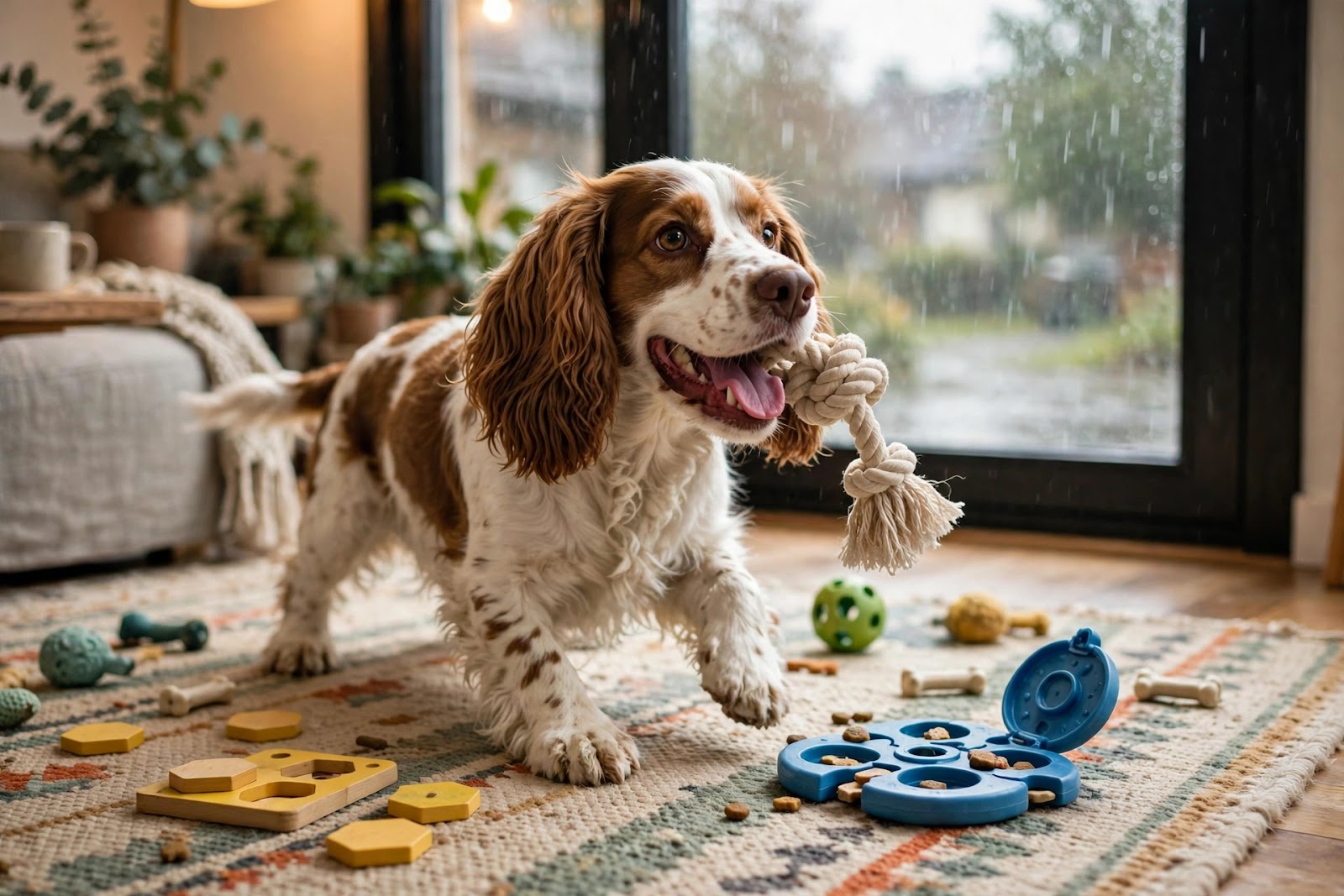
Tug, But With Rules That Save Your Arms
Every dog person knows tug. Not every dog person plays it well. I used to play tug with Milo by grabbing a rope and pulling until one of us gave up, usually me, with a sore shoulder. He loved it, but it wound him up instead of tiring him out. He would finish a game of tug more excited than when he started, which is the opposite of what you want on a rainy afternoon.
The fix was simple, and it took a week to teach. Tug happens only when I say tug, and it stops the second I say drop it. I hold the rope low, near the ground, so he pulls sideways instead of jumping up. We pull for ten seconds, I go still, I say drop it, and I hold a treat near his nose. He drops the rope, he gets the treat, we start again. Stillness is the secret. Dogs pull against movement. If you freeze, the game gets boring for a second, and that second is when the dog lets go.
We play in short rounds, three or four pulls, then a pause where I ask him to sit or lie down before we start again. That pause matters. It teaches him that excitement has an off switch. After four rounds he is panting, his tongue is out, and he is happy to lie on his mat with a chew. Ten minutes of tug with rules tires him out more than twenty minutes of wild pulling ever did. And my shoulder has never been happier.
The Towel Roll: Dinner, But Slower
Some rainy days, the best game is dinner itself. Milo used to eat his evening meal in about forty seconds. He would inhale it, look up at me, and then spend the rest of the evening looking for more food. I tried a slow feeder bowl, the plastic kind with ridges, and it helped a little. What helped more was a tea towel. I spread his dry food across a clean tea towel, rolled the towel up like a Swiss roll, and put it on the floor. He had to unroll it with his nose and paws to get his dinner. Forty seconds became eight minutes. Eight minutes of sniffing, nudging, and thinking, and afterwards he was noticeably calmer.
I vary it now. Some days the food is in the towel roll. Some days it is scattered across the rug so he has to snuffle for every piece. Some days I put his food in a cardboard box filled with scrunched-up newspaper and let him dig it out. The box version is messy — there will be newspaper everywhere — but on a truly awful day, mess is a small price for a tired dog. I keep a dustpan and brush by the back door now, permanently, because of this game. It is worth it.
If your dog eats wet food, the towel trick still works, but use a rubber mat instead. Smear the wet food thinly across a lick mat, the kind with ridges and bumps, and stick it to the floor with its suction cups. Licking is calming for dogs in a way that chewing is not. I learned this from a trainer who said licking releases the same kind of calm as a long sigh. Milo will lick a mat for fifteen minutes straight, and when he finishes he walks to his bed and lies down without being asked. I do not pretend to understand the science. I just know it works.
Training Games That Count as Play
Here is the part most people miss: five minutes of training is a workout for a dog's brain. On rainy days I run through the tricks Milo knows, plus one new thing, in short bursts. Touch my hand with your nose. Spin in a circle. Go to your mat. Wait while I put a treat on the floor and count to five. Each one takes seconds, and each one asks him to think, listen, and control himself. Ten minutes of that and he is yawning.
The new-trick part is the key. A dog who already knows a trick does it on autopilot. A dog learning something new has to concentrate, and concentration is tiring. Last winter I taught Milo to bring me his lead when I say walkies. It took four days of tiny steps, holding the lead, picking it up, carrying it two steps, then all the way across the room. He was exhausted by the end of each session, and all we had done was walk around the living room. Now he brings me the lead every morning, proud as anything, and I pretend it is the cleverest thing a dog has ever done. To be fair, it might be.

Keep sessions short. Three minutes, then a break, then three more if he is still keen. If he starts yawning, looking away, or sniffing the floor for no reason, he is telling you his brain is full. Stop. A tired brain is the goal, but an overloaded brain just gets frustrated. I end every session with something easy that he knows well, so we finish on a win. He gets a treat, I get a calm dog, everybody is happy.
The Cardboard Box Fort (Yes, Really)
I am slightly embarrassed to admit how much Milo loves a cardboard box. Not a fancy toy, not a puzzle feeder that cost forty pounds. A box. I cut a few holes in the sides of a large box, put treats inside, and let him work out how to get them. He shoves his nose in one hole, paws at another, and eventually tips the whole thing over in triumph. It is loud, it is messy, and it is the best ten minutes of his day.
I build on it. Two boxes taped together with a tunnel between them. A box with a smaller box inside it. A box with treats hidden under scrunched paper. The whole thing costs nothing, and when it falls apart, which it will, you recycle it and start again. My living room has looked like a recycling centre more than once. I have stopped caring. A happy dog is worth a messy room, and the room takes five minutes to tidy. The calm afterwards lasts hours.
One practical note: check the box for staples before you hand it over. I missed one once and Milo caught his lip on it. He was fine, just startled, but I felt awful. Now I run my hand around every edge before it becomes a toy. Tape over any sharp bits. Use boxes that held food or books, not cleaning products. If it smells of chemicals, it is not a toy.
The Wind-Down That Makes It All Stick
Games are only half the job. The other half is teaching your dog that after play comes rest, and that rest is part of the fun. After our rainy-day games, I always do the same three things. First, a quiet chew, something that takes him ten minutes and keeps his mouth busy. Second, fresh water, because a thirsty dog paces. Third, I sit down, put my feet up, and ignore him for a bit. Not coldly, just calmly. No eye contact, no chat, no fuss. Within five minutes he is on his mat, sighing, drifting off.
It took me a while to learn that last part. I used to keep playing with him, talking to him, fussing over him, because I felt guilty that he had not had a proper walk. All that attention kept him wired. Dogs take their cue from us. If I am buzzing around, he buzzes around. If I sit still and breathe slowly, he does the same. The calmest thing I do for my dog on a rainy day is nothing at all, after the games are done.
What a Good Rainy Day Looks Like Now
A good rainy day in our house now has a shape to it. Morning: muffin-tin game while I make coffee. Midday: hide-and-seek treats around the flat while I tidy up. Afternoon: tug with rules, then dinner in a towel roll. Evening: five minutes of training, a chew, and then we both sit down. Total active play, maybe forty minutes spread across the day. Total damage to my house, zero. Total naps from Milo, at least three.
It is not the same as a long walk, and I will not pretend it is. He still needs his walks, and the first dry day after a wet week, we go out for a long one and he runs like a mad thing. But rainy days no longer feel like a problem to survive. They feel like a different kind of day, a thinking day instead of a running day. My cushions have survived the last three wet weeks without a single chew mark. My slippers have stayed where I left them. And Milo, who used to stare out of the window at the rain like it had ruined his life, now looks at me when it rains, tail wagging, like he is saying, right, what are we playing today? That look is worth every soggy week.


