Every weekday at about 11:20, my dog loses his mind. It starts with a low growl from the living room window, then a bark, then a full sprint to the front door, barking so hard his whole body shakes. The cause is always the same: the postman, or a delivery driver, or anyone in a high-vis vest walking up our path with a parcel. Milo is a golden retriever, which means he is supposed to be the friendly one, the breed that loves everyone. And he does love everyone, once they are inside the house. But a stranger approaching the front door with a box is, in his mind, a full-scale invasion, and he announces it like the house is under siege.
It went on for over a year before I did anything serious about it. I told myself it was just barking, that all dogs bark at the door, that it was normal. And then two things happened in the same week. First, our regular postman, a lovely man called Dave who has delivered to our street for years, started leaving parcels by the gate instead of coming to the door. He smiled when I asked about it, but he was clearly fed up with being shouted at by a dog through the letterbox. Second, my neighbour knocked on my door and, very politely, asked if everything was all right, because the barking had woken her baby three days in a row. That was the moment I stopped calling it normal and started calling it a problem I had to fix.
The first thing I had to accept was that shouting at Milo to be quiet was making it worse. I know that sounds obvious now, but at the time it felt like the only thing I could do. The doorbell would go, Milo would explode into barking, and I would shout "quiet" over the top of him, which is, if you think about it, just me barking back. He heard my raised voice as excitement, as me joining in, and he barked even harder. The whole house would be in an uproar for two minutes, the delivery driver would be standing on the doorstep looking awkward, and I would be apologising through the letterbox while Milo tried to push past me. Nobody was learning anything except that the doorbell meant chaos.
What I learned about why he does it
I spent an evening reading about door barking, and the part that changed my thinking was simple: from Milo's point of view, the barking works. Every single time. A stranger comes to the door, Milo barks like mad, and the stranger goes away. He has no idea that the stranger was always going to go away. In his head, he chased them off. He did his job. And the next day, the same thing happens, and his belief gets stronger. The postman is the perfect training partner for this, because he comes every single day, at roughly the same time, and he always leaves. Milo gets a daily lesson in how effective barking is.
That also explained why the barking was worst at the front window. Milo spends his mornings lying on the sofa with a view of the street, and he can see the postman coming from about forty metres away. By the time the van stops, he is already wound up. The barking is not really about the parcel. It is about the approach, the uniform, the van door slamming, the footsteps on the path. All of those little sounds stack up, and by the time the doorbell rings he is already past the point of listening to me.
So I stopped trying to fix the barking at the moment it happened, and I started working on the moments before it. That was the big shift. If I could catch him early, when he first noticed the van or the footsteps, I could do something useful. If I waited until he was already barking at the door, I had lost. It is a bit like trying to have a calm conversation with someone who is already shouting. You have to get in before the shouting starts, or you have to wait for it to end, and waiting for it to end takes a very long time when there is a postman on the other side of the door.
The window seat had to go
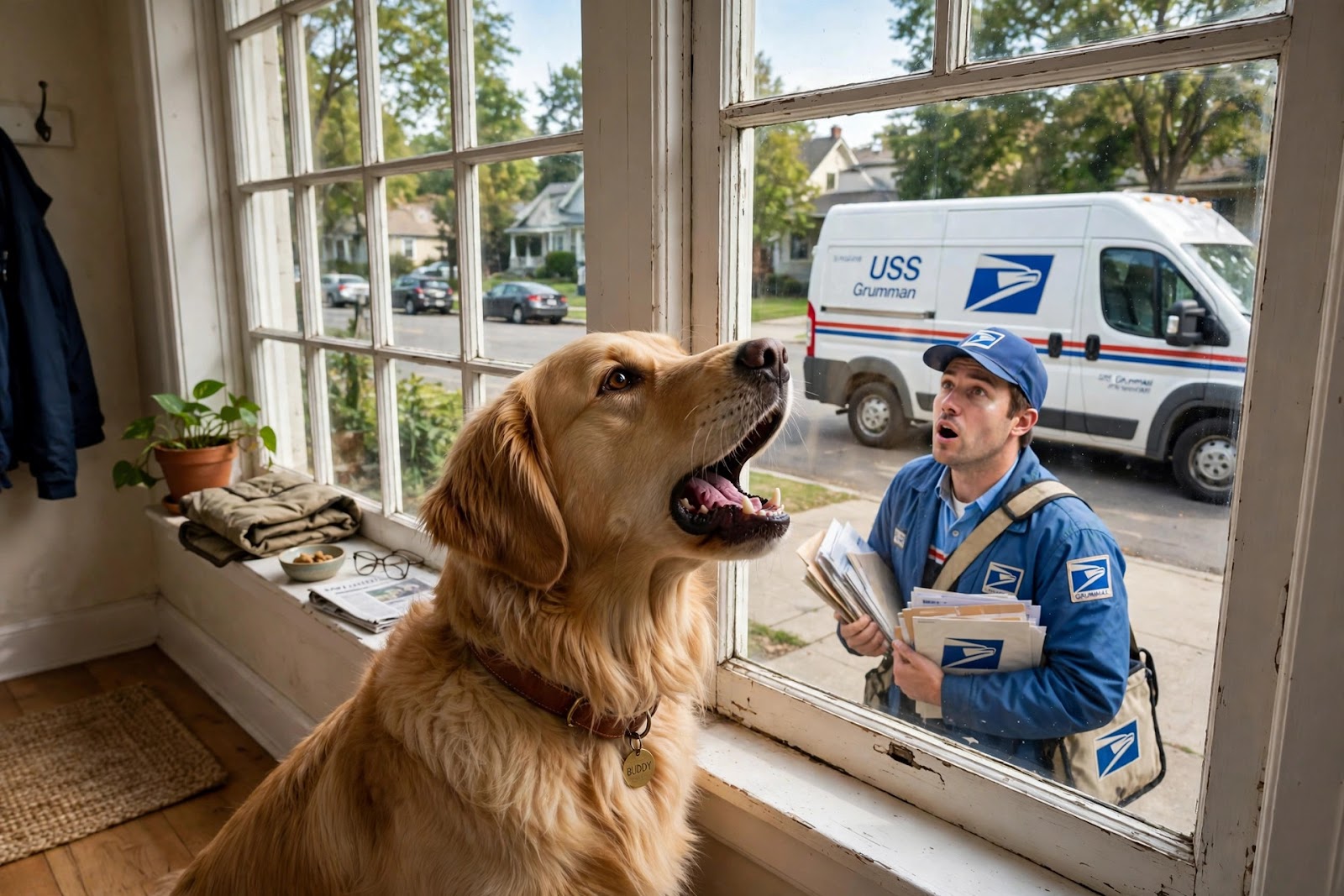
The first practical change was the window seat. Milo's favourite spot was the sofa by the front window, and I moved the sofa. That sounds drastic, and my living room looked wrong for about a week, but it cut the problem in half overnight. Without a view of the street, he could not see the van coming. He could still hear it, but hearing is different from seeing. He would lift his head, listen for a second, and then settle again, because there was nothing to stare at and nothing to track. I also put a frosted film on the lower half of the front window, the kind that costs about six pounds a roll and sticks on with water. It lets the light in but turns the street into a blur. Between the moved sofa and the film, the front of the house stopped being his lookout post.
I felt a bit guilty about it at first, like I was taking away his favourite thing. But his favourite thing was making him miserable. He spent his mornings tense, watching the street, waiting for something to bark at. After the change, he started sleeping in the mornings instead. He moved to the rug in the middle of the room, curled up, and actually rested. I had not realised how much of his day was spent on guard duty until he stopped doing it. A dog that is always watching the street is a dog that is never really relaxing, and I had been letting him do a job that nobody asked him to do.
The second change was the door routine. I bought a mat, a plain rubber-backed mat, and put it about two metres back from the front door. The mat became the place where good things happened. Every day, three or four times a day, I would ask Milo to go to the mat, and when he did, he got a treat. Just a small one, a piece of kibble or a bit of cheese. I did it when nothing was happening, when the house was quiet, when there was no delivery and no doorbell. The mat had to mean something calm before I could ever use it when the doorbell rang. This took about two weeks of boring repetition, and I nearly gave up after the first few days because it felt pointless. He would go to the mat, get a treat, and wander off again. But slowly, the mat started to mean something. He would go there on his own sometimes, just to see if a treat appeared. That was the moment I knew it was working.
Practising with a friend who knocked on cue
The mat alone was not enough, because the doorbell is a different thing entirely. So I asked my friend Sarah to help me practise. She came round on a Saturday morning, stood outside, and knocked on the door every few minutes while I worked with Milo inside. The first time she knocked, he went berserk, exactly as usual. I did not shout. I walked to the mat, pointed at it, and waited. He came over after about thirty seconds, still barking, and I gave him a treat anyway, because he had done the one thing I asked. Sarah knocked again. This time he went to the mat in about fifteen seconds. By the fourth knock he was going to the mat before I even pointed.
We did that for about twenty minutes, and then we stopped, because he was tired and I was tired and Sarah's knuckles were sore. We did it again the following Saturday, and the one after that. Each time, the barking got shorter and the trip to the mat got faster. The key, I think, was that Sarah was not a real delivery. There was no parcel, no rush, no stranger standing on the step. It was just a knock, and then nothing. Milo learned that a knock could mean a treat on the mat, not an invasion. After three Saturdays, a real knock on the door got a completely different response. He still barked, once or twice, but then he ran to the mat and looked at me, waiting. It was like watching a different dog.
I also changed what happened after the door opened. Before, I used to try to hold Milo back with one hand while taking the parcel with the other, which meant he was straining at the door and I was stressed. Now, when the doorbell goes, I ask him to go to his mat, I give him a treat, I close the living room door, and then I answer the front door on my own. He can hear me talking to the delivery driver, but he cannot get to the door, and he knows a treat is coming when I come back. It is not a punishment. The living room door is only closed for about a minute, and when I open it he gets another treat for staying calm. After a month of this, he started going to his mat on his own when the doorbell rang, without me saying a word. That is the moment I knew the habit had stuck.
The van sound that started it all
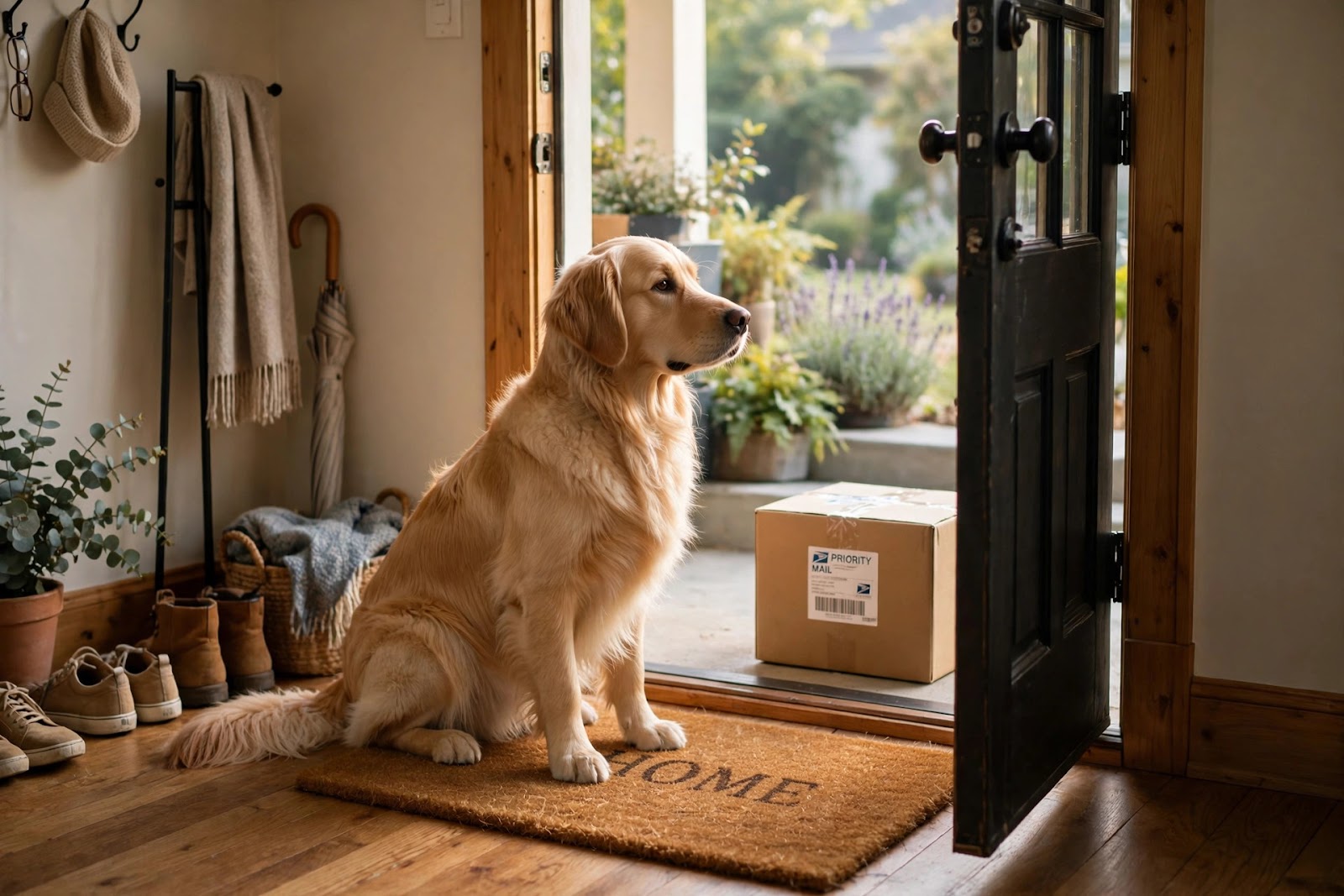
There was one more piece of the puzzle, and it was the delivery van itself. Milo could hear the van door slam from two houses away, and that sound alone would set him off. So I started playing van sounds on my phone, very quietly, while he was eating his dinner. Just a recording of a van door and an engine, at a volume so low I could barely hear it myself. He ignored it completely, because he was busy eating. Over the next two weeks I turned the volume up a tiny bit every few days. If he lifted his head or stopped eating, I turned it back down and tried again the next day. If he kept eating, I left it where it was.
It took about three weeks to get the volume up to normal, and by then he had heard the sound so many times while eating that it meant nothing to him. It was just background noise, like the washing machine. The first time a real van pulled up outside after that, he lifted his head, listened for a second, and put his head back down. I nearly cried. I know that sounds dramatic, but after a year of daily barking, a dog that hears a van and does nothing feels like a miracle. It was not a miracle. It was three weeks of playing a sound on my phone while he ate his dinner. That is all it was, and that is the part nobody tells you. The fix is boring. The fix is always boring.
I also started giving him something to do when I knew a delivery was coming. If I was expecting a parcel, I would put a stuffed Kong, a rubber toy filled with peanut butter and frozen overnight, on his mat about five minutes before the delivery was due. He would be so focused on the Kong that the doorbell barely registered. The first time I did this, the driver knocked, Milo lifted his head, looked at the door, looked at the Kong, and went back to the Kong. The driver thought it was hilarious. I thought it was the best eight pounds I had ever spent, because that is what the Kong cost. I have three of them now, and I keep them in the freezer so one is always ready. They are not a bribe. They are a job. A dog with a job is a dog that is not barking at the door.
What I would do differently next time
If I could start again, I would start sooner, and I would start smaller. I wasted a year telling myself it was normal, and then I wasted a month trying to fix it in the moment, shouting over the barking and hoping for the best. Neither of those things did any good. What worked was the slow, boring stuff: moving the sofa, frosting the window, practising with a friend, playing van sounds at dinner, and putting a Kong on the mat. None of it was dramatic. None of it worked in a day. But all of it together worked in about six weeks, and the change has held for three months now.
I also wish I had talked to Dave the postman sooner. I finally did, about a month into the training, and I apologised for the year of barking. He laughed and said it was fine, that he has dogs barking at him on every street, and that Milo was nowhere near the worst. He also told me something useful: he always rings twice, once when he gets to the gate and once at the door. That first ring was the one that set Milo off, because it came out of nowhere. Once I knew that, I started treating the gate ring as my cue to send Milo to his mat, which gave me a ten-second head start on the door ring. Ten seconds does not sound like much, but in dog training it is everything. It is the difference between catching him before the barking starts and trying to stop it after.
The barking is not gone completely, and I do not expect it ever to be. Milo still barks once or twice when the doorbell goes, because he is a dog and the doorbell means someone is there. But once or twice is fine. Once or twice is a dog doing his job. What is gone is the ten-minute uproar, the shaking, the sprinting, the letterbox shouting. Now the doorbell goes, he goes to his mat, he gets a treat, and I answer the door like a normal person. Dave leaves parcels at the door again. My neighbour's baby sleeps through the morning deliveries. And Milo, for the first time in a year, spends his mornings asleep on the rug instead of on guard duty at the window. That is the real win. Not the quiet. The rest.


