The doorbell used to be Biscuit's starting pistol. The second it rang, he'd launch himself at the front door, barking like the house was under siege, and any guest who walked in got a full-body greeting: jumping, spinning, nose in places nobody invited it. I spent two years apologising for my dog. Friends learned to brace themselves. My mum started bringing a change of clothes.
I tried the obvious things first. I tried holding his collar while guests came in (he pulled like a sled dog). I tried putting him in another room (he barked behind the door the whole visit). I tried asking guests to ignore him (nobody can ignore a border collie mix shoving his head into their hand). Nothing stuck, because I was trying to stop the behaviour at the worst possible moment — when his excitement was already at full volume.
What finally worked was giving him a job to do instead. Not "stop barking" but "go to your mat and stay there until I release you." A dog with a clear task has something to think about besides the visitor. It took about six weeks of short daily sessions, and it changed our front door completely. Last month, my brother arrived unannounced, Biscuit trotted to his mat, lay down, and waited. My brother stood in the hallway holding a pizza box, genuinely confused. "Is he ill?" he asked. He was fine. He was just trained.
Step one: make the mat the best place in the house
Before I ever used the word "mat" or asked Biscuit to go anywhere, I spent a week making the mat itself magical. I bought a flat, non-slip bath mat — nothing fancy, about eight pounds, dark blue, with a rubber backing so it doesn't slide on our laminate floor. I put it in the middle of the living room, nowhere near the door, and every time Biscuit so much as glanced at it, a treat appeared. Stepped on it with one paw? Treat. Two paws? Two treats. Lay down on it? Jackpot — five treats, one after another.
This is the part people skip, and it's the part that matters most. If the mat is just a thing you point at when guests arrive, it means nothing to your dog. If the mat is the place where amazing things happen, your dog will want to be on it. By day four, Biscuit was walking to the mat unprompted and lying on it while staring at me expectantly. That's when I knew the foundation was set.
I also made one decision that turned out to be important: the mat lives in one spot and doesn't move. It sits about two metres from the front door, against the living room wall, where Biscuit can see who comes in but isn't in the doorway itself. Dogs settle better when their place is predictable. Moving the mat around the house "to generalise" came later, and honestly, for the guest routine, I've never needed to move it.
Step two: name it, then add distance
Once Biscuit was choosing the mat on his own, I added the cue. I waited until he was walking toward it, said "mat" just before he stepped on, and rewarded him the second all four paws were on it. After a few days of that, I started saying "mat" when he was standing nearby but not moving toward it, and rewarding the decision to go. The cue came before the action, and the treat came after the action. That order matters — say it, he does it, then he gets paid.
Then I added distance, one step at a time. I stood a metre away and said "mat." Then two metres. Then from the kitchen doorway. If he failed twice at a new distance, I went back to the last distance that worked and ended on a success. This is the least glamorous part of dog training and the most important: progress that looks boring is progress that lasts. Rushing distance is how you get a dog who "knows" the cue in the living room and completely forgets it when the doorbell rings.
By the end of week two, Biscuit would go to his mat from anywhere in the flat, lie down, and look at me. That look — the "I'm here, now what?" look — was the whole point. He wasn't just standing on a mat. He was offering me his attention, which is the real currency of the guest routine.

Step three: the doorbell, in slow motion
Here's where most people blow it up: they go straight from "mat in a quiet room" to "real guest at the door" and wonder why it falls apart. I broke the doorbell down into tiny pieces and trained each one separately.
First, I recorded the doorbell sound on my phone and played it at low volume while Biscuit was on his mat, treating him for staying put. Volume up a notch every couple of days. Then I stood by the front door and knocked on it myself, then walked back and treated him on the mat. Then I opened the door a crack and closed it, treating him for staying. Then I opened it wider. Then I stepped outside for two seconds and came back in.
Each step took two or three days. The whole sequence took about three weeks, and there were days when it felt ridiculous — me standing in my own hallway, opening my own front door to nobody, feeding treats to a dog on a bath mat. But when my neighbour finally agreed to be our first practice guest, Biscuit stayed on his mat through the knock, the door opening, and her walking in. He trembled a bit. He did not move. I nearly cried.
Step four: real guests, with rules for the humans
Real guests were the final exam, and I learned quickly that the humans needed as much training as the dog. My rules, which I now text to visitors before they arrive: come in calmly, don't look at Biscuit or talk to him until I say he's released, and if he gets up, step back outside and we'll try again. Most people follow this happily once they understand it's a game with a payoff, not a punishment.
The release is the part I got wrong first. I used to just say "okay" and let Biscuit explode at the guest, which undid all the calm we'd built. Now the release is structured: Biscuit stays on the mat while the guest sits down and gets a cup of tea, and only then do I release him with "go say hello." By that point the excitement has dropped by half, the guest is seated (much less exciting than a standing person at the door), and Biscuit greets like a normal dog instead of a missile.
If he breaks the mat stay before the release, the guest calmly steps back out and the door closes, and we reset. No scolding, no drama, just "that didn't earn the greeting, let's try again." Biscuit figured out the deal within three practice visits: staying on the mat is what makes the guest stay. Getting up is what makes the guest leave. Dogs are excellent economists when the rules are consistent.
The mistakes that cost me weeks
Let me save you the time I wasted. First mistake: training only when guests were actually coming. Biscuit needed hundreds of repetitions, and real visitors arrive maybe twice a week. I started doing two five-minute practice sessions a day, every day, with me playing the guest. That's what built the habit. Waiting for real guests to practice on is like only rehearsing a speech on stage.
Second mistake: asking for too long a stay too soon. I once asked Biscuit to hold the mat for ten minutes during a dinner party in week three. He lasted four minutes, then broke, then spent the rest of the evening wound up because he'd failed. Long stays are built in seconds, not minutes: I added five seconds at a time, and only when he was succeeding nine times out of ten. Today he can hold the mat for twenty minutes while people eat, but that took months, and honestly, for most visits I release him after five or ten minutes anyway.
Third mistake: using the mat as a punishment. Early on, when Biscuit jumped on someone, I'd march him to the mat in frustration. He started avoiding the mat. Of course he did — I'd turned his happy place into a time-out corner. I stopped that immediately, spent a week rebuilding the mat's value with free treats and no demands, and never sent him there angry again. The mat is a good place. It has to stay a good place, or the whole system collapses.
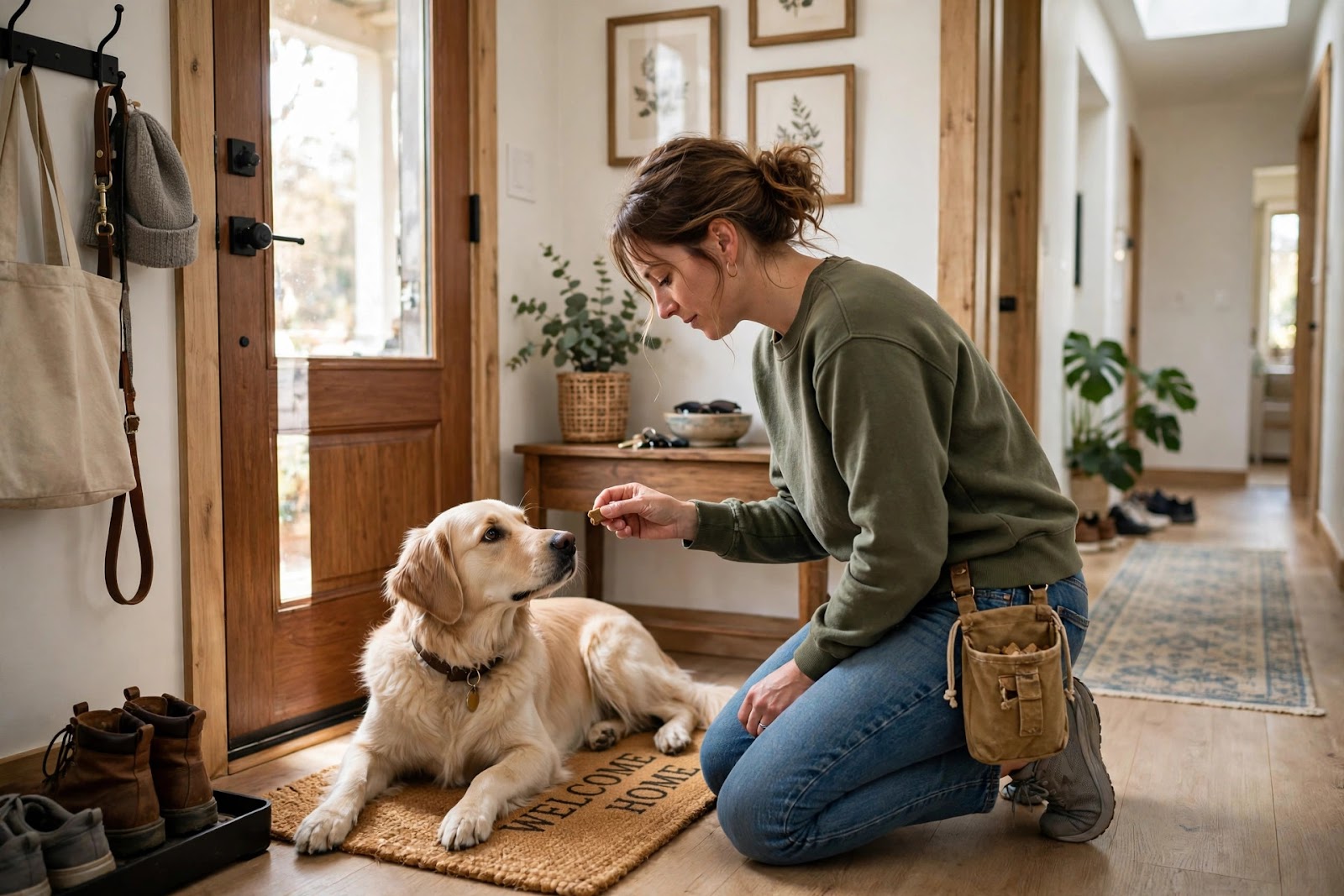
What about dogs who bark through the whole thing?
Biscuit's problem was excitement, not fear or territorial barking. If your dog barks non-stop at the door, the mat alone won't fix it, and I'd be lying if I said otherwise. What the mat does give you is a structure to build on: a dog who knows where to be and what to do has a much easier time learning to be quiet than a dog who is loose, aroused, and making his own decisions.
One thing that helped Biscuit's barking specifically was practising the doorbell sound separately, as its own exercise, before combining it with the mat. I played the recording at low volume during calm moments — while he was chewing, while he was resting — and treated him for simply noticing it without reacting. By the time we combined doorbell plus mat plus guest, the sound itself was boring. Separating the triggers and desensitising each one is slower, but it works where tackling everything at once fails.
When it falls apart mid-visit (and it will)
No training survives contact with a real house party perfectly. Biscuit's mat stay has broken plenty of times, and the difference between a setback and a disaster is what I do in the next ten seconds. The rule I live by now: stay boring. No shouting his name, no chasing him across the room, no big emotional reaction. I walk calmly to the door or to the guest, gently guide Biscuit back to the mat with a treat lure, and ask for a simple sit. If he settles, he gets rewarded and we carry on. If he pops up again immediately, he goes behind a baby gate in the kitchen with a chew for ten minutes while everyone settles, and then we try once more.
The baby gate is my pressure valve, and I wish I'd installed it sooner. It's not a punishment — Biscuit has his bed and a chew behind it, and he can still see and hear the room. It's just a way to stop a spiral. A dog who has broken his stay twice is usually too aroused to succeed on the third try, and forcing a third try teaches him that the mat is a place where he fails. A short reset behind the gate lets his excitement drop, and most of the time he comes back out and nails it.
Another thing that saves visits: I don't ask for the mat the moment a guest arrives if Biscuit has just come in from a walk or is already buzzing. Timing matters. If he's had no exercise that day, I give him a quick garden run or a five-minute game first, then set up the mat routine. Asking a wired dog to lie still is setting him up to fail, and I'd rather spend five minutes burning off the edge than twenty minutes managing a meltdown. The mat is a skill, not a magic spell — it works best when the dog is in a state where succeeding is possible.
One last practical detail: I keep a small treat pouch hanging on a hook right by the front door. Not in the kitchen, not upstairs — by the door. The first month, I lost more repetitions than I can count because I had to leave Biscuit unsupervised to go and fetch treats. The pouch means I can reward the mat stay within two seconds of the door opening, every single time, without thinking about it. It cost four pounds, and it's the single best purchase in this whole routine.
The routine today
These days, the whole thing runs like clockwork, and it takes almost no effort from me. Doorbell rings. I say "mat" as I walk to the door. Biscuit goes to his mat and lies down. I open the door, greet the guest, and bring them into the living room. Biscuit watches from his mat. Once everyone's seated, I release him, and he greets like a civilised animal — a sniff, a tail wag, maybe a polite lean against a leg.
Visitors now compliment him. The same friends who used to brace themselves ask me how I did it. The honest answer is that there was no single trick. It was a mat that meant good things, a cue built slowly, a doorbell broken into pieces, and guests who followed the rules. Six weeks of five-minute sessions, and I got my hallway back.
If your front door is currently a war zone, start today with the mat and a bag of treats. Don't even think about guests yet. Spend a week making that mat the best place in your dog's world, and the rest of the routine gets dramatically easier. Your future self — the one answering the door without apologising — will thank you.


