The afternoon Milo ate half my parsley, I learned two things. The first was that my dog has excellent taste in herbs. The second was that I had no idea which plants in my garden were fine for him to eat and which ones could land us in trouble. I stood at the back door holding a parsley plant that looked like it had been attacked by a lawnmower, watching Milo lick his lips with the satisfied air of a man who has just finished a very good lunch, and I thought: I should probably know this.
It was a Saturday in May. I'd spent the morning planting a little herb bed along the fence — parsley, basil, rosemary, thyme, a pot of mint — the kind of smug weekend gardening that makes you feel like a person who has their life together. Milo had watched me the whole time from his sunny spot on the patio, and I'd assumed he was just keeping me company. He was actually doing reconnaissance. The moment I went inside to wash my hands, he walked over to the parsley, pulled the whole plant out of the soil by the roots, and ate it. Leaves, stems, the lot. Then he looked up at me, tail wagging, like he expected a round of applause.
Parsley, as it turned out, is fine. I rang my friend Sarah in a mild panic, and she laughed at me for a solid minute before telling me that parsley is one of the safest herbs a dog can eat, and that half a plant would do Milo no harm at all. She was right. He was completely fine. But the panic taught me something: I had a garden full of plants, a dog who eats plants, and a knowledge gap right in the middle of the two. So I spent that summer learning which herbs belong in a dog-friendly garden, which ones need to stay far away, and how a few pots of herbs turned into the cheapest enrichment I have ever bought.
The herbs that live in our garden now
Three summers later, the herb bed is bigger than ever, and Milo has a standing arrangement with it. He is allowed to sniff anything, nibble the parsley and the basil, and lie next to the rosemary in the sun. I grow six herbs now, and I picked each one for a reason. None of them are there because a website told me they would fix something. They're there because they smell wonderful, they're tough enough to survive a dog, and a pinch of them in his dinner makes an ordinary bowl of kibble into something he actually gets excited about.
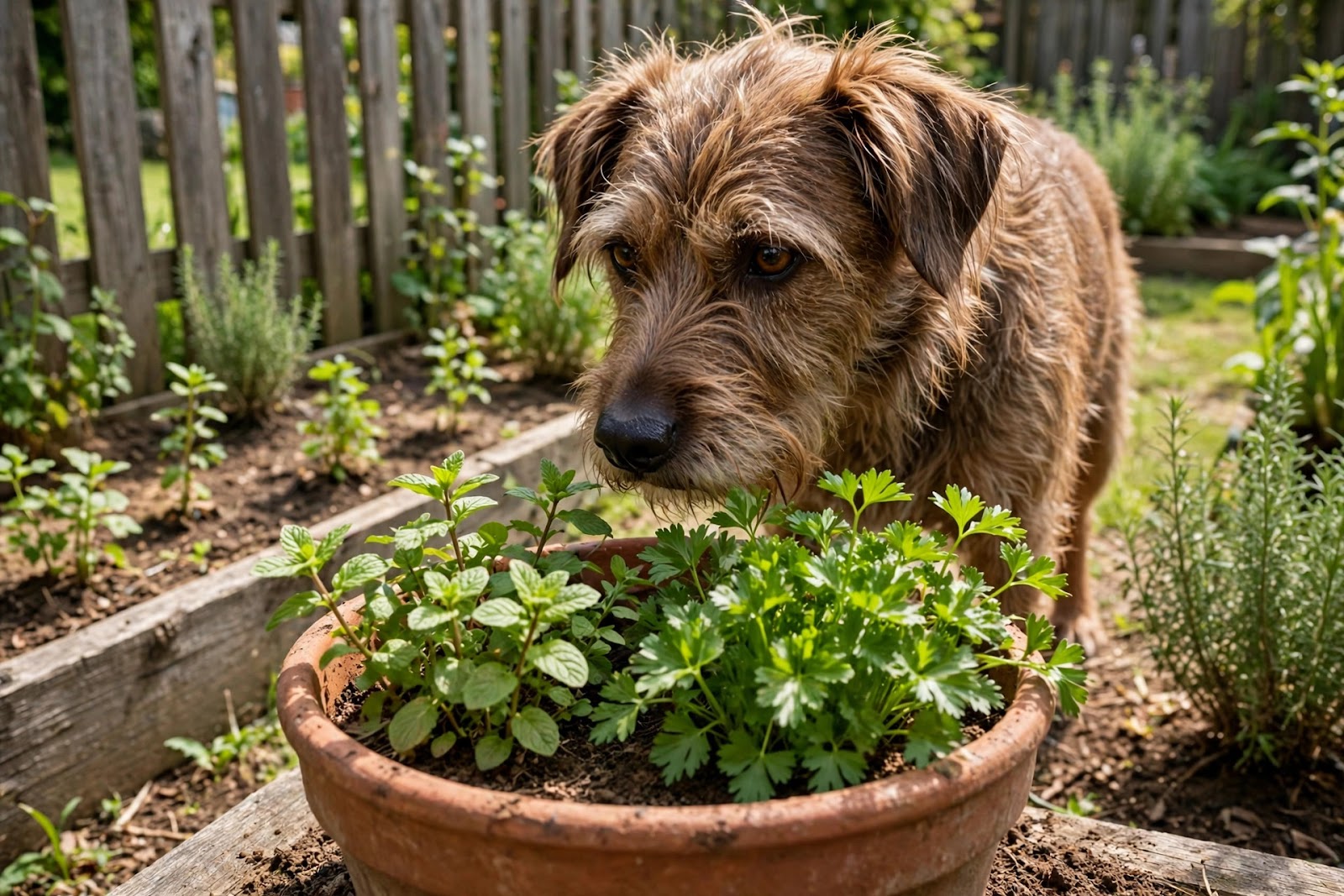
Parsley is the star, and Milo's favourite. Flat-leaf parsley, the kind with the smooth leaves, grows like a weed in our garden and he nibbles it straight off the plant. I also chop a teaspoon of it into his dinner a few times a week, and he eats faster on parsley days, which tells me everything I need to know. It's fresh, it's green, and it makes his breath smell noticeably better, which is a bonus I didn't expect but very much appreciate when he decides to yawn in my face.
Basil is the second favourite. I grow it in pots on the patio table, because slugs love basil and so does Milo, and the pots keep both of them at a manageable level. He doesn't eat the basil plant itself very often — he prefers to sniff it, hard, with his whole face buried in the leaves — but I tear a few leaves into his food in summer and he hoovers them up. Sweet basil is the one I grow. There are fancy varieties with purple leaves and lemon flavours, and I tried one once, but the plain green kind grows fastest and Milo likes it best.
Rosemary is the tough one. It's a woody shrub that survives frost, drought, and being sat on by a 22-kilo dog, which makes it the perfect herb for a garden with Milo in it. He doesn't eat the rosemary much — the leaves are spiky and strong-tasting — but he loves lying next to it in the sun, and the smell of it on a warm day is one of my favourite things about summer. I use it in my own cooking constantly, and a pinch in Milo's dinner on a Sunday is a small luxury we both enjoy.
Thyme is the ground cover. I planted it between the paving stones on the patio, and it has spread into a soft green carpet that smells wonderful when you step on it. Milo walks across it every day, and sometimes he lies on it, and the whole patio smells of thyme afterwards. He nibbles it occasionally, which is fine. Thyme is a gentle herb, and a dog who eats a few leaves of it is a dog having a normal afternoon.
Mint is the one I grow in a pot, and the pot is non-negotiable. Mint spreads like gossip. Put it in open soil and within a year it will have taken over the whole bed, the lawn, and possibly the neighbour's garden. I learned that the hard way in my first year, when a single mint plant colonised a metre of border in one summer. Now it lives in a big terracotta pot by the back door, where Milo can sniff it whenever he walks past.
The ones that never come near the garden
The safe list is only half the story. The other half is the list of plants that never, ever get planted in our garden, and this is the part I wish I'd known on the day I planted that first herb bed. Because a dog-friendly garden isn't just about what you plant. It's about what you refuse to plant, and what you pull out the moment you spot it.
Foxglove is at the top of my never list. It's a beautiful plant — tall spikes of purple bells, the kind of thing you see in cottage garden photos — and it's also one of the most dangerous plants a dog can eat. Every part of it is poisonous, leaves and flowers and seeds, and it self-seeds everywhere if you let it. I found one growing in the corner of our garden in my first summer here, and I pulled it out the same afternoon, roots and all, wearing gloves. I don't plant it, I don't let it grow, and I check the shady corner every spring in case it's come back.
Oleander is the second one, and it's a plant I see in gardens all over the neighbourhood. Pink flowers, glossy leaves, looks lovely in a pot by a front door. It's also seriously poisonous to dogs, and to people too, and I will never have it in a garden where Milo runs free. If you have oleander and a dog who chews plants, that is a combination I would change quickly.
Then there are the bulbs. Daffodils and tulips are everywhere in spring, and the flowers themselves are mostly a mild problem, but the bulbs are the dangerous part. They sit in the soil like little onions, and a digging dog can find them. I plant daffodils in pots on the front step, where he never goes, and never in the back garden where he digs.
I am not a plant expert, and I don't pretend to be. My rule is simple: if I don't know for certain that a plant is safe, it doesn't go in the back garden.
Growing herbs in pots so the dog cannot redecorate them
The biggest practical lesson of my herb garden is that pots are your best friend. Not because herbs need pots — most of them would be perfectly happy in the ground — but because a dog garden and a herb garden have different needs, and pots let you give each of them what they want without a fight.
The basil lives in pots on the patio table, out of slug range and at a height where Milo has to actually decide to eat it rather than just mowing it down by accident. The mint lives in a pot because it would otherwise eat the garden. The sage lives in a pot because I want to control how much of it there is. And the parsley, which Milo loves most, lives in a big pot by the back door, where I can keep an eye on it and he can help himself to a leaf whenever he walks past.
Pots have another advantage I didn't expect. I can move them. In winter, the basil and the mint come into the kitchen windowsill, where they survive the cold and Milo can still sniff them when he comes in for a fuss. In spring, they go back outside. A herb in the ground is a commitment. A herb in a pot is a houseguest. And when a plant is struggling — too wet, too dry, too much sun — I can pick the whole pot up and move it somewhere better in about ten seconds.
The pots themselves don't need to be fancy. Mine are a mix of terracotta pots I bought for two or three pounds each, an old bucket with holes drilled in the bottom, and one chipped enamel pot I found in a charity shop for a pound. Milo doesn't care what the pot looks like. He cares what's in it, and whether he can reach it.
The sniff garden: my cheapest enrichment trick
Here's the part I didn't see coming, and it's my favourite thing about the whole herb garden. The herbs turned out to be the best enrichment I've ever given Milo, and they cost me almost nothing. Not enrichment in the complicated sense — no puzzle feeders, no frozen Kongs, no apps. Just smells. A dog's nose is his whole world, and a garden full of different smells is a garden full of things to think about.

Every morning, Milo does a tour of the herb pots. He starts at the mint by the back door, takes a long sniff, moves on to the rosemary, then the parsley, then the thyme on the patio. He spends about five minutes on this tour, and he does it with the total concentration of a wine taster at a vineyard. Some days he lingers on the basil. Some days he skips the sage entirely. I have no idea what he's learning from all this sniffing, but he comes back inside looking satisfied, like he's read the morning paper and caught up on the news.
I started adding to the tour deliberately. When I prune the rosemary, I leave a few sprigs on the lawn for him to find. When I pick basil for dinner, I leave a leaf on the patio for him to discover. It's a tiny thing, but it turns an ordinary garden into a place where interesting things happen, and a dog who finds interesting things in his own garden is a dog who doesn't need to go looking for trouble elsewhere.
The herb tour has become part of our morning routine, right up there with breakfast and the first walk. He does his tour, I drink my coffee, and we both start the day feeling like we've already done something worthwhile. It costs me nothing. The herbs were already there. All I did was notice what he was doing and let him keep doing it.
What I do when he eats something I did not plant
No matter how careful you are, a dog who eats plants will eventually eat a plant you didn't plan for. It happened to us last summer. Milo found a mushroom growing in the damp corner behind the shed, and by the time I saw what he was doing, he'd already eaten half of it. I have never moved so fast in my life.
Here's what I did, and here's what I'd do again. I took a photo of the mushroom — the half he hadn't eaten, and the place where it was growing — and I rang the vet straight away. I didn't wait to see if he'd be sick. I didn't look it up online first. I rang the vet, described the mushroom, sent the photo, and did what they told me to do. He was fine.
That's my rule now, and it's the only rule in this whole article that I won't bend on. If Milo eats something I can't identify, I ring the vet. Not tomorrow, not after lunch, straight away. A photo of the plant, a note of how much he ate, and a phone call. Most of the time it's nothing, and the vet tells me not to worry, and I feel a bit silly. I'd rather feel silly ten times than be too slow once.
I also keep a list on the fridge now, of the plants in our garden and whether they're safe. It's not a fancy list. It's a piece of paper with two columns — safe and not safe — and the names of every plant in the back garden. If anything ever happens, I can read it out over the phone in thirty seconds. It took me twenty minutes to write, and it's the most useful twenty minutes I've spent on the garden.
What the herb garden gave us
Three summers after the parsley incident, the herb bed is the best thing in our garden, and not because of the cooking. It's the best thing because it gave Milo a garden that belongs to him as much as it belongs to me. He has his sniff tour in the morning, his parsley plant by the back door, his sunny spot next to the rosemary, and his thyme carpet on the patio. And I have fresh herbs for dinner, a garden that smells wonderful, and a dog who is busy, happy, and exactly where I can see him.
If you have a dog and a garden, even a tiny one, try a pot of parsley by the back door. That's all. One pot, two pounds, five minutes of planting. Put it where your dog can reach it, and watch what happens. If he ignores it, you've lost two pounds. If he nibbles it, you've just given him a garden of his own.


