For the first three months, my dog did not sleep through the night. Not once. Every night, without fail, he'd wake up at some point between 1am and 4am, and he'd let me know about it. Sometimes it was whining. Sometimes it was barking. Sometimes it was the sound of his claws on the bedroom door, scratching, scratching, scratching, while I lay there in the dark trying to decide whether to get up or pretend I was asleep. (He always knew. Dogs know when you're pretending.) I'd get up, let him out, stand in the garden in my dressing gown at 3am, bring him back in, and then lie awake for an hour wondering if he'd do it again. He usually did.
I was exhausted. Properly exhausted, in the way where you forget words mid-sentence and put the milk in the cupboard. I started going to bed at 9pm like a pensioner. I stopped making plans for the evening because I knew I'd be shattered the next day. And the worst part was that I didn't know what I was doing wrong. He had a comfortable bed. He had water. He'd been out before bedtime. What more did he want?
The answer, it turned out, was a routine. Not a better bed, not a different room, not a gadget — a routine. A proper, predictable, boring evening routine that told his body, in a language it understood, that the day was over and it was time to sleep. It took us about three weeks to build it, and another two weeks before it really stuck. But we've had six months of full nights' sleep now, and I would guard this routine with my life.
Let me start with what was actually wrong, because I spent weeks fixing the wrong things. My first theory was that he needed to go out in the night because he genuinely needed the toilet. That seemed logical. He was young, his bladder was small, and maybe I was asking too much. So I started setting an alarm for 2am and taking him out before he woke me. That worked, in the sense that he stopped waking me up. But it didn't teach him to sleep through the night — it taught him that 2am was toilet time. When I tried to stop setting the alarm, he woke me at 2am anyway, because that's when I'd trained him to expect a trip outside. I'd accidentally built the very habit I was trying to break. If your dog is waking you at the same time every night, ask yourself whether you trained that time into him. I did, and it took two weeks to undo.
Three wrong theories before I found the real problem
My second theory was that he was cold. I bought a thicker bed, then a blanket, then a heated pad. He slept on the floor next to the bed. Dogs are not always cold just because we would be. He was fine, temperature-wise. He was just awake.
My third theory was that he was lonely. I moved his bed into my bedroom, then next to my bed, then practically on top of my bed. He slept better, a bit, but he still woke up. Loneliness wasn't the main problem either, though being in the same room did help. I'll come back to that.
The real problem was that his evenings had no shape. Some nights we'd have a big play session at 8pm and he'd be wired until midnight. Other nights we'd do nothing after dinner and he'd nap on the sofa from 7pm, wake up at 10pm full of energy, and then be wide awake at 2am. There was no pattern. His body had no idea when the day ended, because the day ended at a different time every night, in a different way, with a different amount of activity. Once I understood that, the fix was obvious: give the evening a shape, the same shape, every night.
Here's our routine now, and I'll go through it in detail because the details are what make it work. It starts at about 6pm, which is when I get home. The first thing we do is a proper walk — not a quick toilet trip, a real walk, forty-five minutes, with sniffing and a bit of off-lead time where it's safe. This is the big energy-burner of the evening. I used to do this walk earlier in the day and then wonder why he was restless in the evening. Moving the main walk to the early evening was the single biggest change. He comes home tired in the good way — the satisfied, floppy kind of tired, not the frantic kind.
Our evening routine, step by step
When we get home, he gets dinner. Same time every night, same place, same bowl. I know that sounds obvious, but for a while I was feeding him whenever I got around to it, and sometimes that was 5pm and sometimes it was 8pm. A regular dinner time anchors the whole evening. His body starts expecting food at 6:30, and after food comes rest, and the pattern builds on itself. I don't know the science behind it, and I'm not going to pretend I do. I just know that when dinner is regular, everything else gets easier.
After dinner, we have a calm hour. This is the part people get wrong, I think. After dinner, I used to play with him — tug of war, fetch down the hallway, all the high-energy stuff. It felt like bonding. What it actually did was wind him up right when I wanted him winding down. Now, after dinner, we do quiet things. He gets a chew — a long-lasting one, something that takes him twenty or thirty minutes — and I sit on the sofa and read or watch television. He lies on his bed and chews. It's peaceful. It's boring. That's the point. I'm teaching him that the evening winds down, not up.
At about 8:30, we go outside for a last toilet trip. Not a walk. A trip. I take him to the same spot in the garden, on the lead, and I stand there like a lamp post while he does what he needs to do. I don't play with him. I don't chat. I keep it dull. This is deliberate. The last toilet trip should be the most boring event of the day. If it's exciting, he'll want to do it again at 2am. If it's dull, he'll do his business and come back inside ready for bed. This took a bit of training, honestly — he kept trying to turn it into a game at first, grabbing the lead, running in circles. I just stood still and waited. After about a week, he got the message: this trip is for toilets only.
Then we come inside, and this is the part of the routine I love most: the wind-down. I dim the lights in the living room. I put on something quiet — sometimes music, sometimes a podcast, nothing with sudden loud noises. I sit on the floor with him for ten minutes and just stroke him slowly. Not excited petting. Slow, long strokes down his back. He sighs. He puts his head on my knee. Sometimes he falls asleep right there, and I have to carry him to his bed, which is ridiculous because he weighs twenty kilos, but I do it anyway because it's sweet. The wind-down is the signal. Lights low, voice low, touch slow. Everything says: the day is over.
The wind-down hour
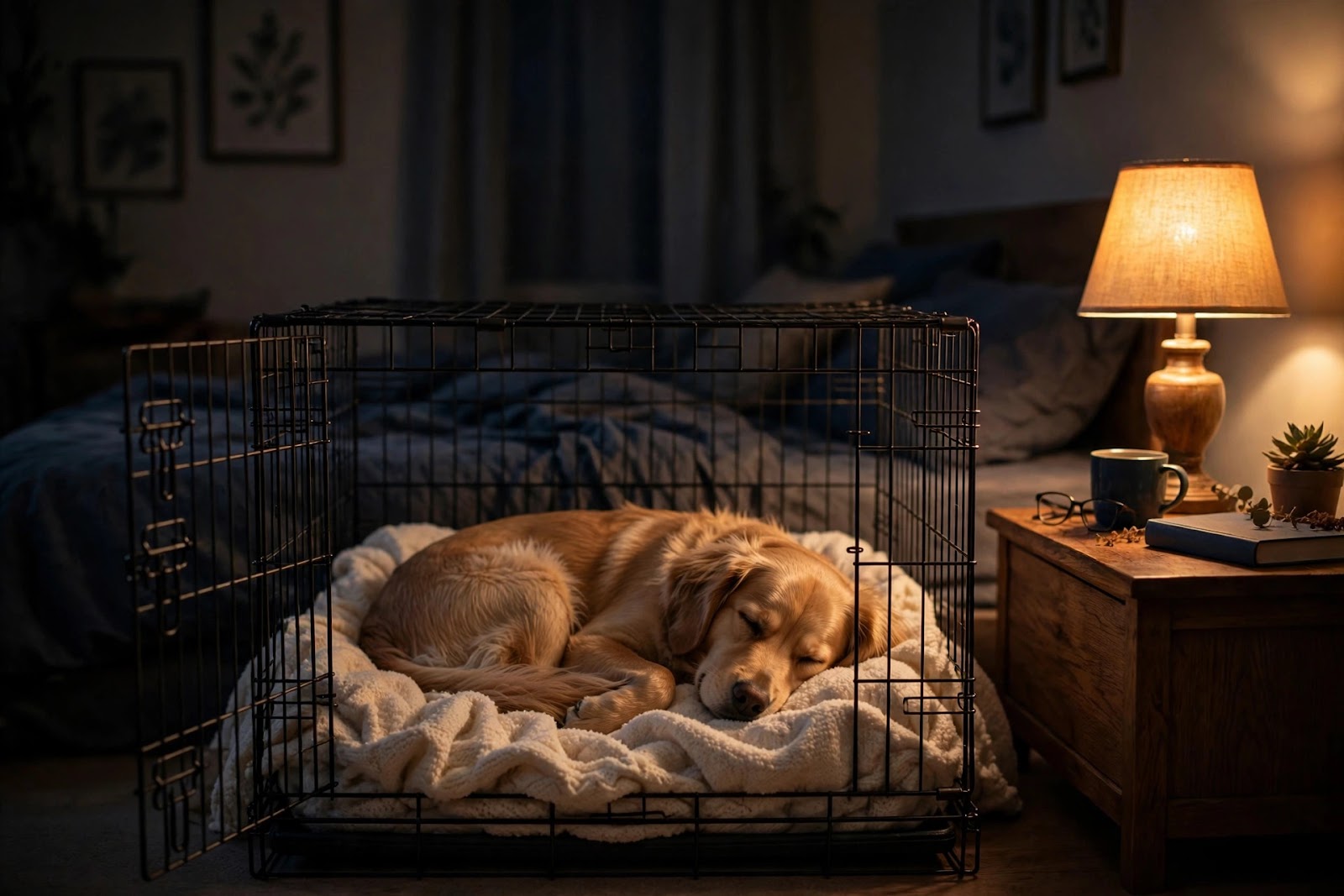
Then, at about 9:30, he goes to his bed. And here's where the crate comes in, because I know people have strong feelings about crates. Our dog sleeps in a crate, and he loves it. It's his den. It's covered with a blanket on three sides, it's got his bed inside, and the door stays open during the day so he can go in and out as he pleases. At night, I close the door — not to lock him in, but because the closed door is part of the routine. It tells him: we're done for the day. I know some people don't like crates, and that's fine. The principle is the same whatever your setup: the sleeping place should be consistent, comfortable, and associated with rest, not with punishment or isolation. Never send a dog to bed angry. Never use the bed as a time-out. The bed should be the best place in the house.
The first week of the new routine, he still woke up. Twice. I nearly gave up. I stood in the garden at 3am thinking, this isn't working, I've changed everything and nothing has changed. But I'd read somewhere — and I wish I could remember where — that it takes three weeks to build a habit, and I decided to give it three weeks before judging it. On day nine, he slept through. On day ten, he woke up. On day twelve, he slept through again. By day eighteen, he'd slept through five nights in a row. By day twenty-one, it was just normal. He goes to bed at 9:30, he wakes up at 6:30 when my alarm goes off, and in between, silence. Beautiful, wonderful silence.
The first three weeks

I want to be honest about the nights he still wakes up, because he does, occasionally. Maybe once a month. Usually there's a reason: fireworks, a thunderstorm, a neighbour's car alarm, or he's eaten something that disagreed with him. When it happens, I handle it the same way every time. I get up, I don't turn on bright lights, I don't talk to him in an excited voice. I take him outside, I stand there like a lamp post, I bring him back in, and I go back to bed. No fuss, no drama, no middle-of-the-night play session. The rule is: night-time is boring. If waking up gets him a boring trip outside and nothing else, there's no reason to keep doing it. And he doesn't, mostly.
There are a few other things that helped that I didn't expect. The first is the morning. A dog who sleeps well at night is partly a dog who had a good day. I make sure he gets enough activity during the day — not just physical exercise, but mental stimulation. A walk where he can sniff is worth twice a walk where he's marched along at heel. A food puzzle at lunchtime, a training session in the afternoon, a new route on the morning walk. A bored dog is a restless dog, and a restless dog is a dog who wakes up at 3am looking for something to do.
Three things that helped that I did not expect
The second is the bedroom environment. I keep the bedroom cool, dark, and quiet. I use a white noise machine — a cheap one, nothing fancy — because our street gets noisy at night and I noticed he was waking up to sounds I was sleeping through. The white noise covers the small noises and lets him sleep through the big ones. I also keep his water bowl full but not right next to his bed, because I read somewhere that dogs drink more when water is right there, and more water in means more need to go out. I don't know if that's true, but it seemed sensible, and it hasn't hurt.
The third is something I didn't want to admit: my own sleep habits mattered. I used to stay up late, scrolling on my phone in bed, and he'd lie there watching me, waiting for me to settle. Dogs take their cues from us. When I started going to bed at a regular time and putting the phone away, he settled faster. It's hard to ask a dog to sleep when you're wide awake next to him with a glowing screen. So part of this routine was fixing my own evenings, which I suppose was good for me too.
I should also mention what I didn't do. I didn't use any sleep aids, calming supplements, or special music marketed for dogs. I'm not against those things, and I've heard good things about some of them from other owners, but I wanted to try the routine first, and the routine worked. If your dog is genuinely anxious at night — panting, pacing, unable to settle even with a good routine — that's a different situation, and it's worth talking to your vet about. I'm not a vet. I'm just someone whose dog wouldn't sleep, and who fixed it with a routine.
If you're in the middle of the sleepless nights right now, I know how miserable it is. I remember standing in the garden at 3am in January, in the rain, in my dressing gown, holding a lead, thinking about how tired I was going to be at work the next day. It felt endless. It wasn't. Three weeks of a consistent routine, and the nights changed. Not overnight — that would be a bad joke — but steadily, night by night, until one morning I woke up to my alarm and realised he'd slept all the way through, and I just lay there for a minute, listening to the quiet, feeling like the luckiest person in the world.
Start tonight. Pick a dinner time and stick to it. Move the big walk to the early evening. Keep the last toilet trip boring. Dim the lights, slow down, and give his body the same message every single night: the day is over, and it's time to sleep. Give it three weeks. And keep the dressing gown by the back door, just in case — some nights, even the best routine needs a backup plan.


