Every walk used to start the same way. I'd reach for the leash, and my dog would lose his mind. He'd sprint to the front door, skid across the floor, and throw himself at it like the outside world was about to disappear. Then he'd bark, spin in circles, and shove his nose into the gap the second I cracked the door open. Half the time he was halfway down the front steps before I'd even got the leash clipped on. I'd stand there, one shoe on, holding an empty collar, wondering how a walk I was supposed to enjoy had turned into a wrestling match before we'd even left the house.
It wasn't dangerous, exactly. It was just miserable. And it set the tone for the whole walk. If we started in chaos, we stayed in chaos. He'd pull, I'd yank, we'd both come home annoyed. Something had to change, and the change had to happen at the door, because that's where it all started.
The idea is simple: the door doesn't open until the dog is calm. Not perfect. Not frozen like a statue. Just calm enough — four paws on the floor, breathing normally, looking at me instead of through me. That's the doorway rule, and it took us about five weeks to get it right.
I didn't invent this. Plenty of trainers talk about threshold training. But reading about it and actually doing it at your own front door at 7am with a dog who's vibrating with excitement are two very different things. Here's what actually worked for us, including the parts where I got it wrong first.
The first mistake I made was trying to train it during real walks. I'd decide, right, today we're doing the doorway rule, and then I'd stand at the door for ten minutes while my dog got more and more frustrated, and eventually I'd give up and just go because we were late. That's not training. That's a standoff. So I separated training from actual walks. For the first two weeks, we did doorway practice as its own thing — five or ten minutes, three times a day, with no walk at the end of it. Sometimes the reward was just going back inside and getting a treat. That took the pressure off both of us.
My first mistake: training during real walks
Here's the setup I used. I needed three things: a leash, a pocket full of small treats, and a door I could open and close easily. I used our front door, but the back door works just as well. I kept the treats tiny — I cut regular training treats in half, because we'd be doing a lot of repetitions and I didn't want him filling up on biscuits before breakfast. I also kept a few higher-value treats, little bits of cheese, in a separate pocket for the moments he really nailed it.
The very first step is the least exciting one, and it's the one most people skip. Before we even touched the door, I taught him that the leash appearing doesn't mean instant chaos. For a few days, I'd pick up the leash, clip it on, and then just stand there. We'd walk around the living room. We'd sit down. I'd put the leash away again. Boring, right? That's the point. The leash stopped being a starting gun. It took about three days before he stopped doing his full-body wiggle the moment he heard the clip.
Then we moved to the door itself. This is the part that needs patience, and I mean real patience, the kind where you accept that you might spend a whole session opening and closing a door twenty times and going nowhere.
The door handle game
The rule I set for myself: I touch the door handle, and if he stays calm, he gets a treat. If he lunges, I take my hand off the handle and wait. That's it. No shouting, no pushing him back, no "no" on repeat. Just — hand on handle means nothing happens unless you're calm, hand off handle means we're paused. Dogs are very good at figuring out cause and effect when the cause and effect are consistent. The problem is that we're usually not consistent.
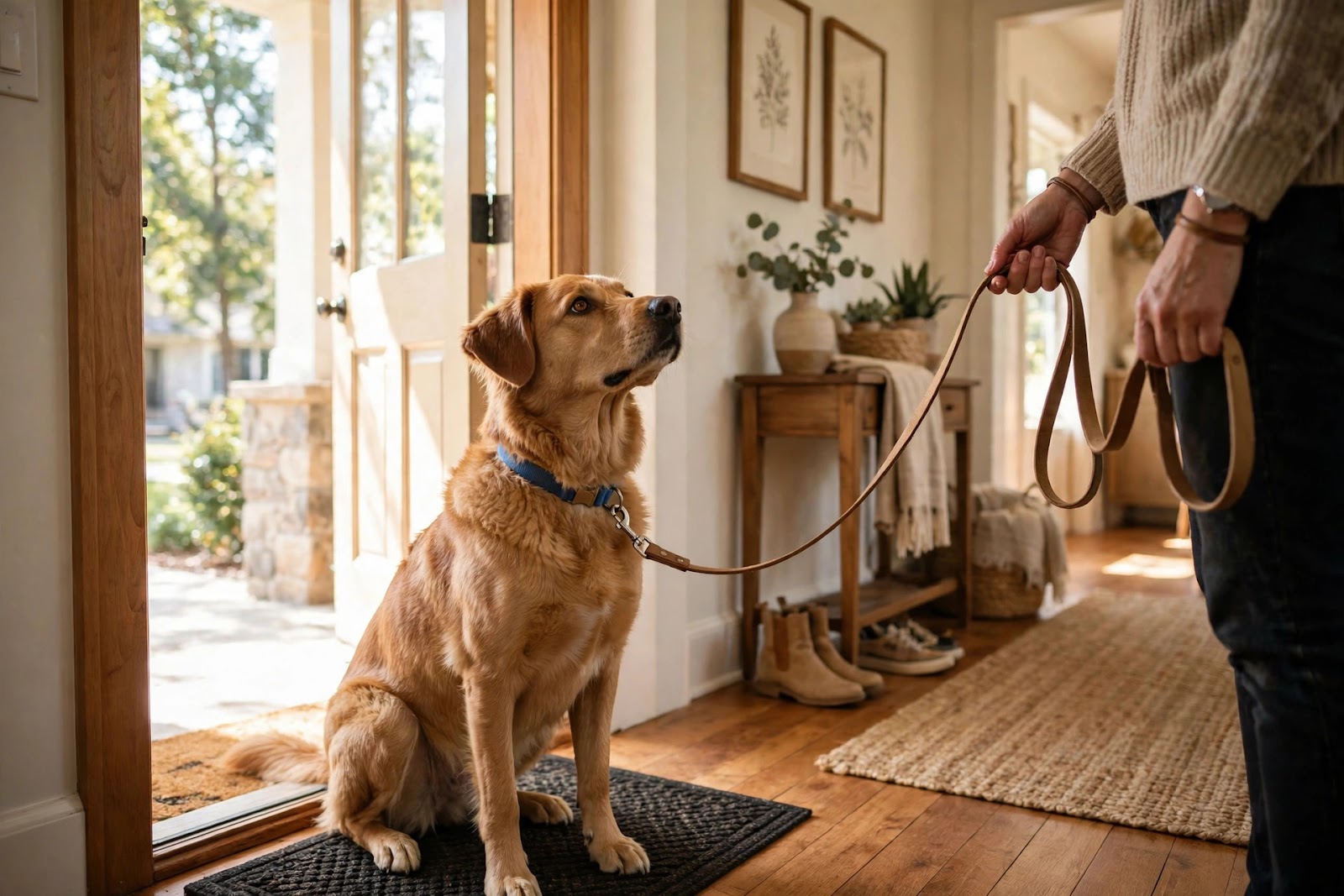
Day one was embarrassing. I touched the handle and he launched himself at the door like it owed him money. I took my hand away. He sat down, confused. I touched the handle again. He launched again. We did this for about eight minutes and I honestly thought it wasn't working. Then, on maybe the fifteenth try, he stayed sitting. Just for a second. I treated him immediately and told him he was a good boy like he'd won something. He had, really. He'd figured out the game.
That tiny moment is the whole training method, really. You wait for the behaviour you want, you mark it the instant it happens, and you repeat it until it's the dog's idea. You're not forcing calm. You're making calm the thing that makes the door open.
Once he could handle me touching the handle, I moved to opening the door a crack. An inch. Two inches. The moment his backside lifted off the floor, the door closed again. Not slammed — just closed, gently, back to where we started. This is where a lot of people give up, because it feels like you're going backwards. You're not. Every time the door closes, your dog is learning something: rushing makes the door close. Waiting makes it open. It's a clean, fair rule, and dogs respect clean, fair rules.
I want to be honest about how slow this part was. It took us four days to get from a door cracked open two inches to a door open halfway with him still sitting. There were sessions where I thought we'd lost it completely. Looking back, those were usually the sessions where I was rushing, and my timing was off. Dogs read your mood better than you think. On the days I was calm and slow, he was calm and slow. On the days I was tense, he was a mess. So part of this training was honestly training myself to slow down.
Around the end of week two, something clicked. I opened the door fully, and he stayed sitting. He looked at me. Actually looked at me, ears up, waiting. I said "okay" — that's our release word — and he walked through the door like a normal, civilised animal. I nearly cried. I gave him about six treats in a row and told him he was the best dog in the world, which he absolutely is, but that's beside the point.
The day it clicked
Now, here's the thing nobody tells you about threshold training: the door is only the first threshold. Once he had the front door down, I realised he did the same frantic thing at the garden gate, at the car boot, and at the park entrance. The good news is that the skill transfers fast once the dog understands the concept. The garden gate took two days. The car took three. The park entrance took one afternoon, because by then he knew the game: calm opens doors.
But I also learned that you can't just train it once and forget it. We still practise. Not every day, but a few times a week I'll do a slow, deliberate doorway exit even when we're in a hurry, just to keep the habit sharp. And if he has a bad day — if a cat runs past the window right before a walk, or the neighbour's dog is barking — he'll sometimes forget himself and lunge. When that happens, I just close the door and start again. No drama. No lecture. Just the rule, applied the same way every time.
A few practical details that made a real difference for us. First, the release word matters. Pick one word and use it only for this. I use "okay" but I say it in a specific way — a clear, upbeat "okay!" — and I never use it in casual conversation around the door. Some people use "free" or "go ahead." The word itself doesn't matter. What matters is that it means one thing: you may go through now.
Three details that made the difference
Second, watch your feet. I noticed early on that I was accidentally rewarding him for standing, because I'd open the door while he was standing still and call that calm. Standing still isn't the same as settled. A dog can be standing still and absolutely buzzing inside. I started waiting for the sit, specifically, and for his breathing to slow. You can see it — the chest stops heaving, the tail stops helicoptering, the ears relax. That's the moment to open the door.
Third, keep the first few steps after the door slow. If you burst out of the door at full speed the moment he crosses the threshold, you've taught him that calm at the door leads to a sprint, which is basically the same chaos with extra steps. We walk the first ten metres slowly. I let him sniff. Sniffing is calming for dogs — it's practically self-soothing — and a dog with his nose on the ground is a dog who isn't pulling.

The third mistake I made was expecting it to work everywhere immediately. It didn't. At my sister's house, he acted like he'd never heard of a door in his life. That's normal. Dogs don't generalise the way we do. A rule learned at one door is, in their mind, a rule about that door. So I re-taught it, briefly, at each new doorway. Each one took less time than the last. By the fourth new door, he got it in about five minutes.
What about when other people are involved? This was our next challenge. My partner would come home, open the front door, and my dog would explode through it. We had to agree on the rule together: nobody opens a door for him unless he's sitting. That sounds simple, but it means everyone in the house has to play along. If one person lets him barge through, the training unravels. It took my partner about a week to get used to waiting the extra thirty seconds. Now she does it automatically.
Visitors were harder. People arrive, they're excited to see the dog, and they throw the door open while he's mid-lunge. I started putting a note on the inside of the front door: Please wait, dog in training. It felt silly. It worked, though. The note bought us three calm weeks while the habit was still fragile, and by the time I took it down, the habit was solid enough to survive a visitor who forgot.
Now let me talk about what the doorway rule actually changed beyond the door. Once he learned that calm behaviour opens doors, he started offering calm behaviour in other situations. He started sitting before meals without being asked. He started settling on his bed when the doorbell rang instead of charging at it. It was like he'd learned a general principle: patience gets you what you want. A dog who can wait at a door can learn to wait for anything.
What the doorway rule changed beyond the door
I should also mention what not to do, because I tried some of it. Don't physically block the dog with your body or your knee. Don't hold the dog back by the collar while you open the door — he'll just learn that the collar means restraint, and the second you let go, he'll bolt. Don't shout "wait" ten times. If you say "wait" and then open the door while he's moving, you've just taught him that "wait" means "go." Say it once, and if he moves, close the door and start over.
One more practical thing: the weather will test you. The first rainy morning after he'd learned the rule, I was in a rush and I opened the door while he was still bouncing. He shot out into the rain, I got soaked, and we'd undone about a week's worth of habit in five seconds. Rainy days are the danger zone because you're rushing. That's exactly when the rule matters most. Now, on rainy days, I deliberately slow down even more. It costs me forty seconds. It saves me a soaking and a pulled shoulder.
If you're starting from scratch, here's the honest timeline I'd expect. Week one: leash work and hand-on-handle. He'll seem to get it and then lose it, repeatedly. Week two: door cracking open, closing when he moves. This is the slow week. Week three: full door open, sitting, release word. You'll have one brilliant day and then a terrible one. Week four: it starts to stick, and you'll notice him offering the sit without being asked. Week five: you realise you haven't thought about the doorway in days because it just works now. Some dogs will be faster. Some will be slower. Five weeks is a reasonable expectation, not a promise.
An honest five-week timeline
What if your dog is genuinely struggling? If after a few weeks there's no progress at all, it's worth checking two things. First, is the dog getting enough exercise and mental stimulation in general? A dog who's bursting with unspent energy will find it almost impossible to be calm at a door. I added a ten-minute sniffy walk in the garden and a food puzzle before our morning walk, and his doorway behaviour improved noticeably within days. Second, is the reward actually rewarding? If the walk itself is boring — same route, no sniffing allowed — then the door isn't really a gateway to something wonderful. Make the walk worth waiting for.
I want to end with the morning that made all of this worth it. It was about six weeks in. I picked up the leash, and he walked to the door and sat down. Not because I asked. He just went and sat, facing me, waiting. I clipped the leash on, put my hand on the handle, and he stayed. I opened the door, and he stayed. I said "okay," and we walked out together, side by side, at a normal human pace. The whole thing took maybe a minute, and it was completely uneventful. That's the goal. Not a dramatic transformation. Just a normal, boring, pleasant start to a walk.
If your walks start in chaos, try the doorway rule. Separate training from real walks for the first two weeks. Keep sessions short. Let the door do the talking. And give it five weeks before you decide whether it works.


