Some dogs are born swimmers. Mine was not one of them. The first time I took Biscuit, my scruffy terrier mix, anywhere near water deeper than a puddle, he planted all four paws on the bank like someone had nailed them there, stared at the lake, and then stared at me with an expression that said, very clearly, you've lost your mind.
I'd made the classic mistake. I'd assumed that because dogs have a "doggy paddle" named after them, swimming must be built in, like barking or sniffing other dogs' bottoms. I'd pictured us gliding across the lake together on a warm afternoon, the kind of scene you see on dog food adverts. What I actually got was a wet dog shaking on the grass, a soaking wet me, and a long walk home in silence.
It took me most of that summer to get it right. Not because Biscuit is a difficult dog — he's not, he's just careful — but because I had to unlearn everything I thought I knew about dogs and water and start again, slowly, on his terms. What follows is the method that actually worked for us, including the mistakes, the gear that was worth the money, and the stuff I bought that turned out to be a complete waste.
The first mistake: throwing him in (please don't)
Let me be honest about what happened at the lake, because it's the part I'm least proud of and the part that matters most. A friend had told me that the quickest way to teach a dog to swim is to just carry them out to where the water is chest-deep and let go. "They figure it out in seconds," he said. "It's instinct."
So I did it. I waded out, Biscuit tucked under my arm like a parcel, and I set him down in the water. He did figure out how to paddle, technically. He thrashed his way back to the bank in about four seconds flat, scrambled out, shook himself violently, and then refused to come within ten metres of the water for the rest of the afternoon. He also gave me a look I still think about sometimes.
Here's the thing nobody tells you: yes, most dogs can paddle. But being able to paddle and feeling safe in water are completely different things. Biscuit could keep himself afloat, but the experience terrified him, and fear is sticky. It took me weeks to undo the damage from those four seconds. If your dog has never swum before, do not do what I did. There is no shortcut that is worth it.
Starting over in the garden
After the lake disaster, I left water alone for a fortnight. I didn't want Biscuit associating every mention of a walk with the trauma of being dropped in a lake. When I did start again, I started in the one place he felt completely safe: our garden.
I bought a cheap rigid plastic paddling pool from the garden centre — the kind that's meant for toddlers, about a metre and a half across and maybe twenty centimetres deep. It cost me eleven pounds, and it was the best eleven pounds I spent all summer. I put it in the middle of the lawn, filled it with about five centimetres of water, and then did absolutely nothing. I didn't call Biscuit over. I didn't point at it. I just sat on the grass nearby with a book and a pocket full of treats and waited.
It took him nine minutes to go and investigate. I know because I checked my watch, twice. He sniffed the edge, put one paw in, pulled it straight back out, and looked at me. I tossed a treat into the shallow water. He stretched his neck out, grabbed it, and stepped in with both front paws to get the next one. Within half an hour he was standing in the pool up to his ankles, happily fishing treats out of the water like it was the best game I'd ever invented.
That was the whole session. I didn't push it. I let him splash about for twenty minutes, then I emptied the pool and we went inside. The next day I did the same thing, with slightly deeper water. By the end of the week, he was lying down in the pool on hot afternoons of his own accord, which is a sentence I never thought I'd write about a dog who once treated a puddle like it was lava.
Choosing the right water (it matters more than you think)
Once Biscuit was happy in the paddling pool, I started looking for a proper swimming spot, and this is where I made my second mistake — I picked the nearest one instead of the best one. The nearest spot was a stretch of river about ten minutes from the house, and on paper it looked fine. In reality, the bank dropped away steeply, the current was stronger than it looked, and the bottom was slippery clay. Biscuit took one look at the drop and refused to go near it. I can't blame him. I wouldn't have fancied it either.
So I went looking properly. What you want, for a dog's first real swim, is almost comically specific: a gentle slope into the water, no sudden drop-off, a firm bottom (sand or small pebbles, not deep mud), slow-moving or still water, and enough space that your dog doesn't feel cornered.

I found our spot through a local dog-walking group — a shallow corner of a reservoir where the water stays ankle-deep for a good three metres before it deepens gradually, and there were no other dogs there on weekday mornings, which mattered more than I expected.
One more thing worth checking: the water itself. I check for blue-green algae in warm weather before I let Biscuit in anywhere, because it can be genuinely harmful, and I avoid anywhere with a lot of litter or an oily sheen on the surface. If the water looks wrong, we don't swim. It's a five-second check and it's worth building into the habit from day one.
The life jacket question
People have strong opinions about dog life jackets, and I was sceptical at first. It felt like overkill — a life jacket for a dog? But I bought one anyway, a Ruffwear Float Coat in his size, and I am very glad I did. It cost me about seventy pounds, which felt steep for what is essentially a foam vest, but it did two things that turned out to be crucial.
First, it gave Biscuit buoyancy. Dogs who are learning to swim often paddle with their front legs only, which tips their back end down and makes them panic. The jacket kept him level, which meant he could learn the actual swimming motion instead of just flailing. Second — and honestly this mattered more — it gave me a handle. A proper dog life jacket has a sturdy handle on the back, and that handle let me support him in the water and guide him without grabbing at his collar or his legs, which is exactly the kind of grabbing that makes a nervous dog more nervous.
I introduced the jacket at home, not at the water. He wore it around the house for a few minutes at a time, with treats, for three days before we ever went near the reservoir. By the time we got to the water, the jacket was just a thing he wore, not a new scary thing on top of a scary situation. That sounds fussy, but stacking new experiences is how you get a dog who shuts down. One new thing at a time.
Do you need a life jacket? For a confident, strong-swimming breed, probably not forever. For a first-time swimmer or any dog with short legs and a heavy body, I'd say yes, at least while they're learning. Get the right size — measure your dog's chest and check the manufacturer's sizing chart instead of guessing. I guessed the first time and had to exchange it, which cost me a week.
The first real swim
Our first session at the reservoir lasted twelve minutes. Short sessions. Always short sessions. A tired dog in water is a dog who starts to panic, and a panicking dog is a dog who decides swimming is terrible forever.
Here's how it went. I walked into the water first, up to my knees, and I called Biscuit to me. He stood at the edge, thinking about it. I had treats in a waterproof pouch — sliced sausage, his absolute favourite, the stuff he would sell his soul for. I tossed one into the shallow water, about a metre out. He waded in to get it. Then another, a bit further. Then I crouched down and held one out, and he swam two strokes to reach me. Two strokes. That was it. And then I let him get out, dried him off, and we went home.
Two strokes doesn't sound like much, but it was everything. He'd chosen to swim. Nobody had pushed him, nobody had carried him out, nobody had thrown him in. He'd gone in because he wanted the sausage, and he'd discovered that the water held him up. That is the whole secret, really: make the dog want to go in, and let the water do the teaching.
Over the next three weeks, we went back every other day. Each time, the distance grew a little. Two strokes became five. Five became a short loop out and back. I stayed close, always within arm's reach, and I always ended the session while he was still having fun — before he got tired, before he got cold, before the novelty wore off. Some days he didn't want to go in at all, and on those days we just walked along the bank and threw sticks into the shallows. No pressure. The water would still be there tomorrow.
The day it clicked
About a month after that first lake disaster, we were at the reservoir on a warm Saturday morning. I'd brought a tennis ball, which Biscuit loves more than is probably healthy. I threw it about four metres out, not thinking much of it, and he launched himself off the bank without a second's hesitation, swam out in a clean, level paddle, grabbed the ball, and swam back. No panic. No thrashing. Just a dog swimming.
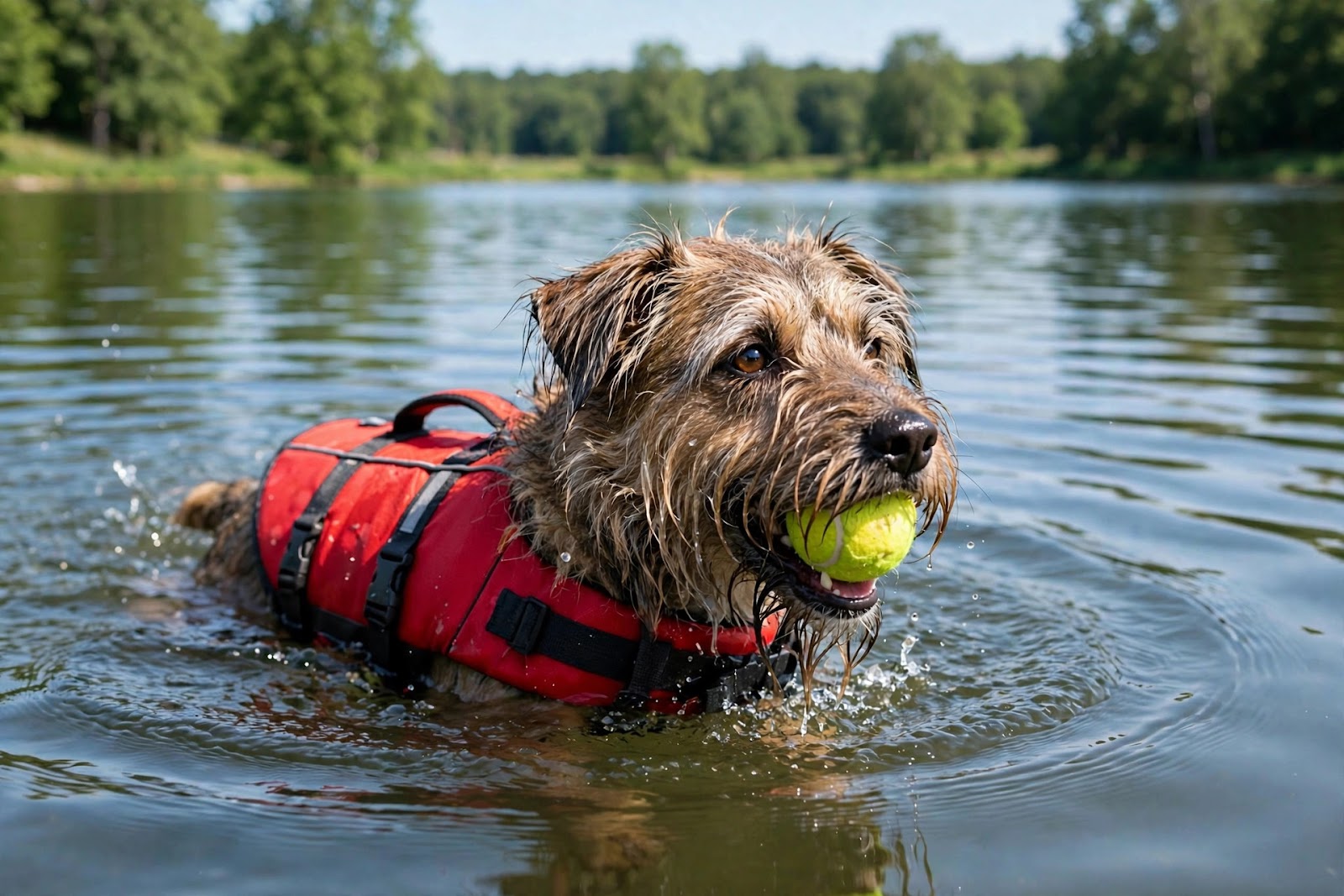
I stood in the water grinning like an idiot. He shook himself all over me, dropped the ball at my feet, and looked up at me as if to say, throw it again, obviously. We played fetch in the water for twenty minutes, and I kept having to remind myself that this was the same dog who had once treated a puddle like a personal insult.
There was no single magic moment, really. It was a month of small, boring, patient steps. But if I had to pick the turning point, it was the day I stopped trying to teach him to swim and started letting him learn to swim. Those are different things, and the difference is everything.
What I do before every swim now
Biscuit swims happily now — rivers, lakes, the sea on calm days — but the routine hasn't changed much from those early weeks, because the routine is what keeps it safe and fun.
First, I check the water. Algae, litter, current, depth, and whether there's an easy way out — a gentle slope or a low bank, not a wall or a steep drop. If Biscuit fell in somewhere without a way out, he'd be in trouble fast, and I never let him swim anywhere he couldn't climb out of on his own.
Second, I warm him up. Five minutes of walking and a bit of play before he goes in, because cold muscles and cold water are a bad combination. And I keep sessions short — twenty minutes is plenty for Biscuit, and in cold water it's more like ten. Dogs don't always know when they're tired, and by the time a dog looks exhausted in the water, it's already too late to be casual about it.
Third, I keep a towel and fresh water in the car. The towel is obvious. The fresh water is for rinsing him off, because lake and river water can irritate skin, and because dogs who swim tend to drink while they swim. I also rinse his ears after a swim, gently, with a cloth — wet ears are where ear problems start, and a thirty-second wipe saves a lot of trouble later.
Fourth, I never let him swim alone. I don't let him go in without me, and I don't go swimming myself while he's loose on the bank. Dogs follow. If I swim out and he decides to follow me, he's suddenly in deep water without a plan. We swim together, or we don't swim.
The things I wish I'd known at the start
If I could go back to that first day at the lake, there are a few things I'd tell myself. The first is that not all dogs are natural swimmers, and that's fine. Some breeds — your Labradors, your spaniels, your Newfoundlands — take to water like they've been waiting their whole lives. Others, like my terrier mix, or anything with short legs and a heavy chest, have to work at it. Neither is a failure. It's just anatomy and temperament, and fighting against either one is a waste of a summer.
The second is that fear is the real obstacle, not technique. A dog who is afraid of water isn't being stubborn or awkward. They're being sensible, from their point of view. The whole job is to change their mind about water, one small, safe, treat-filled experience at a time.
And the third is that you don't need to be an expert. I am not a dog trainer. I am a person who owns a dog and made a lot of mistakes in public. But patience and short sessions and good treats got us further than any clever technique would have.
These days, Biscuit asks to swim. He hears the word "reservoir" and he's at the door before I've finished the sentence, tail going like a windmill. He's a water dog now, and if you'd told me that on the day he shook himself dry on that lake bank and glared at me, I'd have laughed in your face.
So if your dog is scared of water, don't give up — and definitely don't throw them in. Get a paddling pool, get some good treats, find a gentle bit of water, and give it a month. Go at your dog's speed, not yours. The lake isn't going anywhere. Your dog will get there. Mine did, and he was the most stubbornly dry dog I've ever met.


