The first spring in our new house, I looked out of the kitchen window and saw Milo chewing on something purple. He had dug up a clump of bulbs from the flower bed by the fence, and he was sitting in the middle of the wreckage looking extremely pleased with himself. I did not know what the bulbs were. That was the problem. I had a garden full of plants I could not name, and a dog who treated all of them as either food or toys.
So I spent that weekend doing two things: watching Milo like a hawk, and walking around the garden with my phone, photographing every plant and looking it up. By Sunday night I had a list, and the list had two columns. Column one was the plants that could stay. Column two was the plants that had to go, and it was longer than I wanted it to be.
This is the story of how I rebuilt that garden into a place where Milo can run, dig, sniff, and nap without me hovering at the window. It took one spring, about $200, and a lot of digging. It was worth every bit of it.
The plant audit: walking the garden with fresh eyes
Before I ripped anything out, I did a proper audit, and I mean proper. I walked every square meter of the garden with Milo on his leash, and I wrote down every plant I could find, including the scruffy ones at the back that the previous owner had clearly forgotten about.
The previous owner loved foxgloves. Tall, purple, beautiful foxgloves along the whole back fence. They were the first thing on the removal list, because every dog-gardening guide I checked flagged foxgloves as one of the plants to keep away from dogs. There were also lilies in a pot by the back door, and a sago palm in the corner that looked like a small pineapple tree. Both went on the list too.
I want to be clear about something here. I am not a vet, and this is not medical advice. I just read the plant lists that vets and animal charities publish, the ASPCA list being the one I kept coming back to, and I removed anything on it that a dog might chew. If you are not sure about a plant in your garden, check that list before you decide. It takes five minutes, and it beats standing at the kitchen window wondering what your dog just ate.
The audit also turned up things that were not plants at all. A bag of cocoa-shell mulch in the shed, which smells like chocolate and is exactly as bad an idea as it sounds. A tray of slug pellets on a shelf, the blue kind, which I threw away the same day. A compost heap with no lid, full of things I did not want to think about. The garden was not just planted for humans. It was actively hostile to a dog, and nobody had ever noticed because nobody had ever had a dog in it.
What I ripped out on day one
Day one was demolition day. The foxgloves came out first, roots and all, and went straight into bags, not the compost heap, because I did not want them coming back as seedlings. The lilies went next, pot and all, and I gave the pot away with a warning attached. The sago palm was heavy, awkward, and full of spikes, and getting it out of the ground took me an hour and a pair of gloves I later threw away.
I also dug up every bulb I could find in the beds Milo had access to. Bulbs are the sneaky ones. They look like nothing in winter, and then they come up in spring, and your dog digs them up because they smell interesting. I found daffodil bulbs, tulip bulbs, and a whole patch of something I never did identify, which is exactly why it went in the bag too. If I could not name it, it did not stay.
The cocoa-shell mulch went in the bin. The slug pellets went to the hazardous-waste drop-off. The compost heap got a lid and a latch, because an open compost heap to a dog is basically a buffet with no rules.
By the end of the day, the garden looked bare and a bit sad, and Milo kept wandering around sniffing the empty patches where the foxgloves had been, like he was checking whether I had hidden them somewhere. I felt guilty for about an hour. Then I remembered the purple bulb incident, and the guilt went away.

What I planted instead
An empty garden is a chance, not a punishment, and I had more fun planting the new garden than I had ever had gardening before. The rule was simple: everything new had to be safe if Milo chewed it, tough enough to survive being run over, and pretty enough that I actually wanted to look at it.
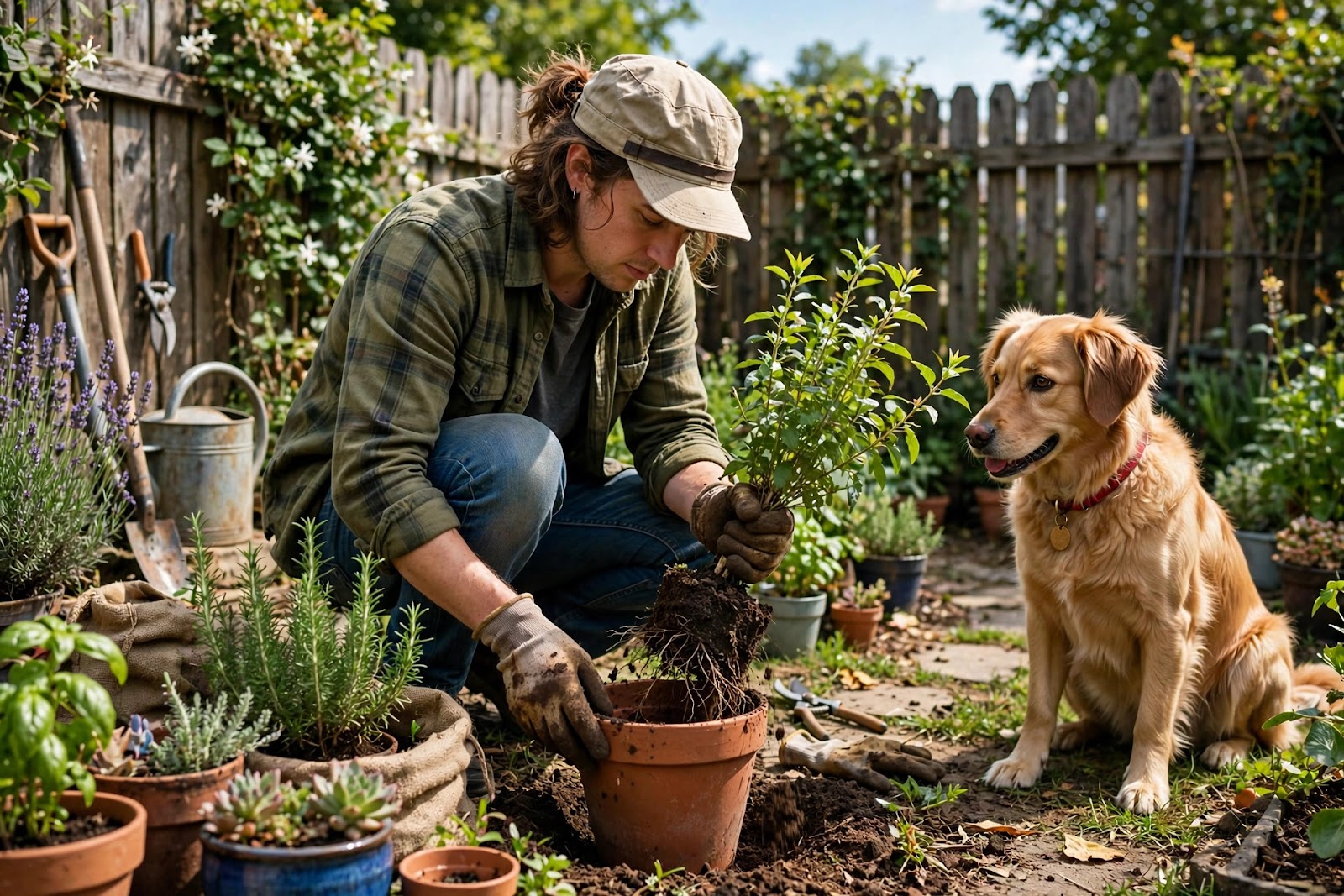
Lavender went in along the sunny wall, and it is now the best thing in the garden. Milo brushes past it every morning and comes back smelling faintly of lavender, which is a lot better than the alternative. Rosemary went in by the kitchen door, because I cook with it and because it is a tough shrub that does not care if a dog leans on it. Sunflowers went along the back fence, tall and cheerful, and they gave Milo a shady tunnel to walk through by August.
I also planted strawberries, because I love them and because Milo loves them even more, which I discovered when he ate the first ripe one straight off the plant while I was still holding the watering can. Now we share them, which is to say he gets most of them and I get the ones he misses. Mint went into pots, never into the ground, because mint spreads like gossip and I did not want it taking over. The pots sit on the patio where Milo can sniff them but cannot dig them up, which seems to satisfy everyone.
The total cost came to just under $200, including the plants, a bag of topsoil, and a roll of edging to keep the beds tidy. I bought everything from a local garden center, and I asked the staff about every single plant before I bought it. One of them kept a dog herself, and she walked me around the nursery pointing at things and saying, that one is fine, that one is not, that one will survive a dog. It was the most useful twenty minutes of the whole project.
The digging zone: give him somewhere legal to dig
Here is the thing nobody told me before I got a dog. Dogs dig. It is not bad behavior. It is what they do. And if you do not give them somewhere to dig, they will pick somewhere themselves, and it will be your favorite flower bed, every single time.
Milo's favorite flower bed was the one by the fence, the one I had just replanted with lavender. He dug a hole in it on the second day, and I stood there looking at the hole and the lavender lying on its side, and I had a choice. I could fight him about digging for the next ten years, or I could give him a place where digging was allowed and even encouraged.
I chose the second one. I built a digging pit in the far corner, about a meter square, edged with logs, filled with a mix of sand and loose soil. Then I buried his toys in it, just under the surface, and let him find them. He went mad for it. Within a week, he had a routine: run to the pit, dig like a machine, find a toy, run a victory lap, repeat. The lavender has not been touched since.
The pit costs almost nothing, and it is the single best garden investment I have made. If your dog digs, do not buy a spray or a gadget. Buy sand, build a pit, and bury a ball in it. The dog will do the rest.
Fencing the veg patch and hiding the compost
I grow vegetables in two raised beds, and the first year Milo treated them like a salad bar with a digging option. He ate the lettuce, trampled the carrots, and once pulled up an entire row of onions, which he then carried around the garden like trophies.
The fix was a low fence, about knee height, made from wooden pickets I bought for $40. It is not tall enough to keep a determined dog out, and I know that. It does not need to be. It is a line. Milo understands lines. He steps over the low edging around the flower beds sometimes, but he has never once jumped the veg-patch fence, because the fence says this is different, and he respects that.
The compost bin got the same treatment, but stronger. I bought a bin with a locking lid, and I put a paving slab on top for good measure. Milo investigated it once, decided it was not worth the effort, and has ignored it ever since. The old open heap is gone, and so is the smell that used to drift across the garden on hot days.
I also moved the water butt. It had a gap at the top where Milo could reach the water, and I did not like the look of it. Now it has a tight lid and a tap, and Milo has a proper water bowl in the shade by the back door, which I change twice a day in summer. A dog in a garden needs water he can actually reach, in a bowl he can actually drink from, and I had somehow missed that for a whole month.
Shade, paths, and the mud problem
A dog-friendly garden is not just about plants. It is about the whole space, and the thing I got most wrong at first was the ground itself. Our garden is mostly lawn, and after a wet week, Milo would come in with muddy paws, muddy belly, and muddy everything, and the hallway would look like a crime scene.
The fix was paths. I laid stepping stones from the back door to the digging pit, and from the pit to the shady corner where he naps, and that alone cut the mud by half. The stones give him a route, and dogs, like people, mostly take the route you give them if it is the easy one.
Shade was the other fix. The garden faces south, and by midday in July there is nowhere cool to lie down. I planted a small tree in the corner, a rowan, which will give real shade in a few years, and in the meantime I put up a simple sail shade over his favorite napping spot. It cost $25, it took twenty minutes to put up, and he naps under it every single afternoon.
I also left a patch of lawn long on purpose, near the fence, because Milo loves lying in long grass. It looks a bit wild, and my neighbor has commented on it twice, but the dog's happiness is worth more than a tidy lawn, and I have made my peace with that.
The weekly garden check
The garden is not a job I finished. It is a job I do a little bit of every week, and the weekly check takes about ten minutes. I walk the fence line and look for gaps, because Milo once found a gap under the gate and went to visit the neighbors, which was funny for everyone except me. I check the plants for anything new that has seeded itself, because gardens grow things you did not plant, and some of those things are not dog-friendly. I check the water bowl, the compost lid, and the digging pit, which needs topping up with sand every month or so.
I also check Milo, in a way. If he is suddenly interested in a plant he has ignored for months, I pay attention. Dogs notice things before we do, and his new interest usually means something has changed. Last month it was a patch of mushrooms after a wet week, and they went straight in the bin. I do not know if they were dangerous. I did not need to know. If I cannot name it and he is eating it, it goes.
That is really the whole philosophy, if I am honest. I do not need a perfect garden. I need a garden where I know what is in it, and where the dog has better things to do than eat the things I do not know. A digging pit, a shady corner, a bowl of water, and plants I can name. That is the list, and it has worked for two summers now.
If you are staring at your garden the way I was staring at mine, wondering what your dog just ate, start with the walk. Walk it, photograph it, look it up. Rip out what you cannot name or cannot trust, and plant something you love in its place. Then build the digging pit, because your dog will dig somewhere, and it might as well be somewhere you chose. Milo still digs up the occasional bulb I missed, and he still looks pleased with himself when he does it. The difference is that now I know what the bulbs are, and so does he, because they are the ones I planted for him.


