The first birthday cake I ever made for my dog was a disaster in slow motion. I'd spent the whole morning in the kitchen, flour on my sleeves, peanut butter on my elbow, feeling very pleased with myself. Milo sat by the oven and watched the whole thing like it was the best show he'd ever seen. When the cake came out, it looked perfect. Golden, round, smelling like roasted peanuts. I set it on the worktop to cool, turned around to wash the mixing bowl, and heard a crash. Milo had dragged a chair across the kitchen, climbed up, and eaten half the cake while it was still warm. Icing everywhere. Crumbs on the floor. And one extremely happy golden retriever with peanut butter on his nose, looking at me like I'd planned the whole thing for him.
That was four years ago. Milo turned one that day, and I learned two things before lunch. First, a dog's birthday cake should never cool on a worktop within reach of a determined retriever. Second, making a cake your dog can actually enjoy is a lot more fun than buying one. I've baked him one every year since, and the recipe has changed every single time. Not because I'm chasing perfection. Because every year I learn something new about what he likes, what sits well with him, and what I should never put in again.
This year he turned five. Five! I still remember carrying him home as a puppy small enough to fit in one arm. Now he weighs thirty-two kilos and takes up the whole sofa. His birthday cake has become a little tradition in our house, and friends ask me about it every spring. So here it is. The whole thing. What I use, what I skip, how I decorate it, and the one ingredient I used in year two that I will never, ever use again.
Why I bake instead of buying
Dog birthday cakes exist in shops now. I've seen them. Little frosted cakes in the pet aisle, some of them costing twelve or fifteen pounds. They look lovely in the box. But here's the thing. I read the label on one once, standing in the aisle with Milo pulling at the lead, and I couldn't pronounce half the ingredients. It had a shelf life of eight months. Eight months! A cake that lasts eight months is not a cake. It's a chemistry experiment.
Baking at home costs me about four pounds in ingredients, takes forty minutes, and I know exactly what's in it. Flour, eggs, peanut butter, banana, a bit of honey, and some carrots I grate in because Milo goes mad for them. That's it. No mystery powders, no colours I can't name, no preservatives. If a friend's child can eat it, my dog can eat it. That's my rule, and it's kept things simple.
There's another reason, and it's the honest one. I enjoy it. There's something lovely about spending a morning making something just for your dog. Nobody else in the house gets a handmade cake. My own birthday cake comes from the supermarket, and I'm fine with that. But Milo's? Milo gets the good stuff. He doesn't know it's his birthday, obviously. He knows there's a smell in the kitchen that makes him drool, and a cake with his name spelled out in carrot sticks, and that's enough for him. It's enough for me too.
The recipe I use now
After four years of tweaking, this is the version that works. It makes one small round cake, about seven inches across, which is plenty for one large dog plus a few friends' dogs if they come round. I~ve doubled it once for a party with four dogs, and it worked fine, just use a bigger tin and add ten minutes to the bake.
You need two ripe bananas, mashed until they're basically liquid. One egg. Four tablespoons of smooth peanut butter, the kind with no added sugar and definitely no xylitol, which I'll come back to because it matters more than anything else in this article. A tablespoon of honey. One cup of plain flour. A teaspoon of baking powder. And one carrot, peeled and grated fine.
Heat the oven to 180 degrees. Grease a small round tin and line the bottom with a circle of baking paper, because this cake sticks. Mash the bananas in a big bowl. Stir in the egg, the peanut butter, and the honey until it looks like a thick, lumpy batter. Then fold in the flour and the baking powder, and finally the grated carrot. It'll be thicker than a normal cake batter. That's fine. Spoon it into the tin, smooth the top with the back of a wet spoon, and bake for twenty-five to thirty minutes. It's done when a skewer comes out clean and the top springs back when you press it gently.
Let it cool in the tin for ten minutes, then turn it out onto a rack and leave it alone until it's completely cold. I mean completely. Warm cake plus frosting equals a sliding mess, and I learned that in year one when the whole top slid off onto the worktop and Milo ate it before I could stop him. Cool cake. Cold frosting. Patience. That's the whole secret.

The frosting that actually stays on
Dog cake frosting is where most people go wrong, in my experience. Cream cheese frosting sounds nice, and it is, but it slides off a warm cake and it goes soft in a warm kitchen within twenty minutes. I tried it in year two and ended up with a cake that looked like it was melting, and a dog licking frosting off the floor.
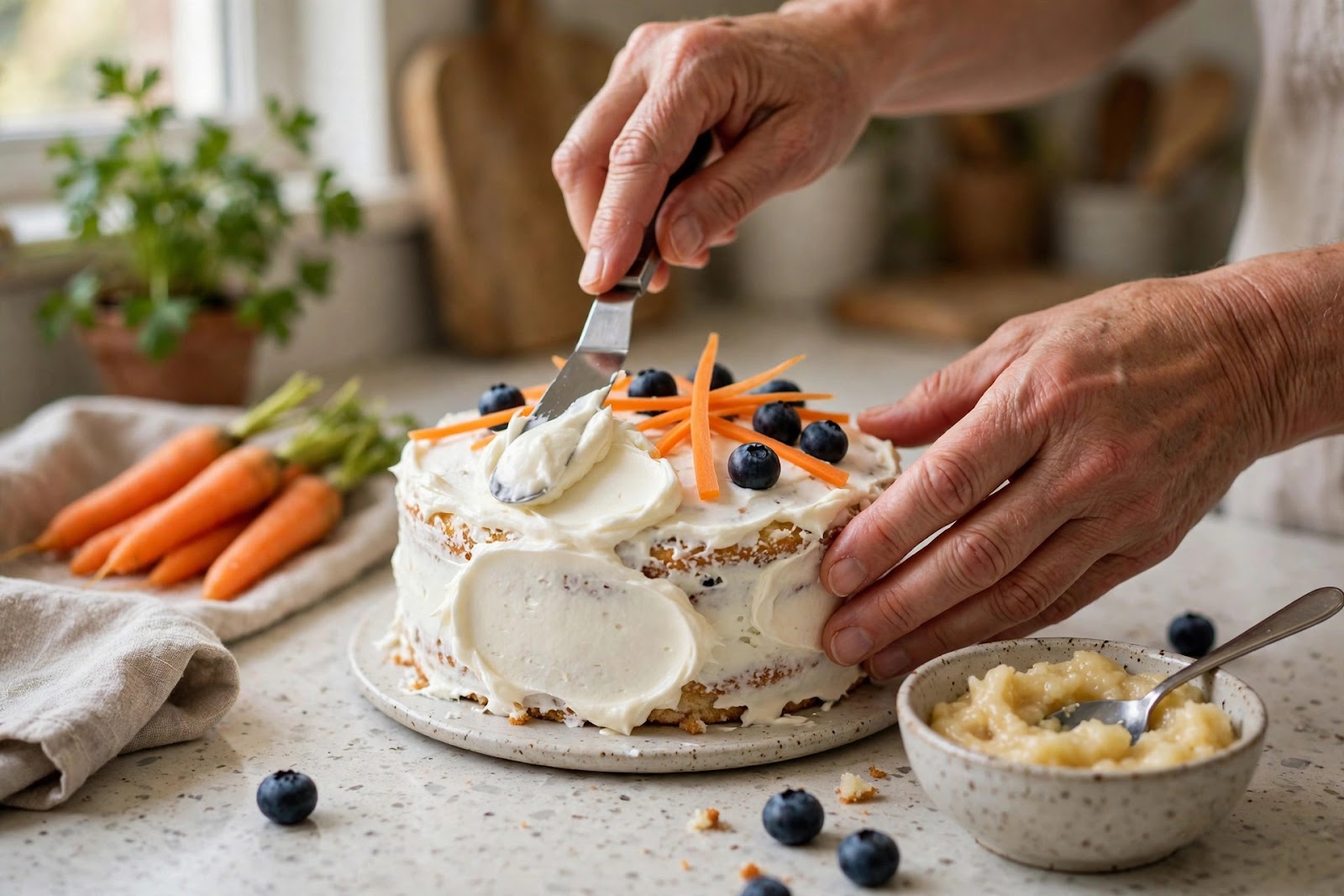
What I use now is much simpler. Half a cup of plain yoghurt, the thick Greek kind, mixed with two tablespoons of peanut butter. Stir it until it's smooth and spreadable, then spread it on the cold cake with a butter knife. It holds its shape, it tastes like something Milo loves, and it doesn't melt all over the table. If the kitchen is warm, I pop the frosted cake in the fridge for twenty minutes before serving, and it firms up nicely.
For decoration, I keep it simple and edible. Thin carrot sticks arranged in a star on top. A few blueberries pressed into the frosting around the edge. A sprinkle of his normal kibble, because Milo considers kibble a garnish now and I'm not going to argue with him. I tried a bone-shaped biscuit on top one year, and it looked great in photos, but Milo ate the biscuit and ignored the cake for five minutes, so I don't bother anymore. The cake is the star. Everything else is just for the photo.
One warning about frosting. Don't use the frosting you have in the cupboard for human cakes. The tubs of ready-made icing are full of sugar, and the chocolate ones are obviously out. I keep a separate little pot of the yoghurt and peanut butter mix in the fridge, labelled in my head as Milo's, and I never mix the two up. It takes two minutes to make. There's no excuse for the sugary shortcut.
The ingredient I never use again
Here it is. The one I promised in the title. In year two, I made the cake with a jar of peanut butter I'd bought on offer. It was a light version, low sugar, and I thought I was being clever. Milo ate his slice happily. An hour later he was sick. Not a little sick. Properly sick, three times, all over the rug I had only just cleaned.
I panicked. I rang my sister, who has had dogs for twenty years, and she asked me one question. Does the peanut butter have xylitol in it? I didn't know what xylitol was. I went to the kitchen, pulled the jar out of the cupboard, and there it was, right there in the ingredients list in tiny print. Xylitol. A sweetener used in sugar-free peanut butter, sugar-free gum, and some low-sugar spreads. And it is dangerous for dogs. Really dangerous. Even small amounts can make a dog very ill, very fast.
I didn't wait around. I rang the vet, explained what had happened and how much he'd eaten, and they told me to bring him in straight away. Milo was fine, thank goodness. The amount he'd eaten was small, a single slice of cake, and the vet said we'd caught it early and his size worked in our favour. They kept him for a couple of hours, gave him something to settle his stomach, and sent us home with strict instructions and a bill that wiped out any savings from that cheap jar of peanut butter.
I threw the jar away that night. Every jar since then, I read the label in the shop before it goes in the basket. I check for xylitol, and I also check for birch sugar, which is another name for the same thing. I buy the plain, full-fat peanut butter with two ingredients on the label. Peanuts and salt. Sometimes just peanuts. It costs a pound more. I don't care. That one scare taught me more than any article ever could. Read the label. Every single time. Even if you've bought the same brand for years, because recipes change and new jars appear on the shelf without warning.
If you take one thing from this article, take that. Check the peanut butter. Then check it again when you get home. And if anyone else in your house bakes with the dog's ingredients, tell them. My husband once nearly grabbed the wrong jar for Milo's cake because the two jars looked identical from the front. Now the dog jar lives on a different shelf, with a strip of tape on the lid. It looks silly. It works.
How the birthday actually goes
Milo's birthday is in April, which means the garden is usually just about usable. I bake the cake in the morning while he watches from his bed, and I let him lick the spoon. Not the bowl, because raw egg, but the wooden spoon after I've scraped most of the batter off. He considers this his job now. He sits by the dishwasher and waits for it.
We do the cake in the afternoon, in the garden if it's dry, in the kitchen if it's not. I put the cake on a plate on the floor, light one candle, and sing happy birthday. Milo does not care about the song. He cares about the candle, which he tries to sniff, and the cake, which he can smell from three feet away. I blow the candle out fast, take the photo, and then cut him a slice about the size of my palm.
That's his portion. Not the whole cake. A dog cake is a treat, not a meal, and Milo still gets his normal dinner that evening, just slightly smaller. The rest of the cake goes into the fridge in slices, and he gets one slice a day for the next three days. By day four it's gone, and he's back to normal biscuits. I don't give him cake every day of the year. Birthdays are special because they're rare. If every day were cake day, cake day would mean nothing.
What I'd change if I started again
If I could go back to year one, I'd do two things differently. First, I'd buy a proper small cake tin from the start. I used a loaf tin the first year because it was what I had, and the cake came out shaped like a brick. Milo didn't mind. I minded, because the photos looked like I'd baked him a doorstop. A seven-inch round tin costs about five pounds and makes the whole thing look like an actual cake. Worth it.
Second, I'd write the recipe down. I spent the first two years trying to remember how much flour I'd used, guessing every time, and every cake came out slightly different. One was too dry. One sank in the middle. Then I wrote it on an index card and stuck it inside the cupboard door. Now it's the same every year, and the only thing that changes is the decoration. Write it down. Future you will be grateful.
The cost, the time, and the mess
People ask me if it's worth the effort, and here's the honest maths. The ingredients cost me about four pounds, and I usually have most of them already. The baking takes thirty minutes, plus ten minutes of cooling and five minutes of frosting. The washing up takes another ten minutes, because banana batter sticks to everything. All in, it's about an hour of my day, once a year.
The mess is real, though. Flour on the floor. Banana on the worktop. A dog-shaped trail of crumbs across the kitchen. I clean up after Milo goes to sleep, and by then I've usually eaten a slice of the cake myself, because it's genuinely nice. Banana, peanut butter, carrot. It's a perfectly good human cake too. Milo and I share the first slice every year, sitting on the kitchen floor, and that's the best part of his birthday. Not the photo. Not the candle. Just the two of us, eating cake on the floor, like we have every year since he was one.
One last thing about the candle
I use one candle, every year, no matter how old he gets. Five candles on a small cake would be a fire hazard and a melted mess, and Milo would try to eat them. One candle, one wish, one photo. I make the wish for him, because he can't. I wish for another year of walks, another year of muddy paws and stolen socks, another year of him flopping on my feet while I work. It's a small wish. It's the only one that matters.
If you bake a cake for your dog this year, start with the peanut butter check, write the recipe down, and let the cake cool properly. The rest is just a happy afternoon in the kitchen with a dog who thinks you're the best person in the world. And honestly, on his birthday, you are.


