The First Night He Ignored His Own Name
Milo came home on a rainy Saturday in March, eight weeks old, small enough to fit in the crook of my arm, and smelling faintly of his breeder's house. We'd picked his name weeks before — Milo, because it sounded friendly and it was short enough to shout across a park — and I spent the whole first evening saying it to him like a spell. Milo. Milo, look. Milo, come here. Milo, no, not the cable. Milo, Milo, Milo.
He ignored every single one. Not in a rude way. In the way that only a puppy can, which is total, cheerful indifference. He sniffed the rug. He fell over his own feet. He fell asleep in the middle of the living room floor with his head on my shoe, and I sat there wondering if we'd picked a name he simply didn't like, or if puppies come with a delay, like a parcel that hasn't arrived yet.
The next morning I said his name about forty times before breakfast. He looked at me exactly twice, and both times it was because I'd waved a bit of chicken under his nose at the same moment. I felt a bit silly, honestly. I'd read three books and watched a dozen videos before he arrived, and I was sure I knew how this worked. Say the name, give a treat, repeat. But in practice, I was just a woman in her kitchen saying a word to a puppy who was busy eating the skirting board.
What I didn't understand then — and what took me three days to figure out — is that a puppy doesn't know his name is his name. To him, "Milo" was just a sound humans made, no different from the kettle or the radio. My job wasn't to say it louder or more often. My job was to teach him that this particular sound meant "look at me, something good is happening," and that it was the best sound in the world. Once I stopped talking at him and started playing a game with him instead, everything changed.
The Game: Say It Once, Pay for the Look
The game is called the name game, and it takes about five minutes per session, which is lucky, because a puppy's attention span is roughly the length of a sneeze. Here's how it works. You wait until your puppy is doing something else — sniffing the floor, looking out the window, chewing a toy — anything except looking at you. Then you say his name once. Just once, in a bright, cheerful voice. Not loud, not stern, just happy.
The moment he turns his head toward you — even a tiny flick of an ear counts in the early days — you say "yes" in a bright voice and give him a treat. Not a dry biscuit. Something small and smelly and wonderful. I used tiny bits of cheese and chicken, cut up into pieces the size of a pea. He gets the treat, he gets a fuss, and then you let him go back to whatever he was doing. Then you wait a minute and do it again.
That's the whole game. Say the name once, pay for the look, let him go. Ten rounds per session, three sessions a day, and I did it for three days straight. Morning, after his breakfast. Midday, while the kettle was boiling. Evening, before his last toilet trip. I kept a little bag of treats in my pocket all weekend, which made me feel like a very strange person, but it meant I was always ready when he wandered off and gave me a chance to play.
The most important part is the "say it once" bit. If you say his name five times in a row — Milo, Milo, Milo, Milo, Milo — you're teaching him that the first four don't count, and he can safely ignore you until number five. I know, because I did exactly that on the first day, out of pure habit. I caught myself doing it, stopped, and started again properly. One call, one look, one treat. It feels slow. It's not slow. It's the fastest way there is.
Day One: Nothing Happened (and That Was Fine)
Day one was mostly a disaster, and I want to be honest about that, because if your first day looks like mine did, you might think the game doesn't work. In the morning session, I said his name ten times and he looked at me twice. Both times were accidents — once because I sneezed right after saying it, and once because the treat bag rustled. I gave him the treat both times anyway, because the rule is that you pay for the look, no matter why it happened.
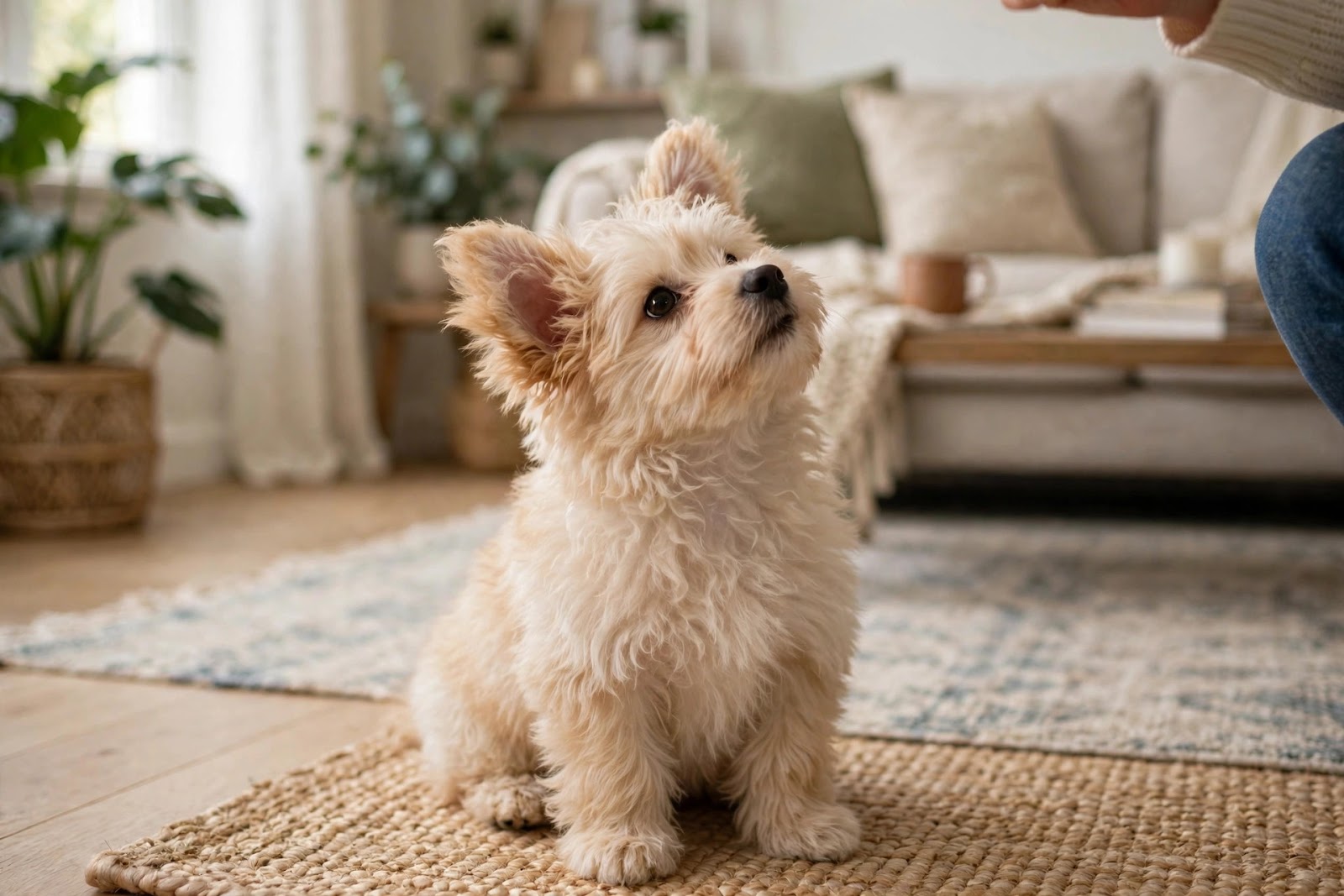
The midday session was worse. He was sleepy after his lunch, and he spent the whole five minutes curled up under the coffee table, snoring softly, while I sat on the floor saying his name to a sleeping puppy like an idiot. I stopped after four rounds and let him sleep. Puppies need about eighteen hours of sleep a day, and a tired puppy learns nothing. That was my first real lesson: short sessions, and only when he's awake enough to care.
By the evening session, something shifted. I said his name, and his ear twitched. Not a full head turn, just an ear. I said "yes" and gave him the chicken anyway, because an ear twitch is a puppy saying "I heard that." Then I said it again, and this time he actually turned his head, just a little, and looked at me with one sleepy brown eye. I made such a fuss of him that he woke up properly, tail wagging, and came over to see what all the excitement was about. That was the first real win, and I wrote it down in my phone like a scientist recording a breakthrough.
Looking back, day one wasn't a failure at all. It was the day he started to connect the sound to the reward, even if the connection was faint and wobbly. Learning isn't a straight line with puppies. It's more like a dripping tap — nothing, nothing, nothing, and then suddenly the whole sink is full. Day one was the dripping part.
Day Two: The Head Turn
Day two was when it clicked. I woke up, made coffee, and Milo was sniffing the kitchen floor. I said his name once, and his whole head came around. Not slowly, not reluctantly — he spun toward me like someone had called his number. I said "yes," gave him the chicken, and he did a little excited bounce, the one where his front paws leave the ground for a second. I nearly dropped the treat bag.
We did ten rounds that morning, and he looked at me nine times out of ten. The one miss was when the postman knocked on the door, and honestly, I don't blame him — a knock at the door beats a name game every time. After the session, I tried it from further away. I stood in the hallway, out of sight, and called his name. He came trotting around the corner, tail wagging, looking for the chicken. I gave him three pieces for that one, because coming to find me was a step beyond just turning his head.
That afternoon I took the game outside, into the garden, where there are smells and sounds and a fence to sniff. He was slower there — five looks out of ten — but that was fine, because the garden is harder than the kitchen, and five out of ten on hard mode is still a pass. I didn't push it. I kept the sessions short, kept the treats coming, and ended every session while he was still keen, not after he'd got bored. Ending on a win matters more than squeezing in one more round.
By the evening of day two, he was responding to his name about eight times out of ten indoors, and I started to notice something else. He wasn't just looking at me for the treat. He was looking at me like I was interesting. Like my voice was worth paying attention to. That's the real prize of the name game — not the head turn, but the fact that your puppy starts to think you're worth listening to.
Day Three: The Name Actually Meant Something
Day three felt like a different dog. I called him from the kitchen while he was playing with a toy in the living room, and he dropped the toy and came running. Not walking, not ambling — running, ears flopping, straight to my feet, looking up at me with his whole face. I gave him the biggest fuss of the weekend, and he leaned against my legs like he was proud of himself.
I tested it in the garden again that morning, and he got eight out of ten. Then I tried something harder. My sister came round in the afternoon, and I called him while she was talking to him in a silly voice and waving a toy. He looked at her, looked at me, and came to me. I don't think I've ever been prouder of a small creature in my life. Three days. Three days of saying one word and paying for a look, and his name had gone from background noise to the most important sound in his world.
We kept the game going for another week after that, but by then it was just maintenance — a few rounds a day, in different rooms, at different distances, sometimes with a distraction in the room. I also started pairing his name with other good things. His name, then his dinner bowl. His name, then the lead for a walk. His name, then a game of tug. His name became the sound that meant good things were about to happen, and that's a habit that pays off for the rest of his life.
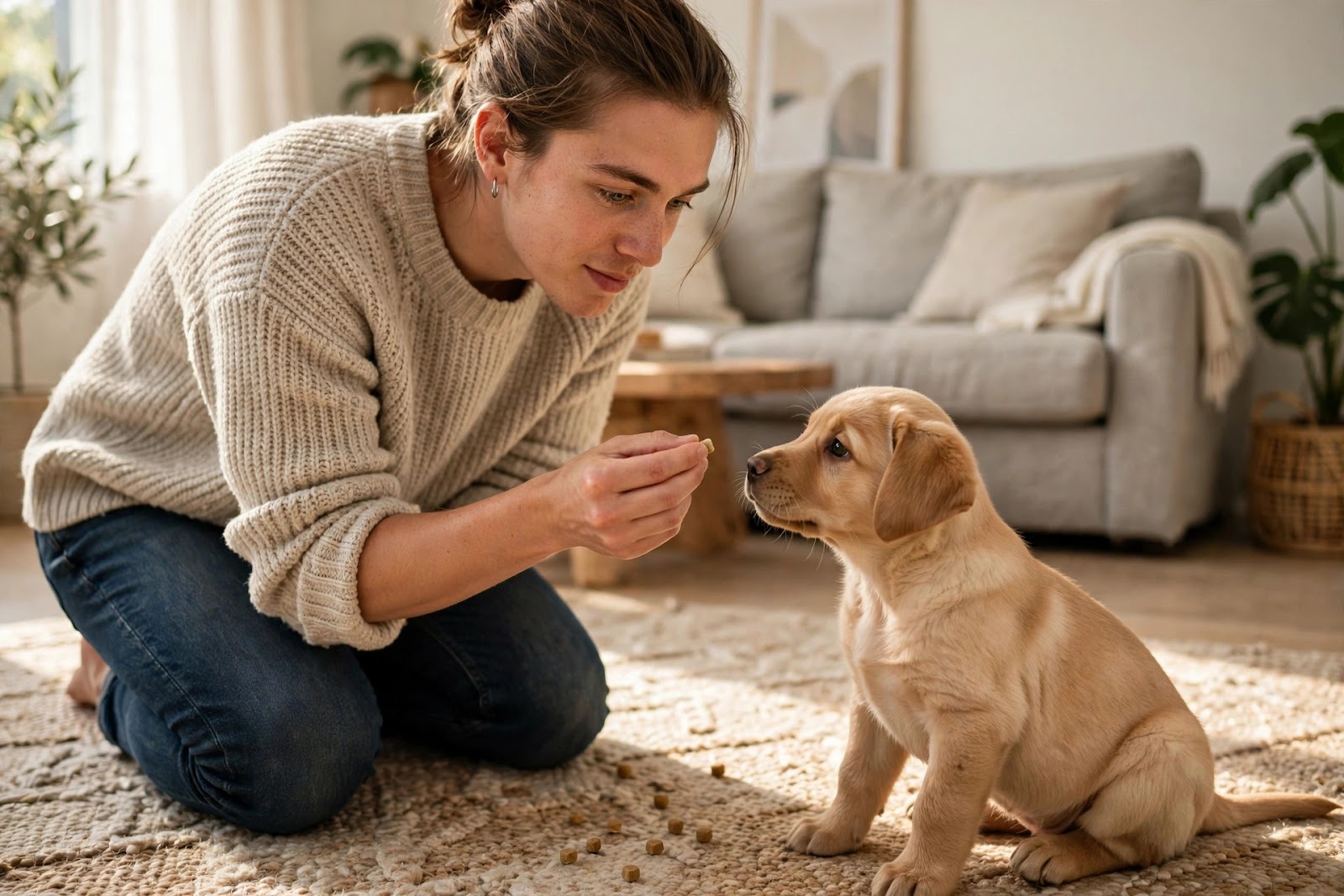
The whole thing cost me a bag of treats, a weekend of carrying chicken in my pocket, and about fifteen minutes a day. That's it. No classes, no special equipment, no shouting. Just one word, said once, paid for every single time.
What His Name Unlocked Next
Here's the part nobody told me before we got a puppy: teaching him his name wasn't just about the name. It was the foundation for everything else. Once Milo knew that his name meant "look at me," every other thing I wanted to teach him got easier, because I could get his attention first. Sit, wait, come — all of them start with a dog who's looking at you, and the name game is what built that habit.
The first time it really paid off was about a month later, at the park. Milo was off the lead, sniffing a bush about twenty feet away, and I called his name once. He turned, saw me, and came trotting back, tail wagging, like we'd been playing the kitchen game all along. I gave him the chicken and stood there grinning like an idiot, because that moment — a dog choosing to come back to you in a big, distracting world — is the whole reason the three days in the kitchen mattered.
It also made the hard days easier. Puppies get into everything. They chew things they shouldn't, they run toward roads, they pick up things off the pavement that you really don't want in their mouths. Having a name he actually answers to means I can interrupt him before the trouble starts, instead of chasing him after it. That's worth more than any trick or command I could have taught him first.
The Three Mistakes That Undo It All
Before I finish, here are the three mistakes that will wreck all of this work if you let them creep in, because I made two of them myself in the weeks after the name game, and I had to fix them.
Mistake one: using his name when you're cross. Milo chewed my favourite book once — a paperback I'd been halfway through — and I shouted his name in that sharp, angry voice we all have. He froze, ears back, and hid under the table. I felt awful, and I was right to. If his name only ever means good things, then shouting it when you're angry teaches him that his name sometimes means trouble, and he'll start hesitating before he looks at you. When he does something wrong, use a different sound — a calm "ah ah" or just go and deal with it quietly. His name stays clean. That's the rule, and I follow it even when he's just eaten my book.
Mistake two: saying it over and over when he doesn't respond. He'll have off days. There will be a moment at the park when he's nose-deep in something wonderful and your first call does nothing. The temptation is to say it again, louder, then again, then again. Don't. Say it once. If he doesn't look, go closer, or wait, or make yourself interesting some other way. Every time you repeat his name, you're teaching him that the first call is optional, and that lesson is much harder to unteach than it was to teach.
Mistake three: only using his name when you want something. If the only time he hears "Milo" is when you need him to come inside, or stop barking, or leave the cat alone, his name becomes a chore list. I say his name dozens of times a day now, and most of the time it's just because he's being good — he's lying quietly, he's waiting nicely, he's just walked past the bins without eating anything. His name, then a treat, then nothing at all. Just a little reminder that his name is a good sound, and that I'm paying attention to him even when he doesn't need to do anything.
That's really the whole secret. A puppy's name isn't a command. It's an invitation. Say it once, make it worth answering, and never, ever use it to scold. Do that for three days, and you'll have a puppy who turns to you like you're the best thing in the room. Because to him, for those three days at least, you are.


