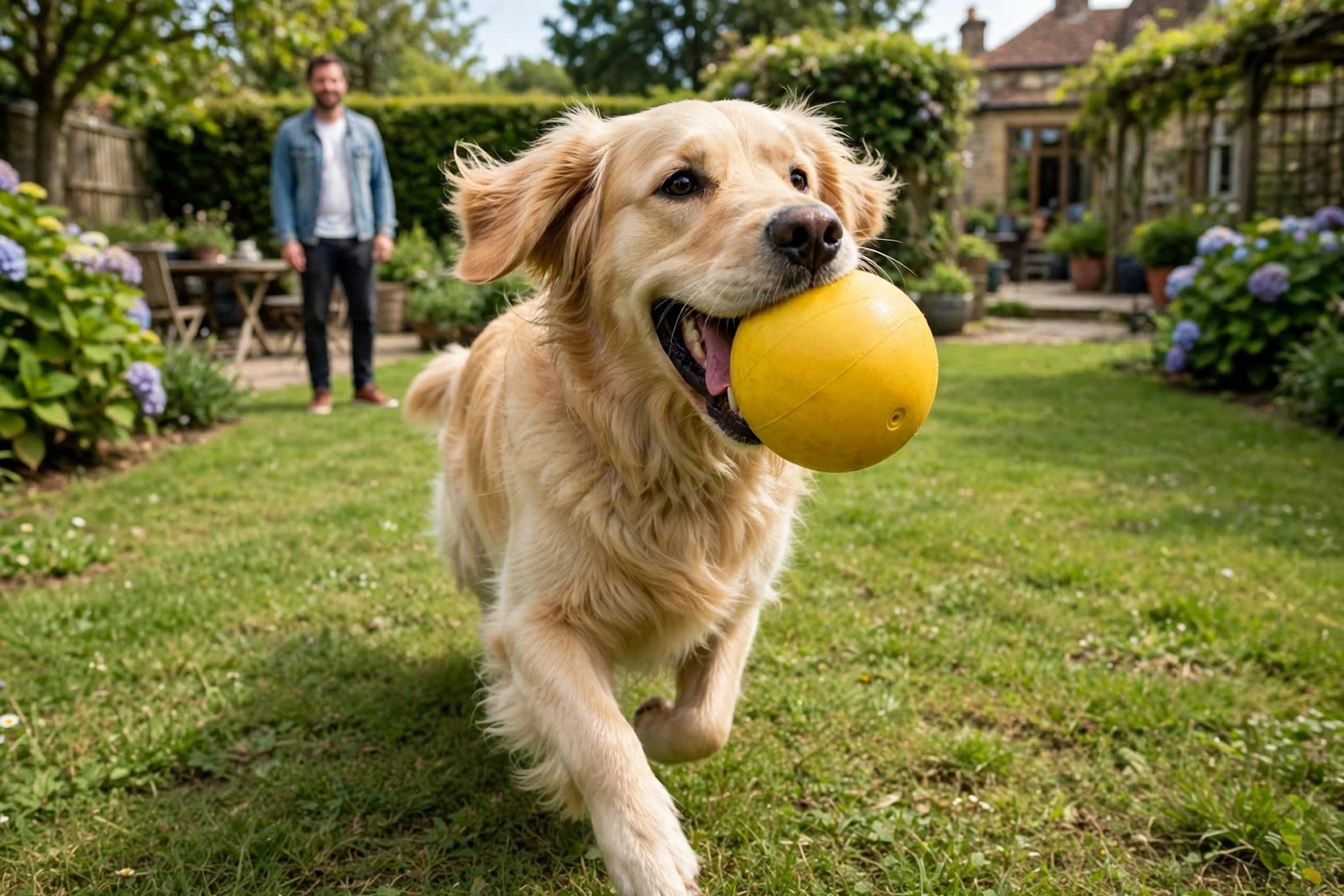
Fetch should be the simplest game in the world. You throw the ball. The dog brings it back. You throw it again. That's the deal. Except Milo never read the contract. For the first year of his life, fetch in our house went like this. I threw the ball. Milo sprinted after it like it was the most important thing in the world. He picked it up, turned around, ran back toward me, and then stopped about ten feet away. He dropped the ball. Or worse, he didn't drop it. He stood there with the ball in his mouth, tail wagging, daring me to come and get it. If I walked toward him, he ran away. If I stood still, he dropped the ball, waited until I bent down, and then snatched it back up again. We weren't playing fetch. We were playing keep-away, and Milo was winning every single time.
I tried everything people suggested. I tried ignoring him. He just lay down with the ball between his paws and chewed it. I tried offering a treat, and he dropped the ball, ate the treat, then picked the ball up again before I could grab it. I tried a second ball, and he ran off with both of them. I tried chasing him, which was the worst idea of all, because now the game had a new rule. The human chases the dog, and the dog is the fastest thing in the garden. By the end of the first summer, I had a dog who could catch a ball brilliantly and a game that lasted exactly one throw.
The fix took me three weeks. Not three days, like the videos promise. Three weeks of short sessions in the garden, five minutes at a time, and one small change that made all the difference. I stopped trying to take the ball from him, and I started teaching him that bringing it back was better than keeping it. Here's how it actually went, mistakes included.
The first mistake: chasing him
Let's start with the mistake, because it's the one nearly every dog owner makes, and I made it for months. Milo runs away with the ball. I run after him. It feels natural. You're trying to get your ball back, and he's right there, ten feet away, grinning at you with a tennis ball in his mouth. Of course you walk toward him.
But think about it from his side. You threw the thing. He caught it. Now you're running toward him, excited, arms out, making encouraging noises. To a dog, that's not a person asking for the ball back. That's a person joining the game. You're the second player in keep-away now, and you're terrible at it, because you have two legs and he has four. Every step you take toward him teaches him that running away works. The ball stays his. The game gets longer. You get more tired. He gets more delighted.
I realised this on a wet afternoon in October. Milo had the ball, I had mud up to my knees, and he was doing laps of the garden while I stood in the middle, out of breath, holding my sides. He stopped at the far end, dropped the ball, and looked at me. Then he picked it up again and did another lap. That was the moment I understood. I wasn't playing fetch. I was his exercise machine. I went inside, dried off, and decided to stop chasing him for good. From that day on, if he ran away with the ball, the game ended. I turned my back, walked inside, and did something else. It felt rude. It worked.
The hallway version that started it all
The breakthrough didn't happen in the garden. It happened in my hallway, with a soft toy, on a rainy Tuesday when we couldn't go out. The hallway is about twelve feet long, narrow, with a door at each end. There's nowhere to run. That's the point. I chose the hallway because Milo couldn't turn it into a chase. He could run to the end and back, but he couldn't do laps around me. The space did the training for me.
I sat on the floor at one end with a soft rope toy, the one he likes but doesn't love. Not his favourite ball. Not the squeaky duck that makes him lose his mind. A middle-of-the-road toy. I tossed it gently to the other end of the hallway, about eight feet. He ran after it, picked it up, and turned around. And then he did what he always did. He stopped halfway back and stood there, toy in his mouth, waiting for me to come and get it.
This time I didn't move. I sat on the floor, legs out, hands open in my lap, and I waited. I didn't reach for the toy. I didn't call him. I just sat there and looked at the floor between us. Milo stared at me. He took one step forward. Then another. Then he came right up to me and stood over my lap with the toy in his mouth, tail wagging so hard his whole back end was moving. And I did nothing. I waited until he got bored of holding it, and the toy dropped out of his mouth into my lap. The second it landed, I said yes, gave him a piece of cheese, and threw the toy again.
That was the whole lesson. Bring it close. Drop it. Good things happen. No chasing, no grabbing, no wrestling the toy out of his mouth. Just a hallway, a soft toy, and me sitting still like a lump. We did that six times that evening. Six throws, six returns, six pieces of cheese. He'd never brought a toy back six times in a row before. I was grinning like an idiot by the end of it, sitting on the hallway floor in my socks, and Milo was asleep ten minutes later. He'd used his brain, and it had tired him out more than a run.
Why the second toy changed everything
The hallway worked, but the garden was a different story. Outside, there was space to run, smells to chase, and a whole world of distractions. The first time I tried the hallway trick in the garden, Milo brought the ball back twice, then grabbed it and ran to the far fence with it. Old habits, wide open space, and I was back to square one.
That's when my sister, who trains spaniels, told me about the second ball. She said, don't try to take the first ball off him. Make the second ball more interesting. It sounded too simple. I bought two identical tennis balls, the cheap ones from the pet shop, bright yellow, same size, same bounce. I threw the first one. Milo ran after it, caught it, and started his usual routine. He stopped ten feet away and waited for me to come to him.
I didn't move. I held up the second ball, waved it, bounced it once on the grass so he could see it move. His ears went up. He looked at the ball in my hand. He looked at the ball in his mouth. And then he dropped the first ball and came running toward me, because the second ball was alive and moving and the first ball was just sitting in his mouth doing nothing. I threw the second ball the moment he got close. He chased it. I picked up the first ball while he was running. When he came back, I showed him the first ball again. Same thing. Drop, chase, swap.
We did that for ten minutes. Ten throws. Ten returns. No chasing, no grabbing, no arguing. The game finally looked like fetch. The secret wasn't a better command. It was a better offer. Dogs don't give up something good for nothing. They give it up for something better, or at least something equally good that's moving. Two identical balls, swapped back and forth, and suddenly Milo was playing the game I thought I'd bought the ball for in the first place.
The words I use, and the ones I dropped
I used to say "give" and "drop it" and "come here" all at once, in a rising panic, while Milo ran away from me with the ball. Three commands, no clarity, and a voice that sounded like I was losing an argument. No wonder he ignored me. He couldn't tell which word mattered.
Now I use one word for the return, and I only say it once. When Milo is coming back toward me with the ball, I say "bring it" in a normal, calm voice. Not shouted. Not repeated five times. Once. When he drops the ball near me, I say "yes" and throw the next one straight away. The throw is the reward. The game continuing is the reward. I save the treats for the early training, and I phase them out once the game is flowing, because the best reward for a ball-obsessed dog is another throw.

The three-week timeline, honestly
People always ask how long it takes, so here's the honest answer. Week one was the hallway. Five minutes a day, soft toy, sitting on the floor, cheese as the reward. By the end of the week, he was bringing the toy straight to my lap eight times out of ten. The other two times, he dropped it halfway and I just waited. No drama. The game paused until he brought it closer.
Week two was the garden with two balls. Ten minutes a day, sometimes less if he lost interest. The first two days were messy. He ran off with ball one twice, and I ended the game both times. I walked inside, put the balls away, and came back an hour later. By day four, he was swapping balls without me having to wave the second one around. By day six, he was dropping ball one at my feet before I even showed him ball two.
Week three was the real test. The park. Other dogs, other smells, a much bigger space, and a ball that could go anywhere. I took both balls, a pocket full of cheese, and low expectations. The first throw went fine. He brought it back. The second throw, he ran to another dog and tried to start a game with them instead. I waited. He came back eventually, ball in mouth, and I threw the second one. By the end of that week, he was fetching in the park about seven times out of ten. The other three times, he got distracted, and I just let the game end. No chasing. No shouting. Just a calm walk home.
The ball I stopped using
One practical thing I learned along the way. I stopped using small tennis balls. Milo is a big dog, and a standard tennis ball fits in his mouth a little too neatly. Twice, he got it wedged at the back of his mouth and had to paw at it to get it out. It scared me both times, and the second time I threw the whole bag of tennis balls in the bin. Now I use the larger rubber balls made for big dogs, the ones that are too wide to get stuck and tough enough to survive his teeth. They cost more, about six pounds each, and I've bought four of them over two years. One of them has a chunk missing from the side, but it still bounces straight, and Milo doesn't care about the chunk.
What fetch looks like now
These days, fetch is our evening ritual. Six o'clock, after dinner, we go into the garden with two rubber balls. I throw the first one, he brings it back, I throw the second, he brings it back. Ten or twelve throws, about fifteen minutes, and then he's had enough. He lies down on the grass with a ball between his paws and chews it quietly while I sit on the step with a cup of tea. That's the game. It's not spectacular. Nobody would film it. But it's ours, and it works, and it took me three weeks of sitting on a hallway floor to get there.
The thing I'm proudest of isn't the fetching. It's that I stopped fighting him. For a whole year, fetch was a battle, and I was losing it, and Milo could tell. The moment I stopped chasing him, stopped grabbing at the ball, stopped repeating commands louder and louder, he started coming to me. Dogs don't want to win against you. They want the game to keep going. Once I understood that, everything else fell into place.
If your dog turns every game of fetch into keep-away, try the hallway. Sit on the floor. Don't move. Wait for the toy to come to you. Then get a second ball, identical to the first, and let the swap do the teaching. It won't work in a day. It might take three weeks. But one evening, you'll throw the ball, and your dog will bring it back, drop it at your feet, and look up at you with his tail going like a windmill, waiting for the next throw. And you'll wonder why you spent a year chasing him around the garden when the answer was sitting still all along.


