Biscuit turned eleven this year, and somewhere along the way our mornings changed. He used to explode out of bed at the first sound of my alarm, ready for a run before I'd even found my slippers. Now he wakes up slowly, stretches one leg at a time, and looks at me with the expression of an old man deciding whether the day is worth getting up for. It usually is — but on his terms, and at his pace.
I fought this change at first. I kept setting the same alarm, offering the same brisk walk, expecting the same dog. He'd go along with it for a while, then spend the rest of the day flat out on the rug, and I realised I was spending his energy in the morning and leaving him with nothing for the afternoon. So I rebuilt our mornings around him: slower, warmer, gentler, with comfort first and exercise second. The difference in his mood has been obvious. He wags more. He chooses to get up instead of being coaxed. And our mornings, which had started to feel sad, feel good again.
Let him wake up on his own clock
The first change was the simplest and the hardest for me: I stopped waking him. Biscuit sleeps in the living room on his bed, and I used to march in at seven, switch the light on, and chirp "walkies!" like a morning television host. He'd haul himself up, stiff and blinking, and we'd be out the door before he'd properly woken up.
Now I get up, make my tea, and wait. He usually wanders into the kitchen within twenty minutes, yawning and stretching, and that's when the day starts. On cold mornings it can take forty minutes. I don't mind anymore. Those forty minutes cost me nothing — I drink my tea, read the news — and they give him a start to the day that doesn't begin with being startled upright.
If your older dog sleeps in your room, the same idea applies: let them stir, stretch, and decide to get up before you clip the lead on. A slow start isn't laziness. It's a body that needs a little longer to get going, and giving it that time sets the tone for everything that follows.
The warm-up lap: inside, before outside
Before we go anywhere near the front door, Biscuit does a slow lap of the flat. Not a formal exercise — just wandering. He checks the kitchen, sniffs the hallway, looks out the back window, and comes back to me. This little ritual does something important: it gets him moving gently, at his own pace, on familiar ground, before he faces steps, curbs, and cold air.
I also started putting his bed somewhere warm. His old spot was by the back door, which is draughty in winter, and I noticed he was slower on cold mornings. I moved his bed to the living room wall near the radiator — not right against it, just in the warm zone — and put a folded fleece blanket on top of his mattress. He settled into the new spot immediately, and his mornings got noticeably easier. Older dogs feel the cold more, and a warm sleeping spot is the cheapest comfort upgrade there is.
Breakfast comes after the lap, not before. He eats better when he's properly awake, and eating on a settled stomach seems to suit him. I split his food into two smaller meals now — half in the morning, half in the evening — because one big bowl in the morning used to leave him sluggish and then hungry by four. Two smaller meals keep his energy steadier through the day. That's just what works for Biscuit; if your dog is happy on one meal, don't fix what isn't broken.
Ramps and steps: the dignity upgrade
This was the change I resisted longest, and the one I'm most glad I made. Biscuit has always jumped onto the sofa and into the car, and I took a stupid pride in the fact that he still could. Then one evening he hesitated at the sofa — just a half-second pause, a little look at me — and I realised he was asking for help and I'd been too proud to offer it.

I bought a set of pet steps for the sofa first: three wide, carpeted steps, about thirty pounds, that sit beside the armrest. He sniffed them suspiciously for two days. On day three, I put a treat on each step, and he walked up them like he'd invented the idea. Within a week, the steps were his normal route, and the hesitation was gone. The sofa is his favourite place in the world, and now he gets there without the jump that was starting to cost him.
The car ramp took longer to accept — mostly for me, if I'm honest. It felt like an admission. But watching Biscuit walk calmly up a ramp into the boot, instead of launching himself and landing with a thud, made me wonder why I'd waited. I got a lightweight folding ramp, about forty pounds, that lives in the boot. It takes ten seconds to set up. He walks up it without a second thought now, and getting out is just as easy.
If you're considering steps or a ramp for your older dog, my advice is to introduce them before your dog desperately needs them. Biscuit learned the steps while he could still jump, so they were a fun novelty, not a scary new thing he had to master while already struggling. Early is easy. Late is stressful.
The slow walk: shorter, sniffier, better
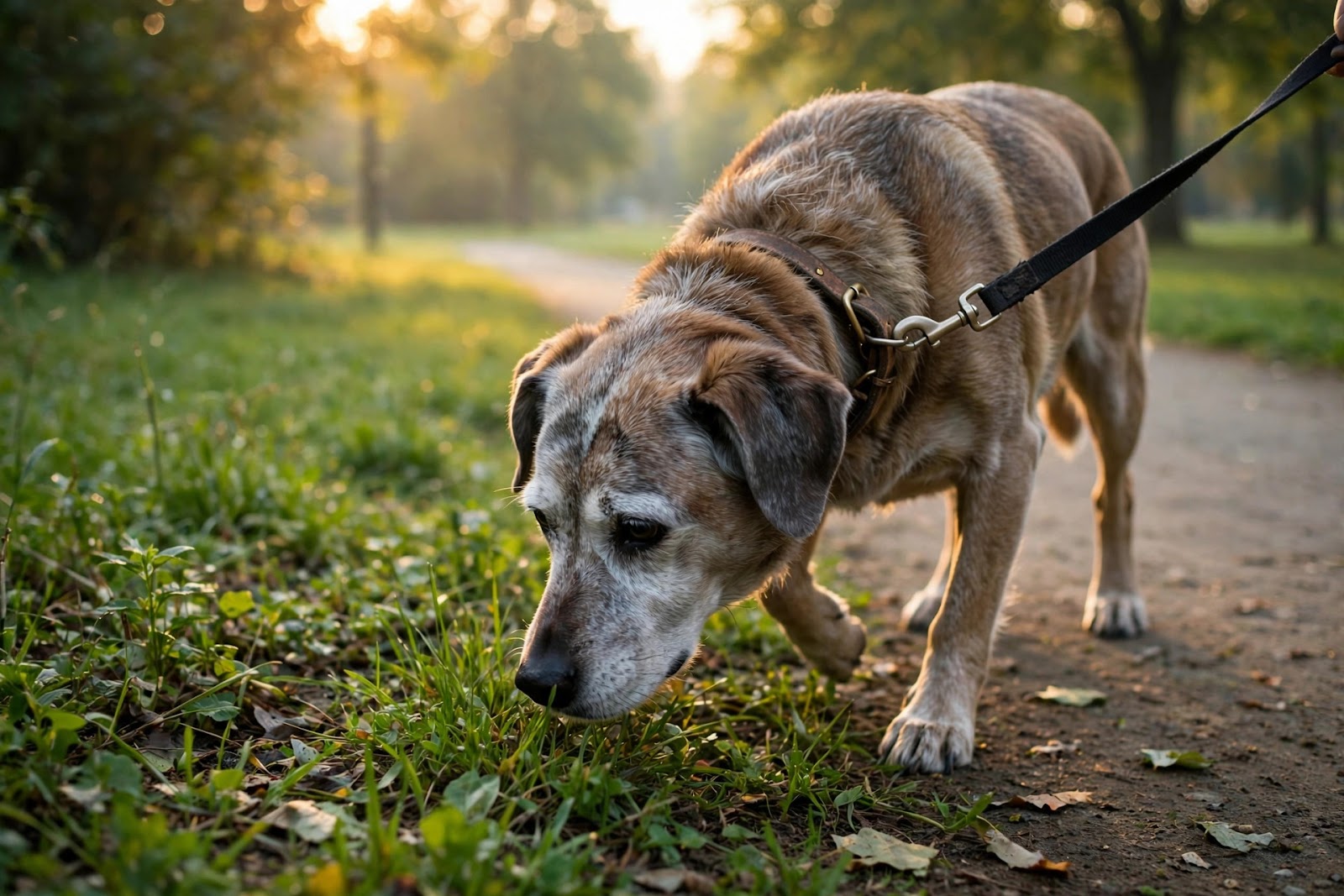
Our morning walk used to be forty-five minutes at a brisk pace. Now it's twenty minutes at whatever pace Biscuit chooses, and honestly, it's a better walk. He sniffs everything. I mean everything — every lamppost, every patch of grass, every spot where another dog has been. It used to drive me mad. Now I understand that sniffing is his newspaper, his social media, his whole morning briefing. A walk where he sniffs for fifteen minutes and walks for five is a walk well spent.
I plan the route around comfort. We avoid steep hills and busy roads with high curbs. We go to the quiet park with the flat path and the bench where I can sit if he wants to stop. And stopping is allowed, always. If he sits down halfway round, we sit. If he wants to turn back after ten minutes, we turn back. The walk is his, not mine, and the days I let him decide are the days he comes home happiest.
One practical thing that helped: a harness instead of a collar for walks. Biscuit never pulled much, but on a collar, any sudden stop or stumble put pressure on his neck. A well-fitted harness spreads the pressure, and he walks more confidently in it. I had him measured at a pet shop — took five minutes, and the staff adjusted the straps properly. If your older dog still walks on a collar, a harness is worth trying, if only for the days when they're a bit wobbly.
The morning check-in I do without thinking
Every morning, while Biscuit eats, I do a quiet once-over. Not a medical examination — just paying attention, the way you'd notice a friend limping. I watch how he walks to his bowl. I notice if he's favouring a leg, if his eyes look cloudy in bright light, if he's drinking more or less than usual. I run a hand over his coat and feel for any new lumps or tender spots. It takes about a minute, and it means I notice changes early instead of realising three weeks later that something has been different for a while.
I keep a little notebook by the fridge — nothing fancy, just dates and notes. "Monday: slow on stairs, fine after. Wednesday: ate slowly, finished it all. Friday: extra sleepy after the park." It sounds obsessive, but when I talk to our vet, I can say exactly when something changed instead of guessing. Vets love specifics, and so do I, now that I've seen how quickly I forget the details otherwise.
This is the part where I have to be clear: I'm not a vet, and this routine isn't medical advice. It's just what a regular owner does to stay tuned in to an old friend. Anything that worries me — a limp that lasts more than a day, a sudden change in appetite, anything new and unexplained — goes straight to the vet, not to the internet. The notebook helps the vet. It doesn't replace the vet.
The little comforts that add up
Beyond the big pieces — the slow start, the steps, the gentle walk — there's a collection of small changes that each made a tiny difference and together made a real one. None of them cost much, and none of them required a trip anywhere special.
First, rugs. Our hallway is laminate, and I'd noticed Biscuit's back legs slipping slightly when he turned quickly. I bought two cheap runners, one for the hallway and one by the back door where he comes in from the garden. The slipping stopped immediately, and he walks through the house with more confidence. Slippery floors are tiring for an older dog because every step takes extra effort to stay steady. A rug fixes that for the price of a takeaway.
Second, a night light. Biscuit sometimes gets up in the night for water, and in a dark house he used to bump into the coffee table. A small plug-in light in the hallway — the kind that costs a couple of pounds — means he can find his way to the water bowl and back to bed without a collision. It's a tiny thing, but his night-time restlessness dropped noticeably once he could actually see where he was going.
Third, I moved his water bowl closer to his bed. It used to live in the kitchen, which meant a walk across the flat every time he was thirsty. Now there's a bowl in the living room near his bed and one in the kitchen, so water is never far away. He drinks more steadily through the day, and I top both bowls up every morning as part of the routine.
Fourth, grooming became part of the morning, not a separate chore. Two minutes with a soft brush while he eats his breakfast — gentle, slow strokes — keeps his coat in good shape and gives me another chance to notice anything new. He leans into it now, which tells me it feels good rather than being something he tolerates. For a long-coated older dog, a quick daily brush also stops the mats that build up when a dog sleeps more and moves less.
None of these changes is dramatic on its own. Together, though, they turned our house into a place that's easy for an old dog to live in. I think of it like this: every small friction I remove — a slippery floor, a dark hallway, a distant water bowl — is energy Biscuit gets to spend on something he enjoys instead, like his walk or greeting a visitor. Comfort isn't indulgence. It's the foundation everything else sits on.
Afternoon naps are part of the routine, not a problem
The last piece of our morning routine is accepting what comes after it: Biscuit sleeps most of the afternoon. For a while, I worried about this. Was he bored? Was he depressed? Was he giving up? Then I watched him properly. He sleeps deeply, twitches his paws in dreams, wakes up for visitors with a wagging tail, and is ready for a gentle evening wander. He's not giving up. He's an old dog who needs more rest, and he's taking it.
So the routine now includes protected nap time. No hoovering next to his bed, no kids' friends charging through the living room at two in the afternoon if I can help it, and his bed stays in its warm, quiet spot all day. I think of it as part of the morning routine's payoff: a good slow morning earns a good long nap, and a good long nap means a pleasant evening.
What our mornings look like now
Seven-ish, I get up and make tea. Biscuit wakes in his own time and finds me in the kitchen. He does his lap of the flat, eats half his breakfast, and we head out for a slow twenty-minute walk with plenty of sniffing. Home again, he climbs his steps onto the sofa, and we sit together while I read. By late morning, he's asleep in his warm spot, and I'm getting on with my day knowing he's comfortable.
It's a smaller morning than we used to have. No runs, no long hikes before work, no frantic energy. But Biscuit is eleven, and he has earned the right to take his time. The gentler routine didn't just make his days better — it made mine better too. I stopped measuring our mornings against the dog he was at three, and started enjoying the dog he is now: slower, greyer, softer, and still, every single morning, pleased to see me.


