I used to think my dog's water bowl was clean because the water in it looked clear. I'd top it up every morning, give it a quick rinse when I remembered, and call it done. Then one day I ran my finger around the inside of the bowl and felt it: a thin, slippery film, like the inside of a vase that's sat too long. The water looked fine. The bowl was not fine at all.
That slimy layer has a name — biofilm — and it's just a thin coat of bacteria and bits of food that builds up on any wet surface. It builds up fast, too. In a bowl that's only ever topped up and never scrubbed, it's there within a day or two. My dog drinks from that bowl a dozen times a day. He licks it, drops kibble in it, and dunks his whole muzzle in it after a walk. Once I felt that slime, I couldn't un-feel it, and the bowl got a proper wash that same morning.
This is not a scary story. It's a two-minute habit story. A clean bowl, fresh water, and a quick daily scrub changed nothing about my dog's day and everything about how I felt about it. And the funny part is how easy it was to fix once I stopped assuming clear water meant a clean bowl.
The day I actually looked
The moment that changed things was embarrassingly small. Milo had finished his dinner, trotted over to his bowl, and drank for a long time, the way dogs do after a dry meal. Then he stopped, sniffed the bowl, and walked away from a bowl that was still half full. He'd never done that before. I picked the bowl up, tipped the water out, and looked at it properly for the first time in months.
There was a faint pink tinge around the water line, and that slippery film all the way round. I'd been rinsing it under the tap and thinking that counted as cleaning. It doesn't. A rinse moves the water around. It doesn't remove the film. You need a brush and a bit of effort for that, and I'd been skipping it for weeks.
I washed it that night with hot water, washing-up liquid, and a brush, rinsed it until it squeaked, and filled it fresh. The next morning Milo drank like normal. Maybe it was a coincidence. Maybe he was just thirsty. But I decided that day that the bowl would get a real wash every single day, the same way his food bowl does. I don't know why I'd treated the water bowl as different. Food bowls get washed after every meal without a second thought. Water bowls somehow got a free pass, and that made no sense at all.
What I do now, every day
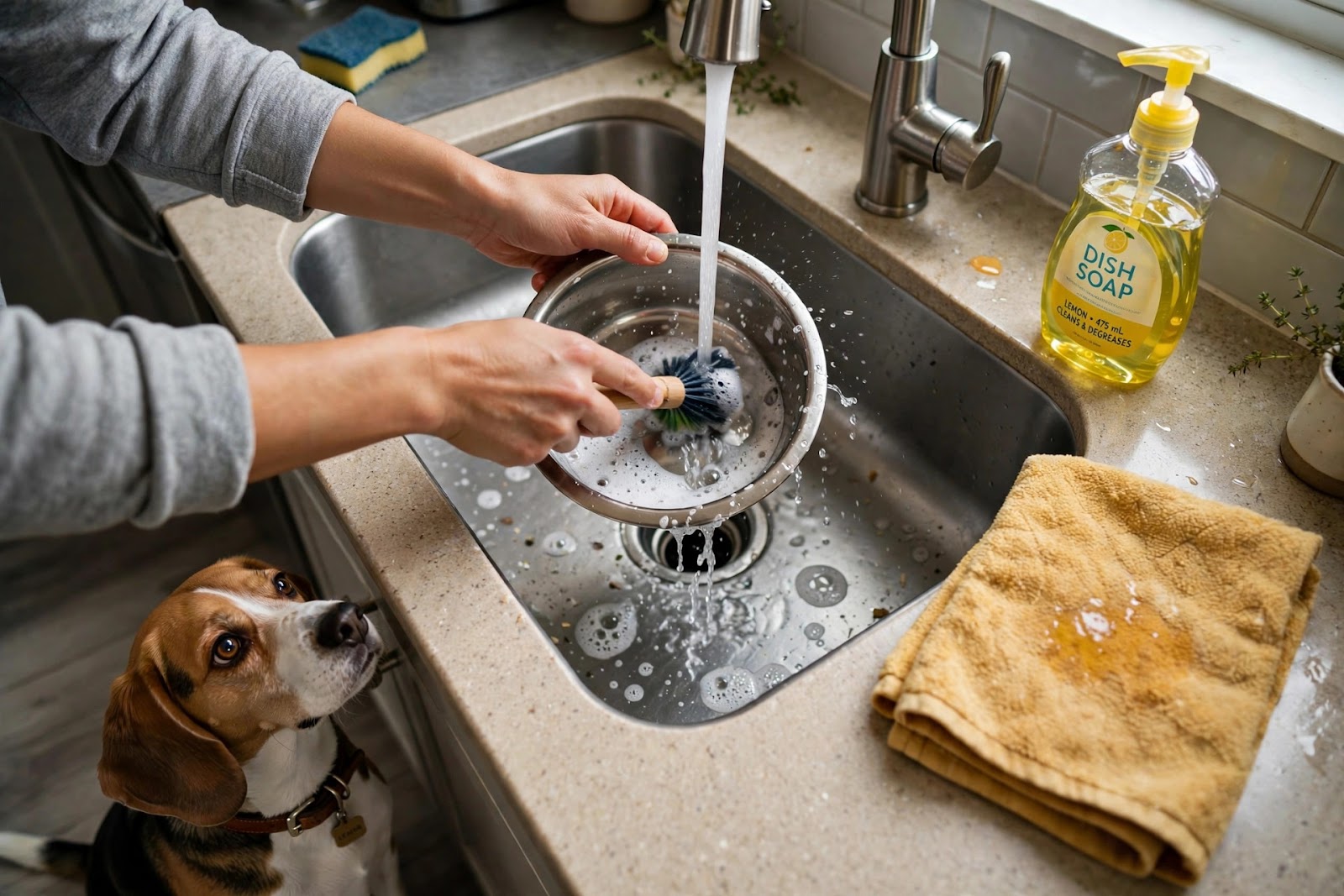
The routine is simple enough that I can do it half asleep, which is when I usually do it. First thing in the morning, I tip out whatever water is left, even if it looks clean. Old water goes down the sink. Then I wash the bowl with hot water and a drop of washing-up liquid, using a small brush that lives by the sink just for the dog bowls. I scrub the inside, the rim, and the base. The rim matters — that's where his mouth touches, and that's where the film builds up thickest.
Then I rinse it properly. This is the part people rush, and it's the part that matters most. Soap left in a bowl puts dogs off drinking, and I don't blame them. I rinse under a running tap until the water runs clear and the bowl feels clean, not slick. Then I fill it with fresh cold water and put it back in its spot. The whole thing takes about two minutes, and most of that is the rinse.
In the evening I do a lighter version: tip, quick scrub, rinse, refill. If it's been a hot day or Milo's been out running, I'll swap the water mid-afternoon too. Dogs drink more when the water is fresh and cool, and less when it's warm and stale. That's not a study, that's just watching my own dog for years. On hot days his bowl gets fresh water three or four times. It costs nothing but a minute of my time.
I keep a second bowl in the cupboard. When one is in the dishwasher — yes, the steel bowl goes in the dishwasher once a week — the spare takes its place. No excuses, no "I'll wash it later" days. The spare bowl is the whole secret to never skipping. If washing the bowl means the dog has no water for an hour, you'll skip it. If there's a clean spare ready to go, you won't.
Steel, ceramic, or plastic?
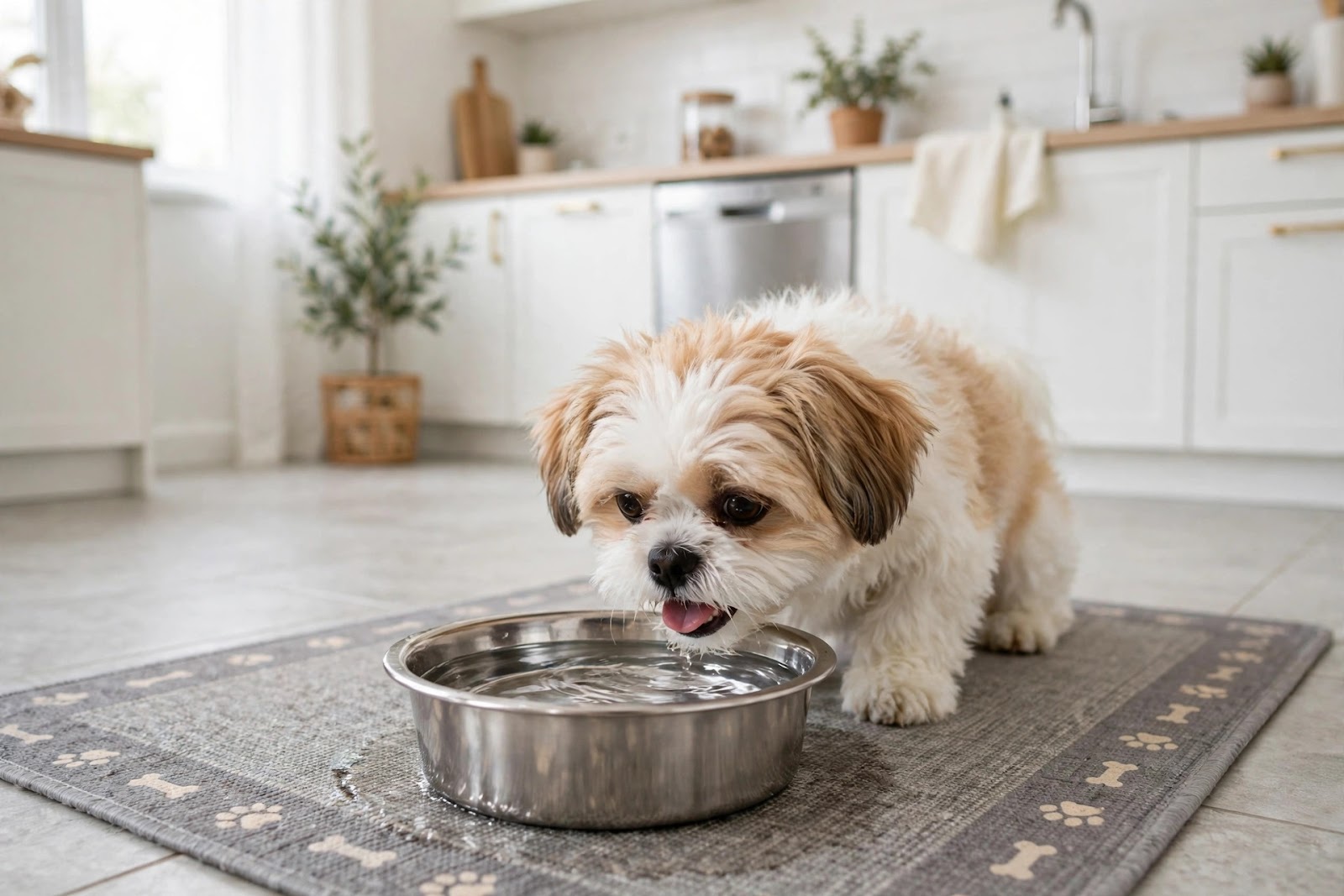
I switched to stainless steel years ago and I've never gone back. It's the easiest to clean, it doesn't hold smells, and it survives being knocked across the kitchen floor, which happens more often than I'd like to admit. Milo once dragged his bowl halfway across the room by the rim. A ceramic bowl would have smashed. The steel one just got a dent and carried on.
Ceramic is my second choice. It's heavy, so it stays put, and it looks nicer in the kitchen. The catch is chips. A chipped glaze is hard to clean properly, and a cracked bowl can cut a tongue. I check ceramic bowls every time I wash them, running my finger round the rim. The day I feel a chip, that bowl becomes a plant pot and a new one takes its place.
Plastic is the one I avoid now. It's light, it's cheap, and it scratches. Those scratches are the problem: tiny grooves that hold the film and won't come clean no matter how hard you scrub. My old plastic bowl looked clean and still felt slimy in the scratches. I threw it out and never bought another. If plastic is what you have, replace it often and scrub it hard, or switch when you can. Your dog won't mind the upgrade.
Whatever the bowl is made of, size matters. Too small and you're refilling it five times a day. Too big and the water sits there going stale. Milo is a medium dog, about twenty kilos, and his bowl holds about a litre. On a normal day I fill it twice. On a hot day, three or four times. A big dog needs more. A small dog needs less. Watch how fast yours empties and pick a bowl that matches. It's a guess the first week and obvious after that.
Where the bowl lives
The bowl sits on a rubber mat in the kitchen, in the same spot it's always been. Dogs like routine, and the water spot is part of it. The mat catches the drips — and there are always drips, because dogs drink like they're trying to flood the place — and it stops the bowl sliding across the floor. I shake the mat out every morning and wash it once a week. It gets just as slimy as the bowl if you forget it, so it goes in the same wash routine.
Don't put the bowl next to the food bowl. I did that for years, and every meal ended with kibble in the water and water splashed into the food. They're in different corners of the kitchen now, and both stay cleaner for it. The water bowl lives by the back door, where Milo comes in thirsty from the garden. It works. He drinks the moment he comes in, which is exactly when he needs it.
In summer I move the bowl out of direct sun. Water in a sunbeam goes warm in an hour, and warm water is water a dog drinks less of. A shady corner, or just a few feet to the left, makes a real difference. In winter I do the opposite in the garden: the outdoor bowl comes in at night so it doesn't freeze, and goes back out in the morning. A frozen bowl is a useless bowl.
The garden bowl
Yes, there's a second bowl, outside, by the back door. Milo drinks from it after playing in the garden, and it's the one I used to forget most. It's out of sight, it fills with leaves and rain, and it was the dirtiest bowl in the house by a long way when I finally looked at it properly.
The garden bowl gets the same daily wash now. I bring it in with the morning routine, wash it with the indoor bowl, and put it back out. It takes thirty extra seconds. In autumn it fills with leaves, so I check it when I let him out. In summer it needs topping up twice a day because the sun gets to it. A quick scrub and a fresh fill, same as inside. No special rules, just the same habit in a second place.
If your dog has a bowl in the car, that one needs the same wash, and it's the easiest to forget. I keep a small bottle of water and a collapsible bowl in the car for walks and trips. The collapsible bowl gets washed when we get home, every time, and hung up to dry. A damp bowl folded up in a hot car goes slimy faster than any bowl in the house. I learned that one the hard way, on a trip where I opened it and the smell hit me before I saw it.
The signs I watch for
I don't test the water or measure anything. I watch the dog, and I watch the bowl. If Milo drinks less than usual, I check the bowl first, before I worry about anything else. Nine times out of ten, the bowl is the answer: stale water, a bit of food in it, a smell I can't quite place. Fresh water fixes it in minutes.
I also watch how the bowl looks at the end of the day. If the water is cloudy, something's in it. If there's a ring at the water line, the film is back. If the bowl smells like anything at all when it's empty, it needs a harder scrub. A clean bowl smells like nothing. That's the test, and it takes one second.
The other sign is the floor around the bowl. If it's always wet and a bit smelly, the mat needs washing, or the bowl is too light and tips when he drinks. A heavy bowl on a clean mat stays put and stays dry around the edges. A light bowl on a dirty mat slides, spills, and smells. It's all connected, and it's all fixed by the same two minutes.
The dishwasher question
People ask me if the dishwasher counts as washing the bowl. It does, mostly. A hot dishwasher cycle cleans steel and ceramic well, and I run Milo's steel bowl through once a week. But the dishwasher is not a daily solution, because the bowl needs to be in use, not in the machine. The daily hand wash is the habit. The dishwasher is the deep clean.
One catch: if you use dishwasher tablets with a strong smell, rinse the bowl under the tap after the cycle. A bowl that smells of lemon cleaner is a bowl a dog will sniff and walk away from. I learned that after a cycle with a new brand of tablets. Milo sniffed the bowl, looked at me, and walked to the garden bowl instead. A quick rinse fixed it, and I went back to my old tablets.
What I stopped doing
I stopped adding things to the water. There are drops and additives sold for dog water, and I tried one once. Milo drank less that day, and I threw the bottle away. Fresh water, changed often, is all a dog needs from a bowl. Anything else is solving a problem I don't have.
I also stopped leaving the bowl full overnight and calling it fresh in the morning. Overnight water sits for ten hours, collecting dust and whatever the dog left in it. It's not fresh by morning, it's just old water that hasn't been touched. Tip it, wash it, refill it. Two minutes. That's the whole rule, and it's the one I break most often when I'm tired, which is exactly when it matters most.
And I stopped using the same cloth for the dog bowls and the dishes. It seems obvious now, but for a while I grabbed whatever cloth was nearest. Now the dog brush lives by the sink, the dog bowls get the brush, and the dishes get their own cloth. Small separation, big difference in how clean things actually get.
Making it stick
The reason this habit stuck, when so many of my good ideas haven't, is that I tied it to something I already do. I make tea first thing in the morning. The kettle takes three minutes to boil. In those three minutes, I wash the bowl. Kettle on, bowl washed, tea made, dog's water fresh. The habit rides on the back of a habit I already had, and that's why it's still going a year later.
If mornings are chaos in your house, tie it to something else: the evening news, the last trip to the garden, the moment you sit down with a cup of tea. Pick a moment that happens every day without fail, and attach the bowl wash to it. That's how habits actually form, in my experience — not with willpower, but with a hook.
I also made it easy to do right and hard to skip. The brush lives by the sink, not in a cupboard. The spare bowl lives in the cupboard right above it, not in the garage. The mat is in the kitchen, not in a drawer. When everything is within reach, the two minutes feel like two minutes. When you have to hunt for the brush, it feels like a chore, and chores get skipped.
It sounds like a lot of fuss over a bowl of water. Maybe it is. But Milo drinks from that bowl a dozen times a day, every day, for his whole life. That's thousands of drinks from one bowl. Two minutes a day to keep it clean is the smallest deal I can make with him, and it's one of the few things in dog care that's entirely in my hands. No training, no money, no special skill. Just a brush, some hot water, and a habit that sticks.
So run your finger round the inside of your dog's bowl tonight. If it feels slippery, you know what to do. And if it feels clean, well done — you're already doing the two-minute habit, and your dog is drinking better water for it.


