The Morning the Sky Turned White
We woke up to snow on a Tuesday in January, and I mean proper snow, the kind that turns the whole street silent and makes the bins look like wedding cakes. Milo had never seen it. He was ten months old, born in the spring, and the world had been green and brown his whole life. I opened the back door and he just stopped. Stared. Then he took one careful step onto the step, lifted his paw straight back up again like the ground had bitten him, and looked at me with an expression I can only describe as betrayal. I laughed. Then I spent the next hour learning, in real time, that taking a dog out in snow for the first time needs a bit more thought than just opening the door and hoping for the best.
By the end of that first week, Milo loved snow. He'd dive into drifts, come up with a white beard, and bounce around like a puppy half his age. But getting there took a few mistakes, one very cold paw, and a towel routine I still use every winter. If your dog is about to meet snow for the first time, or if last winter was a shivering, miserable mess, here's everything I wish I'd known before that first white Tuesday.
The First Five Minutes Matter More Than You Think
My first mistake was taking him straight out for a normal walk. Forty minutes, our usual route, in snow that was coming down sideways. He lasted about fifteen minutes before he started lifting his paws one at a time and looking at me hopefully, and by twenty minutes he was shivering and trying to turn for home. I felt awful. He wasn't being dramatic; he was cold, and I hadn't given him any chance to get used to it.
Now I treat a dog's first snow like introducing them to anything new: short and positive. Five minutes in the garden, lots of praise, a treat, back inside to warm up. Then ten minutes the next time. Then a short walk. Milo's paws needed time to get used to the cold surface, and his brain needed time to work out that snow is fun and not something to be scared of. By day three he was asking to go out. If I'd forced the full forty minutes on day one, he'd probably still hate it.
The other thing about first snow: let them sniff it, eat a little of it, and figure it out. Milo spent the first ten minutes licking the ground like it was the world's biggest ice lolly, and I let him, because a mouthful of clean snow is harmless and stopping him would have made the whole thing stressful. What I did stop was him eating the grey, gritty snow at the edge of the road, because that's where the grit and salt live, and that stuff is not something you want in a dog's stomach. Fresh white snow in the garden: fine. Slushy grey snow by the kerb: steer them away.
The Twenty-Minute Rule That Saved Our Walks
Here's the rule I landed on after that first bad week, and it's the single most useful thing in this article: in proper cold and snow, twenty minutes out, then check. I set a timer on my phone. At twenty minutes I stop, I look at Milo's paws, I watch how he's moving, and I decide whether we carry on or head home. Some days he's bouncing and we do another twenty. Some days he's lifting his paws and we turn around straight away. The timer takes the guesswork out of it, and it stops me from doing what I did on day one, which was assuming he was fine because he wasn't complaining. Dogs don't complain. They just get colder.
Signs he's had enough are easy once you know them: lifting paws one at a time, slowing down, shivering, tucking his tail, or suddenly wanting to be carried (Milo is twenty kilos, so that last one is more of a hint than a practical request). If you see any of those, head home. Don't push through it. A short, happy walk beats a long, miserable one every single time, and a dog that comes home cold and sore will be less keen to go out tomorrow.

And here's something I didn't expect: snow is tiring. Milo came home from a twenty-minute snow walk more worn out than from a forty-minute summer walk. Ploughing through snow uses different muscles, and the cold burns energy faster. So don't be surprised if your dog sleeps for three hours after a short snowy walk. That's normal. That's a good walk.
Boots: The Great Debate (and What Actually Worked)
Everyone has an opinion about dog boots, and most of those opinions are very loud. I tried them. Milo hated them. He did the high-stepping comedy walk, tried to chew them off, and managed to lose one in a snowdrift within four minutes, which I then had to dig out with my bare hands. I tried three different types over two winters before I accepted the truth: my dog will not wear boots, and forcing the issue was making winter walks worse, not better.
What worked instead was paw balm. I rub a paw wax on his pads before we go out, which protects them from the salt and ice, and I wipe his paws properly when we come home. The balm cost about eight pounds, lasted the whole winter, and Milo tolerates it because it takes ten seconds and involves a treat. If your dog will wear boots, brilliant, genuinely, they are the best protection there is, especially on salted pavements. But if your dog does the boot dance of fury like mine, don't keep fighting it. Balm plus a short walk plus a good wipe-down is a perfectly good plan B.
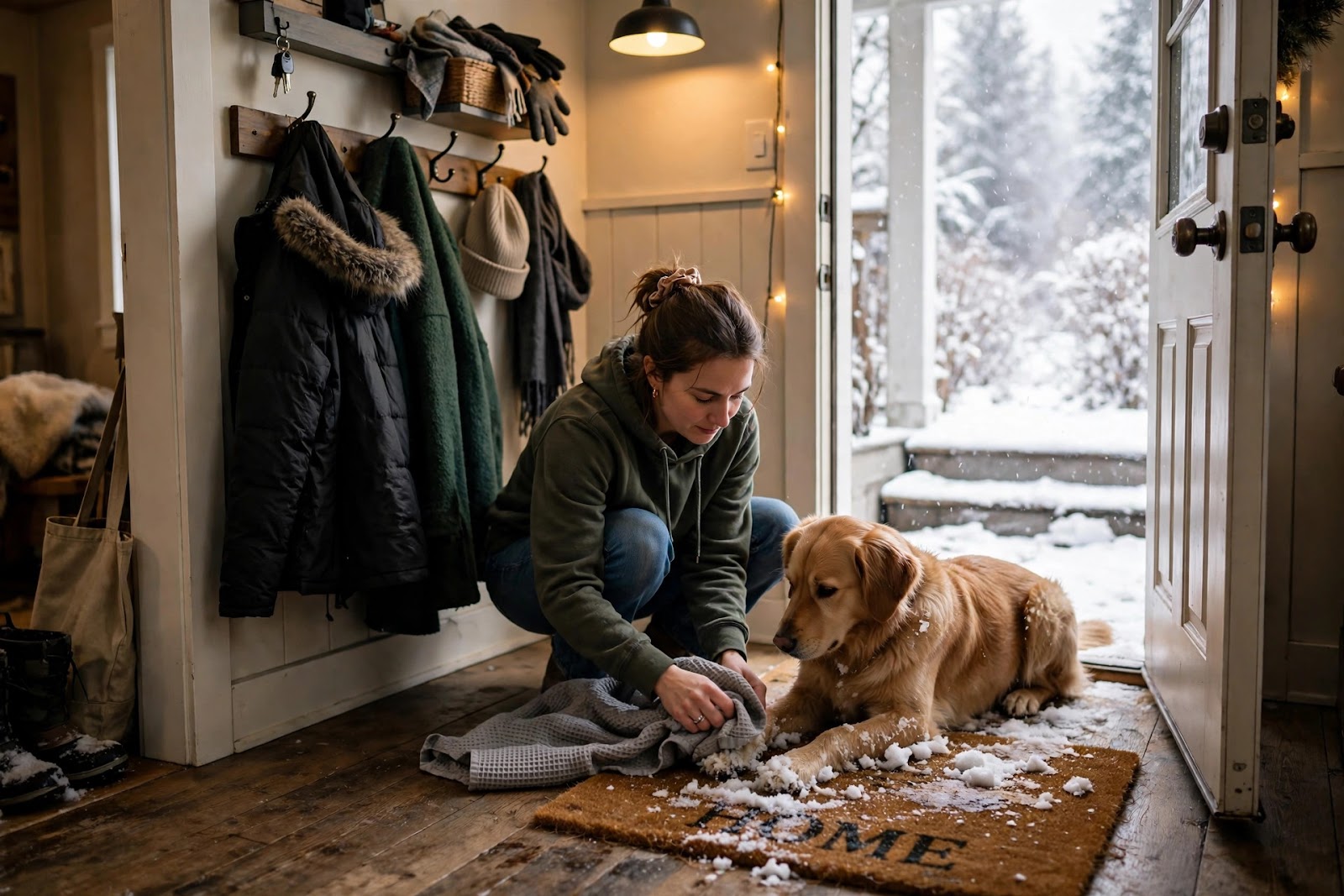
The wipe-down matters more than people think. Salt and grit from treated pavements can irritate paws and upset stomachs if the dog licks it off. So every winter walk ends the same way at our house: Milo stands on the doormat, I wipe each paw with a warm damp cloth, I check between his toes for little balls of ice, and then he gets a treat. The ice balls are the sneaky one. Snow packs between the toes, melts a bit, refreezes, and suddenly your dog is walking on tiny ice marbles. If your dog has hairy feet, trimming the fur between the toes before winter starts helps a lot. I do it with blunt-ended scissors while he's sleepy in the evening, and it takes five minutes.
The Coat Question (He Has One, He Hates It, We Compromise)
Milo is a short-coated mixed breed with not much body fat, so in real cold he does need a coat. He also thinks coats are a personal insult. Our compromise, worked out over two winters, is this: the coat goes on for walks when it's below freezing or snowing hard, and it stays off for quick garden trips and mild days. I put it on inside, give him a treat, and we go straight out the door before he has time to stage a protest. By the time we're at the end of the street he's forgotten about it.
If you're buying a first coat, get one that covers the chest and belly, not just the back, because that's where the cold and the wet slush hit hardest. And measure your dog properly, around the chest and from neck to tail, rather than guessing by weight. I guessed the first time and bought a coat that fit his body but strangled his neck. The shop swapped it without a fuss, but I could have saved the trip. A coat that fits badly is worse than no coat, because a cold dog in a badly fitting coat is a cold dog who also can't move properly.
Snow Games (the Part That Makes It Worth It)
Once Milo got over the shock, snow became his favourite thing. The game that made him fall in love with it was the simplest one: I throw a ball, it lands in the snow and disappears, and he has to find it with his nose. He goes absolutely mad for it. The ball vanishes, he dives in headfirst, and comes up sneezing with the ball in his mouth and snow all over his face. It tires him out in ten minutes flat, and it turns a cold walk into a proper adventure.
The other game is the snowman tax. Whenever I build anything out of snow, Milo inspects it, steals the carrot nose, and runs away with it. I have accepted this. The carrot is his now. I've also learned to keep the treats in an inside pocket, not a coat pocket, because treats left in an outside pocket freeze solid in about fifteen minutes and then you're trying to break a frozen biscuit in half with gloves on while your dog judges you.
One safety note from a game that went wrong: I once threw a ball onto a frozen pond edge without thinking, and Milo went after it. The ice held, he was fine, but my heart stopped, and I have never thrown anything near frozen water since. Frozen ponds, lakes and canals are dangerous for dogs, full stop. The ice can look solid and not be, and a dog that falls through freezing water is in serious trouble fast. Keep games well away from frozen water, and if your dog does go near it, call them back and keep them on the lead until you're past it.
Coming Home: The Warm-Up Routine
The after-walk routine is as important as the walk itself, and it's the part I got wrong for the longest time. On that first day I just let Milo drip all over the kitchen floor and shiver on his bed. Now we have a proper routine and it takes about five minutes. Towel dry, starting with the paws and belly, then a rub down with a dry towel. Check the paws for ice, salt or cuts. Offer a drink of lukewarm water, because dogs get dehydrated in cold weather too and they don't always think to drink. Then he gets his bed by the radiator and a chew, and he dries off properly.
I also learned not to use a hair dryer on him after a cold walk, because the first time I tried it he panicked at the noise and the hot air on cold paws, and we spent the next week rebuilding his trust in the bathroom. Towel dry, warm room, time. That's it. If your dog is really cold, a blanket over them while they warm up is kinder than any gadget. And if they're still shivering after twenty minutes indoors, or they seem stiff and unhappy, that's worth a call to the vet, because that's not normal cold, that's something else.
The Bit About Salt (Please Read This One)
Gritting salt is the hidden villain of dog winter. It irritates paws, it's toxic if eaten in quantity, and it's everywhere on pavements after a frost. I try to walk Milo on unsalted routes where I can, like the park paths and the grass verges, rather than the heavily gritted main roads. When we do have to cross a salted pavement, I keep it brief and I wipe his paws as soon as we're on grass again.
At home, I stopped using standard grit on our own path and switched to a pet-safe de-icer, which costs a bit more but doesn't leave my dog licking chemicals off his paws. If you use grit, sweep the worst of it off the path before the dog goes out, and always do the paw wipe when you come in. And if your dog does eat a mouthful of salt or grit, don't panic, but do watch them, offer water, and ring your vet if they start vomiting or acting strangely. Most of the time a small amount passes without trouble, but it's not something to ignore.
What I'd Tell Anyone Facing Their Dog's First Snow
Start short. Keep it fun. Twenty minutes, then check. Balm the paws, wipe them after, trim the fur between the toes, and keep games away from frozen water. Let them eat a bit of clean snow and figure it out at their own pace. Don't force boots if they hate them, and don't force a coat if it's mild, but do use both when the weather actually calls for it. And keep the treats in an inside pocket, because frozen biscuits are nobody's friend.
Milo is three now, and snow days are his favourite days of the year. He hears the word, runs to the door, and does a full-body wiggle that nearly knocks the coat stand over. That first Tuesday, when he lifted his paw off the step and looked at me like I'd betrayed him, feels like a lifetime ago. It took a week of short, happy outings to turn a scared puppy into a snow dog, and it was worth every minute. Your dog's first snow doesn't have to be perfect. It just has to be short, warm, and fun enough that they want to do it again tomorrow.


