Our vacuum cleaner has a name in this house, and it's not a nice one. Milo calls it The Monster, or at least that's what his behaviour says. The moment I pulled it out of the cupboard, he'd start barking — not a little alert bark, but the full-throated, hackles-up, I'm-going-to-fight-this-thing bark. Then he'd charge it, bite at the wheels, herd it around the living room, and by the end of a twenty-minute clean he'd be panting, stressed, and hoarse. I'd be stressed too. Vacuuming, the most boring chore in the house, had become a twice-weekly battle, and I was losing.
It took me an embarrassingly long time to realise the problem wasn't Milo being naughty. The vacuum is loud, it moves unpredictably, it vibrates, and it sucks things up. From a dog's point of view, that's a legitimate threat. Barking at it and chasing it off is exactly what a dog is supposed to do with a strange noisy thing in its territory. I wasn't dealing with a behaviour problem. I was dealing with a dog doing his job.
Six weeks later, Milo lies on his bed while I vacuum the living room. He watches me, he sighs, and sometimes he falls asleep. No barking, no charging, no herding. Here's the slow, boring process that got us there — and the mistakes I made on the way.
The mistake I made first (please don't do this)
My first approach was the worst possible one. I thought if I just kept vacuuming and ignored him, he'd get used to it. He didn't. Every session ended the same way: Milo exhausted and stressed, me annoyed, and the carpet still half full of dog hair because I'd given up early.
Then I tried the opposite — I tried to "show him it's safe" by holding the vacuum still and luring him toward it with treats. That was worse. He'd creep forward, take the treat, then snap at the vacuum head and run off. I was asking a scared dog to approach the scary thing, which is the opposite of how confidence works. All I taught him was that treats appear near the monster, and the monster is still a monster.
I also tried scolding him for barking at it, which I regret. A dog barking at something scary isn't being rude — he's telling you he's scared. Scolding a scared dog doesn't make him less scared. It makes him scared and confused, and it damages the trust you need for the training to work at all. Once I stopped punishing the fear and started working with it, everything changed.
Step one: the vacuum becomes furniture
For the first week, the vacuum didn't move, didn't make a sound, and didn't clean anything. I just left it standing in the corner of the living room, unplugged, while life went on. Every time Milo looked at it, sniffed it, or walked past it without barking, he got a piece of chicken. I kept a little tub of chicken in the fridge specifically for vacuum sessions, because — as with the nail trims — the boring biscuits don't cut it when the scary thing is in the room.
By day four, he was sniffing the wheels. By day six, he was lying down about six feet away from it, which was further than he'd ever voluntarily been near the thing while it was out of the cupboard. The goal was the same as with any fear: make the scary thing boring before you make it move. A vacuum standing still in a corner is the easiest version of a vacuum, so that's where we started.
I also started feeding him his dinner next to it — not right next to it, but in the same room, with the vacuum parked in its corner. Dinner is the best thing that happens in Milo's day, and I wanted some of that good feeling to rub off on the machine. Within a week he was eating happily with the vacuum six feet away. A month earlier, that distance would have had him barking from behind the sofa.
Step two: noise from another room
Week two was about sound, but from a safe distance. I'd put Milo in the living room with my partner and a Kong stuffed with frozen peanut butter, then go into the kitchen and switch the vacuum on for ten seconds. Ten seconds, off, done. Through the wall, the noise was muffled, and Milo had something delicious to focus on. He lifted his head, listened, went back to the Kong. That was the reaction I wanted — noticing, not panicking.
Over the next few days I increased the time: ten seconds, then twenty, then thirty, then a full minute. I only moved up when he stayed relaxed at the current level. If he stopped licking the Kong and started staring at the kitchen door, I went back down. That's the rule that matters most: if the dog looks worried, you've gone too far — go back to the level where he was fine.

By the end of week two, I could run the vacuum in the kitchen for two minutes while Milo worked on his Kong in the living room, and he barely looked up. That felt like a miracle. It wasn't a miracle. It was just ten careful repetitions a day for a week, each one slightly harder than the last.
Step three: same room, short bursts
Week three, I brought the noise into the living room — but on my terms. Milo on his bed with a Kong, vacuum across the room, on for five seconds, off. Chicken. Five seconds on, off. Chicken. I kept the sessions short, five minutes at most, and I always ended while he was still relaxed. Ending on a good note matters more than squeezing in one more repetition.
The hardest part was the movement. Sound was one thing — Milo had learned the sound meant nothing bad. But a vacuum that moves toward you is a different beast entirely, and the first time I pushed it two feet across the carpet, he stood up and barked. One bark, then he looked at me. I switched it off, gave him chicken, and we went back to the vacuum standing still while turned on. No movement, just noise. Two days later, I moved it six inches. Then a foot. Then two feet. Each tiny increase was a separate training session, and I didn't rush any of them.
I learned to move slowly and predictably. No sudden turns, no rushing the vacuum toward him, no backing him into a corner. I vacuumed in straight lines, away from his bed, so he always had an escape route and never felt trapped. A dog who can leave is a dog who usually chooses to stay. A dog who feels cornered by a noisy machine is a dog who panics.
The "place" command that changed everything
Somewhere in week four, I added the piece that tied it all together: his bed became the safe spot. Every time I got the vacuum out, Milo went to his bed, and staying on the bed paid out in chicken. I didn't send him there as a punishment — I built it up over the week as the best place in the house during vacuum time. Bed meant Kong, bed meant chicken, bed meant nothing scary ever came near the bed.
This gave him a job to do. Before, vacuuming left him with a choice between fight (bark at it) and flight (hide behind the sofa). Now he had a third option: go to your bed and get paid. Dogs do better with something to do than with something to avoid doing. "Don't bark" is a hard instruction. "Lie on your bed and eat this Kong" is easy, clear, and rewarding.
The bed rule had a side benefit I didn't expect: it stopped the herding. Milo is a retriever, and his instinct is to circle and control moving things. But lying on his bed, watching me work, gave that energy nowhere to go — and after a few sessions, the urge faded.
What a normal cleaning day looks like now
Six weeks after I started, here's the routine. I get the vacuum out of the cupboard and Milo walks to his bed. Not because I tell him to — because the vacuum coming out is his cue that bed-time chicken is coming. I give him a Kong stuffed with a bit of frozen banana and peanut butter, which takes him about fifteen minutes to finish. I vacuum the living room in about twelve.
He watches me for the first minute or two, then settles down and works on the Kong. Sometimes he falls asleep before I'm done. The first time he fell asleep while I was vacuuming, I actually stopped and stared at him, because the dog who once tried to fight the vacuum was now snoring through it. I took a photo. It's still my phone wallpaper.
Once a week, I still give him a jackpot — a handful of chicken at the end of the clean, after the vacuum is back in the cupboard. I want the end of every session to be the best part, so the whole sequence stays positive in his mind. Training doesn't really end; it just gets easier to maintain. Skip the rewards for a month and the old barking can creep back. Keep the routine, and it stays solid.
Things that helped that I didn't expect
A few extras made a real difference. First, I started vacuuming at the same time of day — Saturday mornings, after his walk, when he's tired. A tired dog is a calmer dog, and a calm dog learns faster. Vacuuming when he was fresh off a nap and full of energy was asking for trouble.
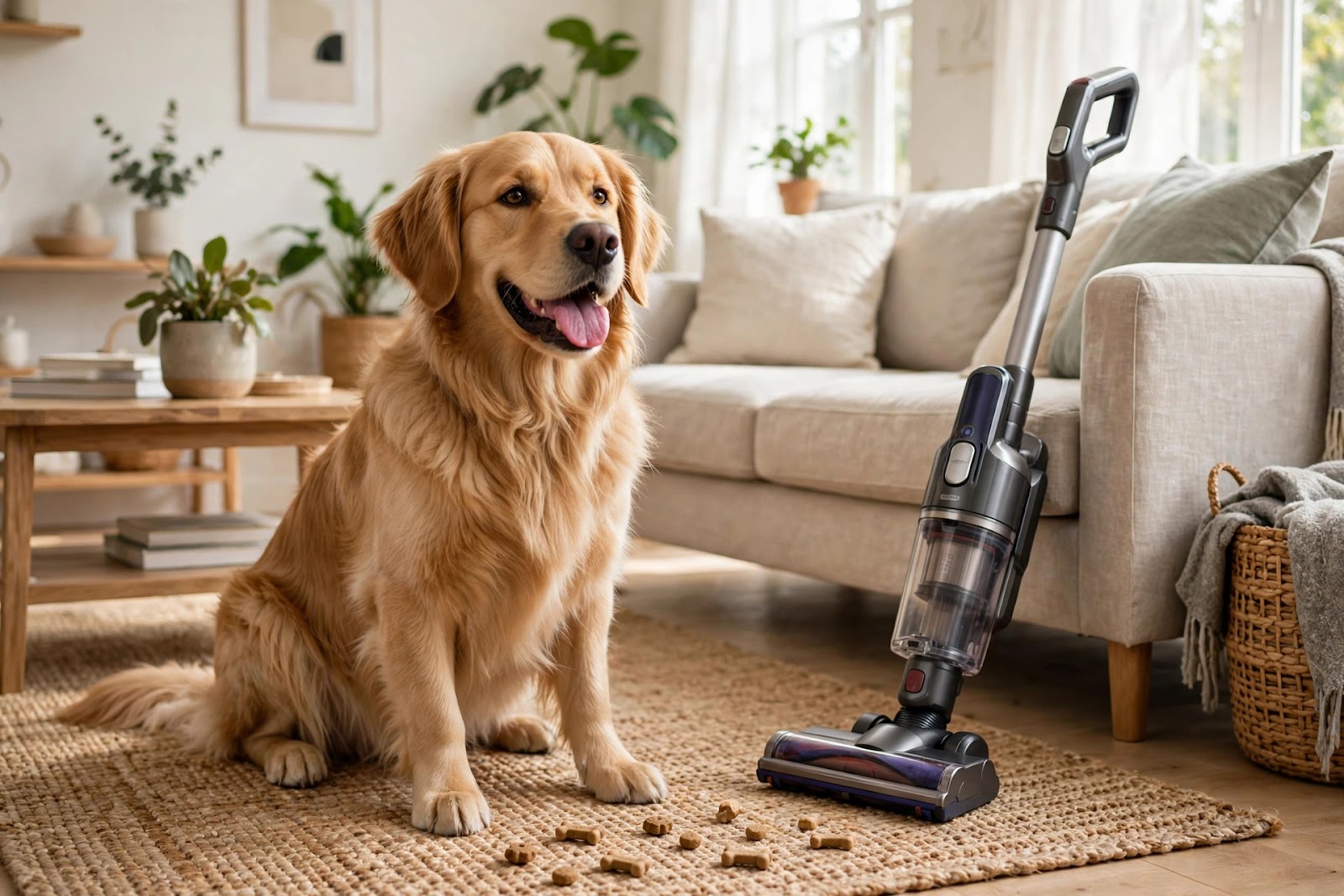
Second, I switched to a quieter vacuum. Our old one was a cheap, loud upright that sounded like a jet engine. The new one is a mid-range canister model, and it's noticeably quieter — not silent, but a lower hum instead of a scream. I didn't buy it for Milo, honestly; the old one broke. But the difference in his reaction was obvious from the first use, and if your vacuum is extremely loud, a quieter model is worth considering.
Third, the robot vacuum. A friend lent me hers for a weekend, and I introduced it the same way — off first, then on in another room, then short runs while Milo had a Kong. He adapted to the robot faster than the upright, probably because it's smaller and moves slowly. Now it runs twice a week while he's napping and he doesn't even open his eyes.
What about when someone else vacuums?
One thing I didn't plan for was what happens when someone else does the cleaning. My partner vacuums differently from me — faster, in different patterns, and usually while I'm out. The first time Milo heard the vacuum start with a different person holding it, he barked twice before remembering the routine and trotting to his bed. It was a useful reminder that dogs don't generalise the way we do. Milo hadn't learned "vacuums are safe." He'd learned "the vacuum is safe when my owner is holding it, on a Saturday, after a walk."
So we repeated the short version of the plan with my partner: vacuum off in the corner, chicken for looking at it, then short bursts with a Kong on the bed. It took three days, not six weeks, because the foundation was already there — he just needed to learn that the rules applied to her too. Now either of us can vacuum and he goes to his bed without being asked. If you live with other people, or you have a cleaner who comes in, it's worth doing a quick version of the training with them. A dog who only trusts one person's vacuum is a dog who will still bark when the cleaner arrives on a Tuesday.
The same goes for new places. We took Milo to my parents' house last month, and their vacuum is a different model with a higher whine. He barked at it once — one bark, then looked at me, then went and lay down. I gave him chicken for that, because choosing to settle after one bark is exactly the behaviour I want. He didn't need the full six-week plan again. He needed one reminder that the rules still applied in a new house, and then he was fine.
What I'd tell anyone whose dog hates the vacuum
Start with the vacuum standing still and switched off, and don't move past that step until your dog is genuinely relaxed around it — not tolerating it, relaxed. That step alone might take a week, and that's fine. Every day you spend on the easy version is a day you don't spend undoing a bad experience at the hard version.
Use treats your dog actually loves, keep sessions to five minutes, and always end while things are going well. If your dog barks, you've gone too far — go back a step, make it easier, and try again tomorrow. There's no deadline on this. Nobody is judging how fast your dog stops hating the vacuum.
And stop scolding the barking. The bark is information: your dog is telling you he's scared. Listen to it, make the scary thing smaller and further away, and let him learn at his own pace. Six weeks of patient, boring repetitions got me a dog who sleeps through vacuuming. The two years of ignoring it and hoping he'd get used to it got me nothing but a hoarse dog and a half-clean carpet. Slow works. Boring works. Chicken works most of all — and a Kong stuffed with frozen peanut butter is worth its weight in gold.


