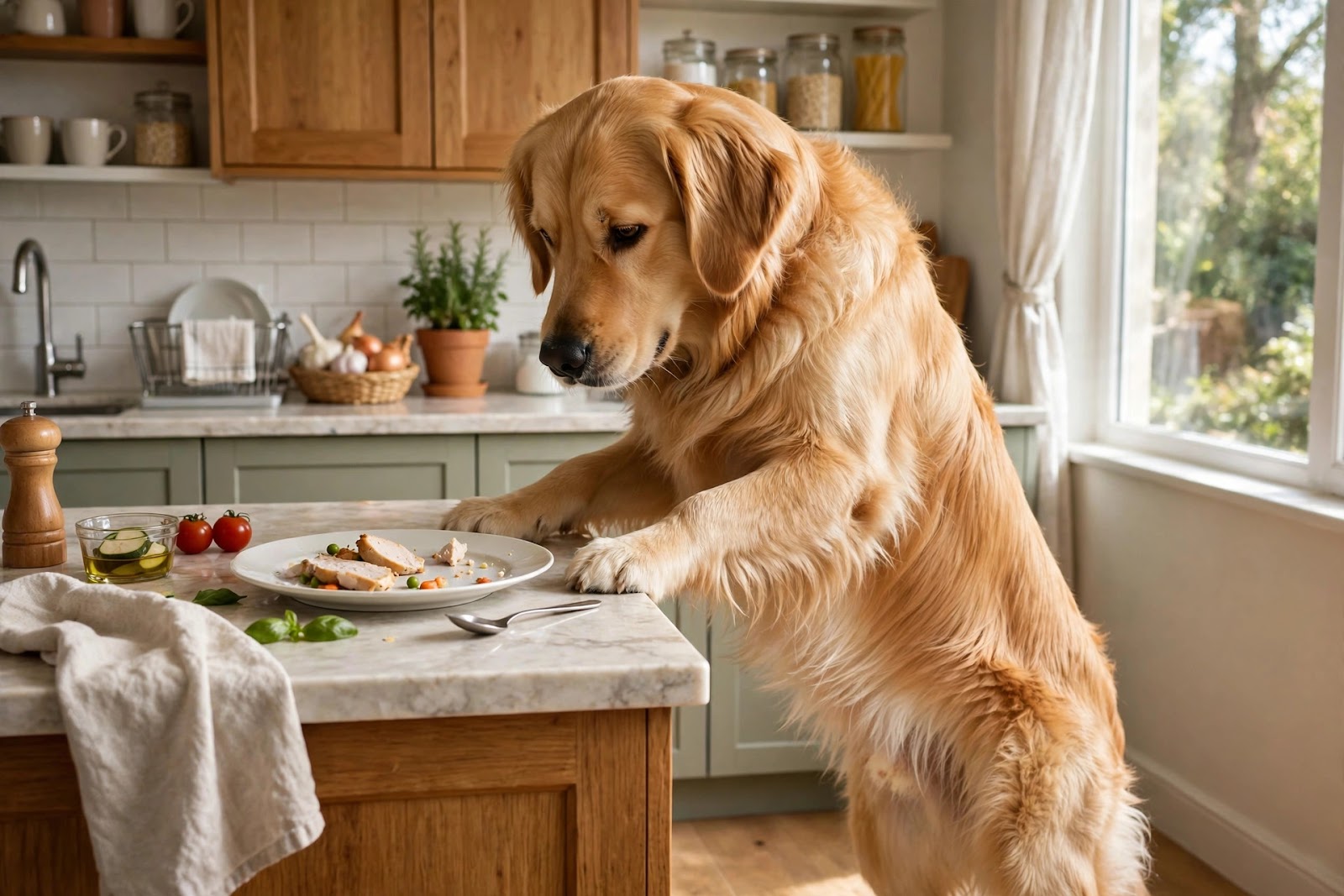
I came home from the shops to silence, which should have been my first warning. Maple, our golden retriever, usually meets me at the door with a toy in her mouth and a full-body wag. That afternoon the house was quiet, and when I walked into the kitchen, the roast chicken I had left cooling on the counter was gone. Not half-eaten. Gone. The plate sat in the middle of the floor, licked clean, and Maple was lying on her bed looking deeply pleased with herself and slightly guilty at the same time, which is a combination only a golden retriever can pull off.
I had left the chicken out for ten minutes. Ten. I had turned my back to put the shopping away, and in that time she had dragged a chair across the kitchen floor, climbed up, and helped herself to a whole roast chicken. My first reaction was fury, honestly. My second, once I had cleaned the plate off the floor and checked that she had not eaten any bones that worried me, was embarrassment, because I knew, deep down, that I had trained her to do exactly this. Not on purpose. But every time I had left food within reach and she had grabbed it, the food itself had been the reward. She had learned a simple rule: counters equal jackpots. Why would she ever stop checking?
Counter surfing is one of those dog habits that feels rude and greedy, and owners take it personally. I did. It helped, eventually, to stop thinking of it as naughtiness and start thinking of it as a job my dog had given herself. She was foraging. Dogs are built to forage. A kitchen counter at nose height, covered in smells, is the best foraging patch in the house. If I wanted her to quit, I had to make the counter boring and make another behaviour pay better. That took about five weeks, and it worked, but only after I stopped relying on scolding, which had done precisely nothing except teach Maple to surf when I was out of the room.
The scolding trap I fell into first
For the first month after the chicken incident, I did what most people do. I shouted "no" when I caught her. I clapped my hands. Once, I am ashamed to say, I banged a pan on the counter. Maple would jump down, look sorry, and then surf again the next day, usually when I was in the shower or had popped upstairs. Scolding after the fact is useless, because by the time you find the empty plate, the dog has already been paid. And scolding in the moment teaches the dog one lesson only: do not surf while the human is watching. It does not teach her to leave food alone. It teaches her to wait until you leave.
The other problem with scolding was that it made Maple sneakier, not better behaved. She started checking over her shoulder. She learned which floorboards creaked near the kitchen door. She surfed faster. I was not training a dog. I was training a better thief. The day I found her eating butter straight from the dish, wrapper and all, while I was on a phone call in the next room, I knew the shouting approach was finished. I needed a plan that worked when nobody was watching, because that was when the surfing actually happened.
Step one: make the counter pay nothing
The unglamorous truth about counter surfing is that management comes before training, and management is boring. For three weeks, nothing edible stayed on the counters, ever. Not a butter dish. Not a fruit bowl with bananas in it. Not a cooling tray of muffins with a tea towel over it, because Maple learned to nose the tea towel off in about four seconds. Everything went into the fridge, the microwave (switched off, obviously), or a high cupboard with a child lock on it.
This felt like losing. My kitchen looked bare, and I kept forgetting where I had put things. But it was the single most important part of the fix. Every day Maple checked the counter and found nothing, the surfing habit got a little weaker. Dogs repeat what pays. A counter that never pays stops being interesting, slowly, like a vending machine that never delivers. I also pushed chairs away from the counters and moved the recycling bin, because Maple had learned to climb from the bin onto the counter, which I only discovered when I caught her mid-climb one morning and finally understood how she had reached the chicken in the first place.
We also fitted a baby gate at the kitchen door. Not as a punishment, and not forever, but as a way to control access during the riskiest moments: cooking dinner, cooling food, unloading shopping. When I was cooking, Maple stayed on the other side of the gate with a chew, where she could see me but could not reach the worktops. Some people dislike gates, and I get it, but a gate used kindly, with something good on the other side of it, is just a management tool. It bought us the clean stretch of no-reward days we needed for the training to have a chance.
Give her a job that pays better
Management alone was never going to be enough, because the day I forgot to put the butter away, Maple would be back on the counter in a heartbeat. She needed a competing behaviour, something she could do in the kitchen that earned her better rewards than surfing ever had. For us, that was the mat.
We already had a mat in the kitchen, a thick washable bed near the fridge, but Maple had never been taught that lying on it during cooking was a job. So we taught it properly, in tiny steps, away from food first. I would point at the mat, say "mat", and the moment all four paws landed on it, a treat landed on the mat too. Then another for lying down. Then I started waiting, two seconds, five seconds, ten, before the next treat arrived. Short sessions, three or four a day, never more than five minutes. Boring, repetitive, and completely effective.
Once she understood the mat in a quiet kitchen, I started using it while I cooked. The rule was simple: Maple on her mat while I worked, and treats arrived on the mat at random intervals. Not on a schedule. Sometimes after thirty seconds, sometimes after two minutes. The unpredictability kept her lying there hopefully instead of clock-watching and then exploding into a surf when the treats stopped. And I kept the treats deliberately ordinary: kibble from her dinner portion, mostly. If I had used roast chicken as the mat reward, I would simply have moved the begging to a new address.
The "leave it" that actually works in a real kitchen
Everyone teaches "leave it", and most versions of it fall apart the moment real food is involved, because they are taught with a boring treat in a closed hand and then tested on a roast chicken. That gap is too big. I rebuilt ours in stages, and the stages mattered.
Stage one was the classic version: a treat in my closed fist, Maple sniffs, I wait, the second she pulls her head back I say "yes" and give her a better treat from my other hand. The food in the fist is never the reward. That rule stayed true at every stage, and it is the whole point. Dogs learn fast when the boring thing never pays and the turning away always does.
Stage two moved the boring treat to the floor, covered by my hand, then uncovered but with my foot ready to cover it if she lunged. Stage three put it on a low stool. Stage four put it on the kitchen counter, with Maple on a lead held by my partner, at a distance where she could succeed. If she lunged, we had gone too far too fast, and we went back a stage without any fuss. No scolding. Just a reset.
The breakthrough came in week four, when I dropped a piece of cheese on the kitchen floor by accident, said "leave it" without thinking, and Maple actually looked at me instead of diving on it. I nearly cried. I gave her three treats from the fridge, one after another, because that moment deserved a jackpot. The cheese went in the bin. She had chosen the better deal, and that choice is what real training looks like. It is not obedience under threat. It is a dog deciding that listening pays more than stealing.
Set-ups: the training trick nobody wants to do
Here is the part of the fix that feels slightly ridiculous and works brilliantly: deliberate set-ups. Once Maple could leave food on the counter while I stood next to her, I started staging temptations and then leaving the room, but only for a few seconds, and only with food she did not actually get if she failed. I would put a plate with a piece of bread on the counter, walk to the doorway, and watch from around the corner. The first time, she surfed it in about six seconds. I walked in calmly, said nothing, and put her on her mat for a minute. No drama. The second time, she hesitated. The third time, she looked at the plate, looked at me, and lay down on her mat, and I came in with a handful of treats like she had won the lottery, because in her world, she had.
Set-ups work because they teach the dog that the rule holds even when you are not in the room, and they do it safely, with food that will not hurt her if she does grab it. I used bread, plain crackers, a carrot. Never anything dangerous, never chicken bones, never chocolate or anything with onion or garlic in it. If she grabbed the bread, the worst outcome was a stolen cracker, and I simply reset and tried again with an easier set-up. The key was keeping the failure rate low. If she failed three times in a row, the set-up was too hard, and I made it easier: shorter absence, less tempting food, greater distance. Training should feel like a game the dog mostly wins, not a test she mostly fails.
What about the rest of the household?

This is where most counter-surfing plans quietly die. One person trains, another person leaves a sandwich on the coffee table, and the dog learns that surfing still pays sometimes. Intermittent rewards are the strongest kind. A slot machine that pays out once in twenty pulls keeps people pulling all night. A counter that pays out once in twenty checks keeps a dog checking forever.
So we had the family conversation, the unglamorous one, and we made a house rule: no food left unattended on any surface below Maple's nose height, and that included the coffee table, the dining table when nobody was eating, and the low shelf by the back door where my brother kept leaving his lunchbox. Everyone agreed, and everyone broke it at least once, and each time we just reset without a row about it. The rule was not about blame. It was about consistency.
Guests got a version of the same talk, delivered cheerfully before they sat down with a plate: "Maple is in training, please don't leave your plate on the arm of the sofa." People were fine with it, mostly because I gave them something they could do instead: if they wanted to treat her, they could put a treat on her mat after dinner. People want to be kind to the dog. Give them a kind thing they can do, and they stop inventing one that undoes your training.
The things that did not work
I tried a few popular fixes that failed in our house, and I list them so you can skip the same dead ends. Double-sided tape on the counter edge sounded clever. Maple peeled it off with her nose and ate a strip of it, which was a vet phone call I did not enjoy making. She was fine, but the tape was not a deterrent, it was a snack. A can full of coins, shaken when she surfed, startled her once and then became background noise. She learned to surf between shakes.
I also tried the "booby trap" style pans balanced on the counter edge, and I abandoned that fast. The first time one fell, it crashed loudly and Maple panicked and knocked a glass off the counter, and I spent the evening cleaning glass out of her paws and feeling awful. Scare tactics might stop a behaviour in the moment, but they do not teach a dog what to do instead, and they can make a nervous dog worse. The mat, the management, and the set-ups were slower, but they built something that lasted instead of something that just suppressed the behaviour while I was holding a pan.
Where we are now, honestly
Maple has not counter-surfed in four months, and I write that with the caution of someone who knows dogs. I still do not leave a roast chicken cooling on the counter and go upstairs. I probably never will, and that is fine. Management is not failure. It is part of living with a dog who is taller than your worktops when she stands up and who has a nose that can smell a sandwich through a closed door.
What changed is the default. Maple's default in the kitchen used to be "check the counters". Now it is "go to the mat and wait, because good things arrive there". When I cook, she trots to her bed without being asked, flops down with a sigh, and watches me like a supervisor who is slightly disappointed in my knife skills. When something drops on the floor, she looks at me first. That look, that tiny pause before acting, is the whole victory. It means she has learned to think instead of just grabbing.
If you are standing where I stood, staring at an empty plate and a guilty dog, here is the short version of what I wish someone had told me on day one. Stop shouting, because shouting only teaches your dog to surf when you are not looking. Clear the counters completely for a few weeks, even though it is annoying, because a counter that never pays stops being interesting. Teach a mat behaviour that pays better than the counter ever did, rebuild "leave it" in small stages until it works on real food, and stage safe set-ups so the rule holds when you leave the room. Give it five weeks, not five days. Counter surfing took months to build. It will not disappear in a weekend, but it will fade, one unrewarded check and one rewarded mat lie at a time, until one day you realise you cooked a whole dinner without thinking about the dog at all, and that is a very good feeling indeed.


