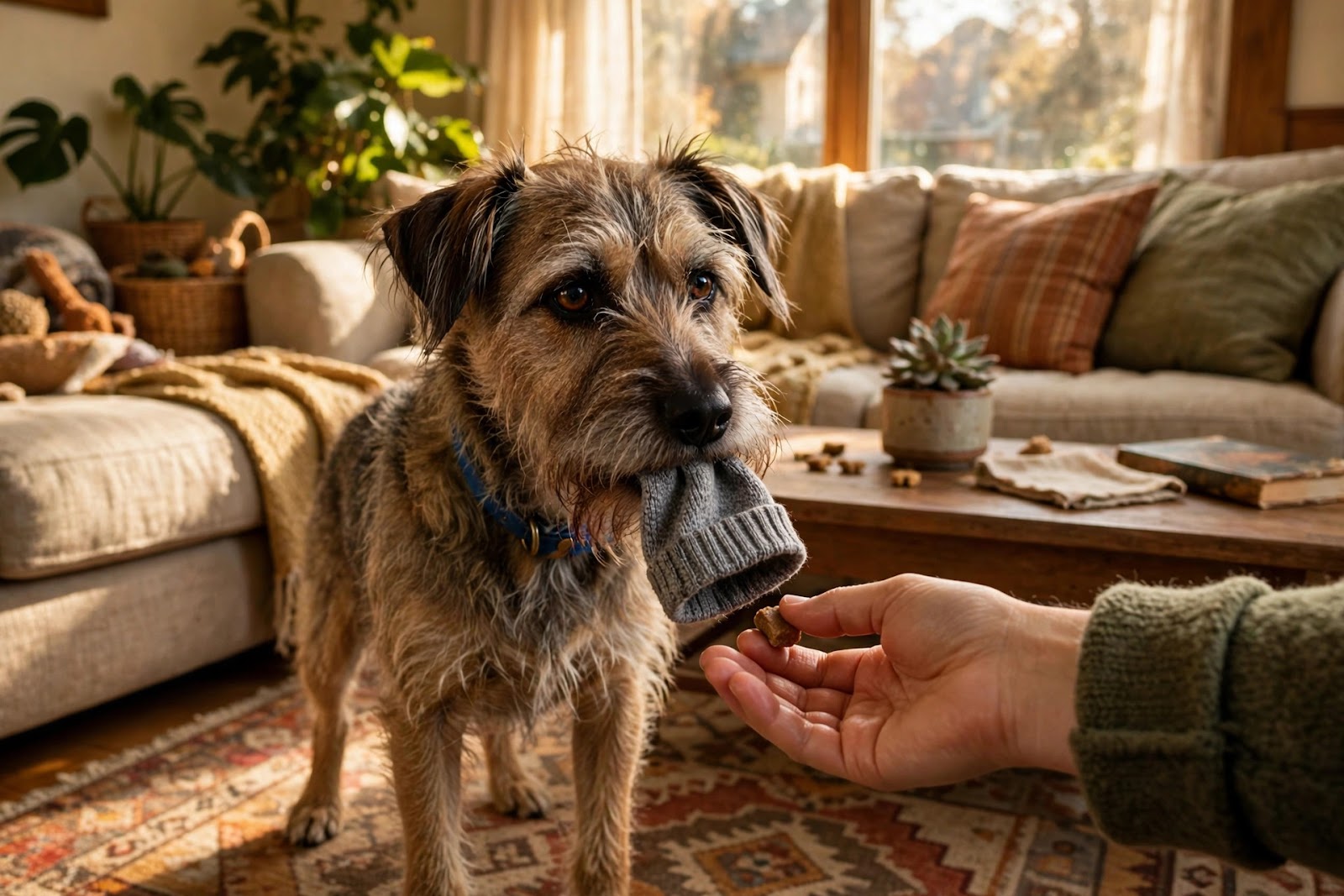
There is a sock thief living in my house. He is about knee-high, he has a brown patch over one eye, and he answers to the name Biscuit. For the better part of a year, no sock in this house was safe. Clean socks, dirty socks, socks still warm from the tumble dryer — if it was a sock and it was within reach, it was gone, and it would turn up later, damp and chewed, under the sofa, in the garden, or once, memorably, floating in his water bowl.
I want to be clear about something up front: Biscuit does not steal socks because he is a bad dog. He steals socks because stealing socks is, from a dog's point of view, an absolutely brilliant game. You leave a soft, smelly, portable object lying around. He picks it up. You chase him. He runs. Everyone is having a wonderful time except the person who now owns one sock.
It took me far too long to fix this, partly because I kept making it worse without realising it, and partly because the actual fix was so boring that I kept looking for a cleverer one. There isn't a cleverer one. What follows is the unglamorous truth about how I got my socks back, including the phase where I made the problem twice as bad by doing exactly the wrong thing with the best intentions.
How the sock game started (and why it was my fault)
Biscuit was about seven months old when the sock thing started. He'd just discovered that he could reach the laundry basket if he stood on his back legs, and the basket was always full, because in this house the laundry basket is always full. The first time he took a sock, I laughed. It was funny. A tiny puppy trotting around with a sock twice the size of his head, looking enormously pleased with himself.
Then I chased him. Of course I chased him. He had my sock, and I wanted it back, and I hadn't yet learned the first rule of dogs and stolen objects, which is this: chasing a dog who has something you want is not how you get it back. Chasing a dog who has something you want is how you teach him that stealing things makes an exciting game happen.
Within a week, the pattern was locked in. Biscuit would take a sock, wait until I noticed, and then run. I'd follow him around the kitchen table while he dodged left and right, tail wagging, having the time of his life. Sometimes I'd catch him, and the sock would come out of his mouth in a damp, stretched-out mess, and I'd throw it in the wash and think, well, at least I got it back. What I didn't understand was that I was paying him for the theft. The chase was the reward. The sock was just the ticket that bought the game.
And then it escalated, as these things do. Socks led to tea towels. Tea towels led to a dishcloth. The dishcloth led to a pair of boxer shorts, which he paraded around the living room while my brother tried not to laugh and failed completely. That was the day I decided something had to change, because a dog who steals your underwear in front of guests is a dog who has gone too far, even by Biscuit's standards.
The things that didn't work
Before I tell you what worked, let me save you some time and money by telling you what didn't. First: the bitter apple spray. Everyone recommends it. I sprayed it on a sacrificial sock and left it out as a trap, feeling very clever. Biscuit picked it up, licked it, looked mildly disappointed, and then ate the sock anyway. He is not a dog who is deterred by bitter flavours.
Second: telling him off after the fact. I would come home, find a sock on the rug, and say "no" in a firm voice while pointing at it. Biscuit would look guilty — ears back, tail low — and I thought, good, he knows he did wrong. He did not know he did wrong. He knew that when there is a sock on the rug and I am standing over it, I make an unhappy noise. The connection between the theft and the telling-off was never made, because by the time I found the sock, the fun part was long over. Dogs live in the moment.
Third: the laundry basket with a lid. This one helped, in that he couldn't get into the basket any more. But socks don't only live in the basket. They live on the floor next to the bed, on the radiator, and — on laundry day — in a heap on the sofa waiting to be folded. A lid on the basket is a fence with the gate open.
Fourth, and this is the one I'm embarrassed about: I tried to trade him for it with a treat, but I did it wrong. I'd hold out a biscuit and say "drop it", and he'd drop the sock, take the biscuit, and then — because I'd taught him that dropping a sock produces a biscuit — he'd go and get another sock. I had accidentally built a sock vending machine. Drop sock, get biscuit. Drop sock, get biscuit. It was, in retrospect, a perfectly designed incentive system for a dog who wanted biscuits and had an unlimited supply of socks.

The trade that actually worked
The trade idea wasn't wrong, it was just incomplete. The missing piece was the word "drop it" itself — Biscuit didn't actually know what it meant. I'd been saying it while waving a biscuit at him, and he'd been dropping the sock to take the biscuit, but he hadn't learned the cue. He'd learned that biscuits appear when socks are in his mouth. So I had to teach "drop it" properly, from scratch, with nothing valuable at stake.
I started with the most boring object I could find: a rubber toy he barely cared about. I gave it to him, waited until he had it in his mouth, held a treat right next to his nose, and said "drop it" exactly once. He dropped the toy, took the treat, and I picked the toy up and gave it straight back to him. That last part matters. I gave it back. Because the thing dogs fear about "drop it" is that dropping means losing, and if dropping means losing, they hold on tighter. If dropping means a treat AND getting the toy back, dropping becomes the best deal in the world.
We did that ten times a day for a week. Toy, "drop it", treat, toy back. Then I moved up to things he liked a bit more — a rope toy, a chewy bone, a tennis ball he was mildly obsessed with. Same deal every time. Drop it, treat, item back. By the end of the second week, he'd drop anything on cue, happily, because in his experience "drop it" had never once meant losing something for good.
Then — and this is the important bit — I practised with socks. Clean socks, ones I didn't care about. I'd hand him a sock, let him hold it for a few seconds, say "drop it", treat, sock back. I did that until he was bored of it, which took about three days. Then I put a sock on the floor and walked away, and when he picked it up, I asked for it, and he dropped it. No chase. No drama. Just a dog who'd learned that giving things up pays better than running away with them.
Stopping the chase (the hardest part)
Teaching "drop it" was the easy half. The hard half was me. I had to stop chasing him, completely, even when he had something I wanted back, even when it was my favourite pair of socks, even when guests were watching. Because every single chase was a payment, and I had to stop paying.
The first time he grabbed a sock after we'd started training, I did what I'd always done — I took two steps towards him — and then I stopped. I stood still. I turned my body sideways so I wasn't facing him directly, and I waited. Biscuit ran three steps, realised nobody was following him, and stopped. He looked back at me, confused. The game had no second player. He dropped the sock, trotted over to me, and I gave him a treat and a fuss, and we moved on.
That sounds simple and it was, but it took real self-control, because the instinct to chase is strong. It helps to have a plan for the moment it happens, so you're not deciding in the heat of the moment. My plan was: freeze, turn sideways, wait five seconds, then call him with a treat in my hand. I wrote it on a sticky note on the fridge for the first month. My brother laughed at it. His socks stopped disappearing too.
There's one exception worth mentioning. If your dog has something dangerous — a chicken bone, a sock he's actually trying to swallow, medication, anything he could choke on — don't stand around being clever. Get it out of his mouth, carefully, right now. The "don't chase" rule is for socks and tea towels, not for emergencies. If Biscuit ever gets hold of something that could hurt him, I trade fast and I don't worry about the training implications. Safety first, manners second. Always.
Making socks boring (and giving him something better)
Here's the part most people skip: you have to make the sock less interesting, and give the dog something more interesting to do instead. A dog who steals socks is often a dog who is bored, and Biscuit, at seven months old, was bored a lot. He had energy and curiosity and no outlet for either, and socks were the most interesting thing in the house that he was allowed to touch.
So I changed two things. First, I made socks hard to get. The laundry basket got its lid back. The clean washing went straight from the airer into the drawer instead of sitting in a pile on the sofa for three hours while I watched television. The bedroom door stayed shut during the day, because that's where the sock drawer lives and Biscuit had learned to nudge it open.
Second, I gave him legal things to carry. This turned out to be the real breakthrough, and I wish I'd thought of it months earlier. Some dogs just love having something in their mouth. It's comforting, it's satisfying, and for a lot of dogs it's a genuine need, not a habit. So I bought him a soft rope toy — one specific toy, always in the same spot by the back door — and I made it his job to carry it. When I came home, I'd hand it to him. When we went into the garden, I'd hand it to him. He started picking it up himself when he got excited, because he'd learned that carrying something is what you do when you're excited, and the rope toy was the thing he was allowed to carry.
It sounds almost too simple, but it worked. The sock thefts dropped off a cliff within a fortnight, because Biscuit had a better option and the sock game had stopped paying out. He still picks up a sock occasionally, but now he brings it to me and drops it at my feet, because that's what he's been paid to do a hundred times.
What to do when they actually swallow one
I need to be straight about this, because it's the one part of the sock problem that isn't funny. Dogs do swallow socks. Biscuit did, once, and it was the worst afternoon of my dog-owning life. I found a sock missing from the laundry pile, counted the pairs, realised one was unaccounted for, and watched Biscuit for the rest of the day like a hawk. He was fine — he passed it the next morning, if you'll forgive the detail — but I spent the night reading about blockages and feeling sick, and I would not wish that night on anyone.
If you think your dog has swallowed a sock, or anything else that isn't food, don't wait and hope. Call your vet and describe exactly what happened. That's the advice, the whole advice, and I'm not going to dress it up with home remedies, because this is the one place where guessing wrong can go badly. Know what your dog swallowed, know when it happened, and get professional advice fast. And then, once it's resolved, go and buy a laundry basket with a lid.
The sock census (and the honest ending)
I did a sock census last month, because I'm that kind of person now. I counted every pair in the drawer and every odd sock in the drawer of shame that everyone has and nobody admits to. The numbers: twenty-three complete pairs, two odd socks, and zero socks in the garden, under the sofa, or in the water bowl.
It took about six weeks from the day I stopped chasing him to the day I realised I hadn't lost a sock in a fortnight. Six weeks. That's the honest timeline, and it's worth knowing, because if you're in week two and it's still happening, that doesn't mean it's not working. It means you're in week two. Biscuit had been practising the sock game for months before I started undoing it, and unlearning takes time. The rule I kept repeating to myself was: every time I don't chase, I'm making the next theft slightly less likely, even if I can't see it yet.
And the other honest truth is that I still manage the environment. The laundry basket has a lid. The bedroom door is shut. The clean washing doesn't sit on the sofa. That isn't failure — that's just living with a dog. Good training plus good housekeeping beats either one on its own, and anyone who tells you that training alone should be enough has never lived with a terrier mix who can open a laundry basket.
So if your dog steals socks, here's my advice, in order: stop chasing, teach "drop it" with boring things first and always give the thing back, make socks hard to reach, and give your dog something legal to carry instead. It won't work overnight, and you'll feel silly standing still while your dog runs away with your underwear, but it works. My socks are back in the drawer where they belong, and Biscuit has a rope toy, a clean record, and a treat budget that frankly got out of hand. I call that a win for both of us.


