Three weeks before our daughter was born, I sat on the nursery floor with Milo's head in my lap and tried to explain the situation to him. He thumped his tail against the skirting board, licked my hand, and fell asleep. He had no idea his life was about to change, and honestly, neither did I. I'd read the articles. I'd watched the videos of dogs gently sniffing newborns while soft music played. None of them prepared me for the reality, which was messier, louder, and — once we got it right — much calmer than I expected.
Milo was four when our daughter arrived, a golden retriever who had been the baby of the house since the day we brought him home. He slept on our bed. He got the last bite of my toast. He had never once had to share our attention with anything smaller and louder than him. I was worried about two things: that he'd be jealous, and that he'd be too excited. A twenty-eight-kilo dog bouncing with joy around a three-kilo baby is not a cute photo opportunity. It's a problem that needs solving before the baby comes home, not after.
What worked for us was a slow introduction in three stages: before the birth, the first meeting, and the first month at home. Nothing fancy. No expensive training course. Just a lot of small, boring steps, done in the right order, with plenty of treats involved. Six months on, Milo lies next to the play mat while our daughter grabs at his ears, and he sighs like a long-suffering uncle and goes back to sleep. That's the result. Here's how we got there.
Before the baby arrived
The first thing we did was set up the nursery early — six weeks before the due date — and let Milo explore it properly. He sniffed the cot, the changing table, the pile of tiny clothes, and then he tried to climb into the Moses basket, which was both funny and exactly the kind of thing we needed to deal with before a baby was in it. We taught him that the cot and the basket were not his. Not by scolding him, but by redirecting him to his own bed every single time, with a treat waiting there. It took about four days of patient repetition before he stopped trying to claim the basket as a new dog bed.
We also started playing recordings of baby sounds in the house. Crying, mostly — the thin, piercing wail that newborns do. The first time I played it, Milo's head shot up and he ran to the speaker, confused, looking for the source. We played it at a low volume during his meals, a few minutes at a time, and over two weeks we worked up to full volume. By the end, he'd hear a baby crying on the recording and just carry on eating. That was the point. The sound needed to be background noise before it was real, not a brand-new alarm going off in his ear at two in the morning with a real baby attached.
The other preparation was scent. A friend who'd done this before told us to bring home a blanket the baby had slept in before the baby herself came home. My wife was in hospital for two nights after the birth, and on the second day I brought a muslin cloth home that our daughter had been wrapped in. I let Milo sniff it, then I put it in his bed so he could get used to the smell on his own terms. He sniffed it thoroughly, sneezed, and lay down on it. I chose to take that as a good sign.
We also changed Milo's routine in small ways before the birth, rather than all at once afterwards. His walks moved half an hour earlier, because we knew the new morning routine would be chaotic. His feeding time shifted to fit around the feeding schedule we expected. The idea was that when the baby arrived, Milo's day would already look like the new normal, so he wouldn't associate every change with the small human who'd just moved in.
The first meeting — and the mistake we nearly made
Here's the mistake we nearly made. I had planned a big, emotional homecoming: my wife walking through the front door with the baby in her arms, Milo rushing over, everyone crying happy tears. A friend stopped me the day before and said something that changed the whole plan: let your wife come in first, alone, without the baby. Let the dog greet her properly. Then bring the baby in calmly, after the excitement has burned off.
I'm glad I listened. When my wife walked in, Milo lost his mind with joy — he'd not seen her for two days, and he bounced around the hallway like a puppy, tail going, making those ridiculous happy groaning noises goldens make. It took about five minutes of fuss and cuddles before he settled. If the baby had been in her arms during those five minutes, she'd have been in the middle of twenty-eight kilos of excited dog.
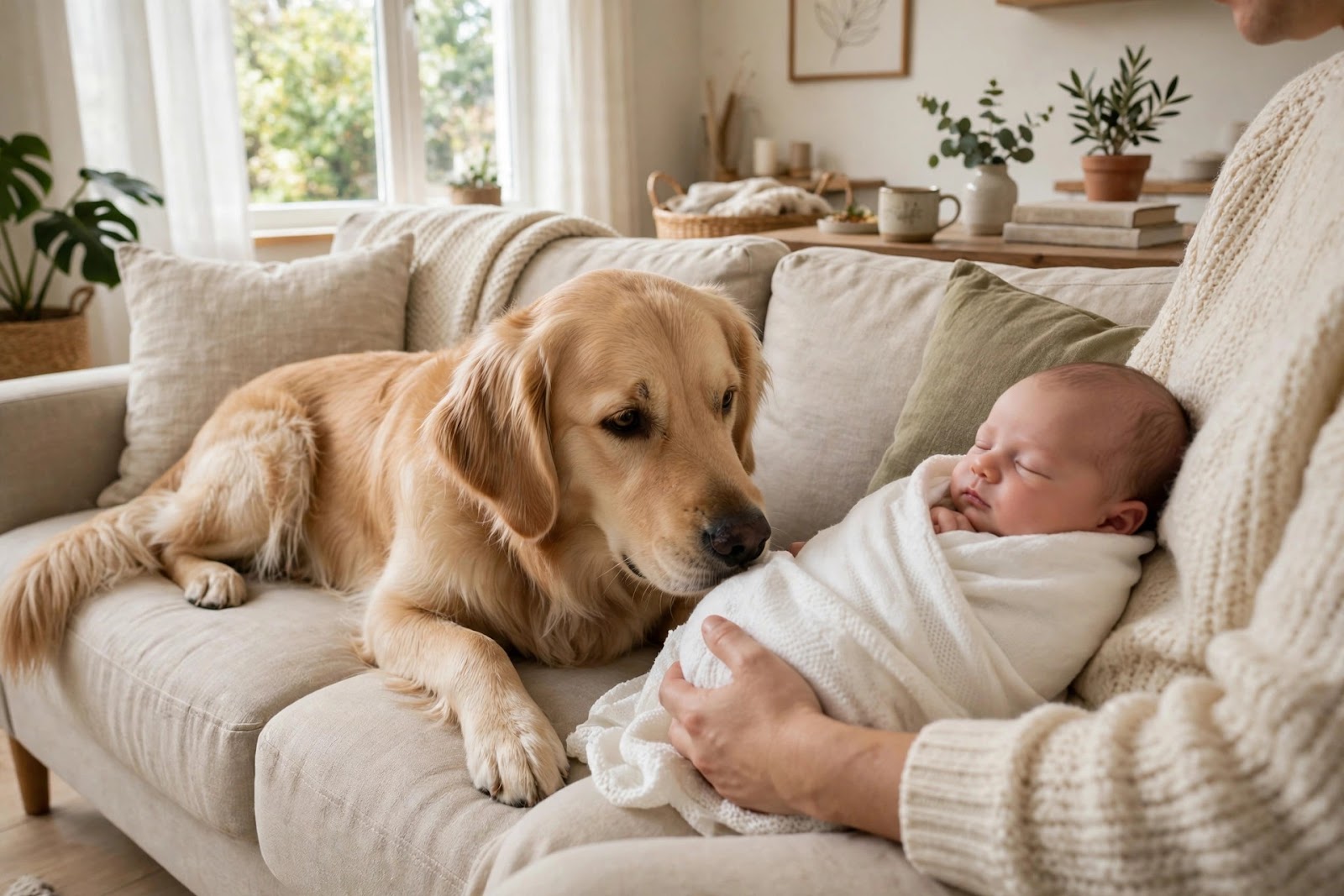
When I carried our daughter in, wrapped in her blanket, Milo was already calm. I sat on the sofa with her in my lap, and my wife held Milo's lead — loosely, just as a precaution. We let him approach slowly. He sniffed her feet first, then her blanket, then — very gently — her head. His tail wagged slowly. He sniffed, sighed, and lay down at our feet like it was the most normal thing in the world. The whole meeting took about three minutes, and then it was over, and the baby was just... there. Part of the house.
That calm first meeting set the tone for everything that followed. But I want to be honest about something: it was calm because we'd done the preparation, and because we controlled the excitement, not because Milo is some naturally perfect dog. He's a normal, bouncy retriever. If we'd done the big emotional doorstep reunion, it would have been chaos, and I'd probably be writing a very different article.
The rules we kept for the first month
We had four rules, and we stuck to them even when we were exhausted, which in the first month was most of the time.
Rule one: the dog and the baby are never in the same room unsupervised. Not for a minute, not while I "just pop to the kitchen," not while she's asleep in the Moses basket and he's asleep on the floor. It sounds strict, and it is strict, and it's also the only rule that really matters. Babies make sudden noises and sudden movements. Dogs react to sudden things. Even the gentlest dog in the world is still an animal, and a sleeping baby can't move away. When I left the room, one of them came with me — usually Milo, who was delighted to follow me to the kitchen anyway.
Rule two: Milo's stuff stayed Milo's stuff. His bed, his food bowl, his toys, his walk — none of it got taken away or moved to make room for the baby. This was harder than it sounds, because the house filled up with baby things and there was barely room to move, but it mattered. A dog who loses his bed, his routine and his humans' attention all in the same week has every reason to resent the cause. Milo kept his corner, his evening walk, and his ten minutes of undivided attention from me every night after the baby's bath. Those ten minutes were sacred.
Rule three: the baby's things were not dog toys, and we were consistent about it. The first time Milo picked up a soft toy that belonged to our daughter, we swapped it calmly for one of his own toys and gave him a treat. No shouting, no drama. He learned within a week that the colourful things in the cot were boring and the rope toy by the back door was the fun one. Consistency beat correction every time.
Rule four: we rewarded calm behaviour around the baby, loudly and often. Every time Milo lay down quietly near the play mat, every time he walked past the cot without jumping up, every time he chose to settle instead of bounce — he got a quiet "good boy" and a treat. We were basically paying him to be boring around the baby, and it worked. Dogs repeat whatever gets rewarded. Make calm the most profitable thing your dog can do near the baby, and calm is what you'll get.
What the first month was actually like
The first month was not the peaceful picture from the videos. It was loud, sleep-deprived, and chaotic, and Milo handled it better than I did. The night feeds were the hardest — the baby crying at 3 a.m., Milo lifting his head and looking at me with that expression that said, "Are you going to deal with that?" He never barked at her crying, which I had been dreading. I think the sound training helped. The crying was familiar, just louder and at a worse hour.

The funniest problem was the jealousy that wasn't quite jealousy. Milo started bringing me his toys during the baby's feeds, one after another, dropping them at my feet while I was trying to hold a bottle. He wasn't being naughty. He'd just worked out that when the baby was in my arms, I sat still for twenty minutes, and a sitting human is a human who can throw a toy. Once I realised that, I started keeping a toy by the nursing chair and giving him a quick game between feeds, and the toy deliveries stopped.
There were two moments that worried me. The first was when our daughter started crying loudly in her bouncer and Milo barked — one sharp bark, right next to her. My heart stopped. But he wasn't barking at her. He was barking at the front door, where the postman had just knocked. The timing was coincidence, and the baby slept through it. The second was when he tried to lick her face while she was in her bouncer. Not aggressive at all — just a big, enthusiastic golden retriever tongue. We redirected him to her feet, which she seemed to find hilarious, and that became the rule: feet are fine, face is not.
The thing nobody warned me about was the smell of the nappies. Milo found the nappy bin fascinating in a way that was deeply unpleasant, and we had to move it into a cupboard with a child lock. If you're preparing for a baby and a dog, put the nappy bin behind a closed door from day one. Trust me on this. The day I caught him with a nappy in his mouth is not a day I want to repeat, and it took a very long bath to sort out.
Six months on
Our daughter is six months old now, and the relationship between her and Milo is my favourite thing in the house. She reaches for his ears when she's on the play mat, and he lies there with the patience of a saint, occasionally sighing deeply, as if to say, "This is my job now." When she cries, he goes and lies next to her cot, not because we've trained him to, but because that's where he wants to be. When she laughs, his tail starts wagging, and she laughs harder, and it's the best feedback loop in the world.
We've started the next stage now — teaching her, as she grows, how to be gentle with him. She doesn't know yet that pulling ears hurts, so we guide her hands and show her slow, gentle strokes. And we're teaching Milo that he can walk away whenever he wants. His bed is his safe place, and when he goes there, we leave him alone. A dog who can leave a situation will almost never escalate it. That's a rule for life, not just for babies.
If I could give one piece of advice to anyone about to bring a baby home to a dog, it would be this: start early, go slowly, and control the excitement. The preparation matters more than the meeting, and the meeting matters more than anything you do afterwards. Give your dog a job — lying calmly near the baby is a job — and reward it like it matters, because it does.
And keep the nappy bin behind a closed door. I can't say that enough.
People ask me if Milo misses being the only baby in the house. I don't think he does. He still gets his walk, his bed, his ten minutes of undivided attention every night, and now he has a small person who thinks he's the most interesting thing in the world. Last week, our daughter pulled herself up on his back while he was lying down, and he just turned his head, licked her hand, and went back to sleep. Six months ago he was the baby of this house. Now he's the big brother. And honestly, I think he prefers it.


