The Afternoon He Ran Straight Past Me
It was a Tuesday in late spring, the kind of warm afternoon where the park fills up with dogs and their people, and I let Milo off the lead at the far end of the field because he'd been good all week. He trotted off to sniff the fence line, tail up, perfectly happy. Then a squirrel shot across the path about thirty feet away, and Milo went after it like he'd been fired from a cannon. I called his name. He didn't even flick an ear.
I called it again, louder. Then I shouted it, which is embarrassing to admit now but completely true. Milo! Milo! Come! He ran the full length of the field, cornered the squirrel up a tree, and then — because squirrels are rude like that — turned around and ran straight past me in the other direction, chasing a spaniel he'd spotted near the pond. I stood there in the middle of the field, lead dangling from my hand, calling the name of a dog who was acting like he'd never heard it in his life.
It took me twenty minutes to get him back. Twenty minutes of jogging after him, calling, clapping, and finally crouching down with the last biscuit from my pocket, which is the only thing that worked. A woman with a border collie watched the whole performance and gave me the look you give someone whose dog has just made a scene. I went home furious — not really at Milo, if I'm honest, but at myself, because I'd spent months saying his name a hundred times a day and somehow it meant nothing to him when it mattered.
That evening I sat down and thought about it properly for the first time. The truth was uncomfortable. I'd been using his name as background noise. Milo, stop that. Milo, come here. Milo, what have you got in your mouth? Milo, leave the cat alone. His name had become the soundtrack to my nagging, not a signal that meant anything good. No wonder he ignored it. If someone said my name that often, and half the time it meant trouble or boredom, I'd tune it out too.
The Mistake I Kept Making
The biggest mistake was calling him when I had nothing to offer. I'd call him across the park just to check he'd come, then clip the lead on and march him home. From his point of view, coming when called meant the fun stopped. Why would he bother? He was being smart, not stubborn. Every time he ran to me and got led straight home, he learned a little more that "come" was a trap.
The second mistake was repeating myself. I'd call his name four or five times, each time a little louder, until I was basically yelling across a field. What I was really teaching him was that the first call didn't count. He could safely ignore calls one through three and only bother moving on call four, when my voice hit that particular panicked pitch. I had trained him — patiently, over months — to wait for the shout.
The third mistake was the one that stung most. I only practised recall when I needed it, which meant I only practised it when it was hardest: at the park, with squirrels, other dogs, and a hundred smells competing for his attention. That's like entering a dog in a marathon before you've taught him to walk around the block. I was setting him up to fail and then getting annoyed when he did.
So I changed the whole approach. I stopped calling him at the park entirely for a while — just stopped. If I needed him back, I walked over and got him, or I waited until he wandered close and clipped the lead on quietly. No drama, no shouting. And at home, I started a game that, three weeks later, gave me a dog who turns on a sixpence when I call him. The game is so simple it almost feels like cheating.
The Game That Changed Everything
Here's the game. I call it the chase-me game, and it works because it uses the one thing Milo can't resist: the chance to chase something. I wait until he's a few steps away from me in the garden, not looking at me, doing his own thing. Then I call his name once — just once, in a bright, happy voice — and the second he looks at me, I turn and run away from him. Not far. Ten steps, maybe fifteen. Just enough to make him think I've started a game without him.
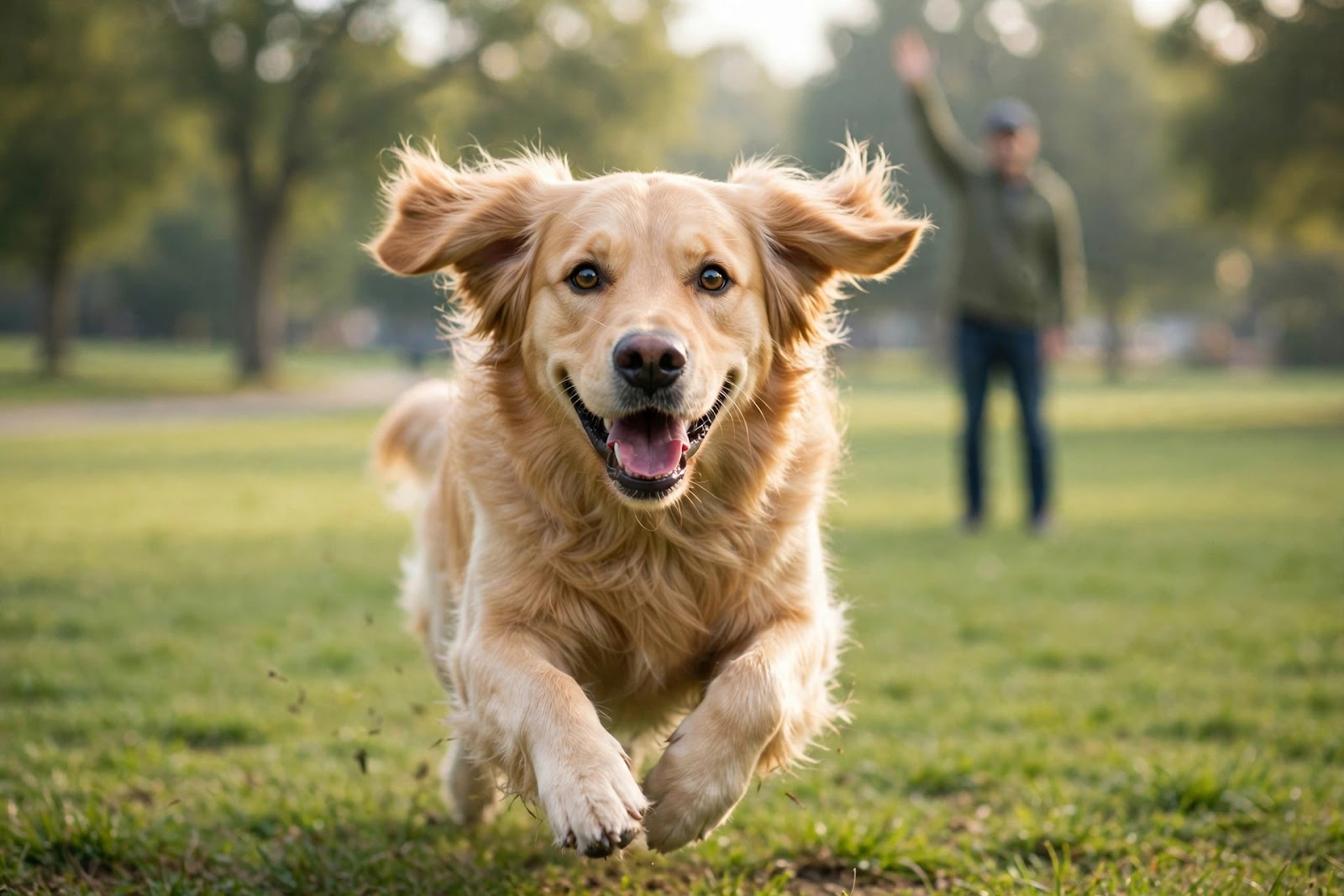
He comes tearing after me, of course. Dogs can't help it. A person running away from them is the most exciting thing in the world. When he catches up to me, I stop, crouch down, and give him the best treat I have. Not a dry biscuit. The good stuff — a bit of chicken, a chunk of cheese, something that smells like a party. I make a huge fuss of him for three or four seconds, then I let him wander off again, and we do it all over.
The first session lasted about five minutes, and I did maybe six rounds. He caught on by round three. By round five he was watching me out of the corner of his eye, waiting for the game to start, his whole body leaning toward me like a sprinter at the blocks. That was the moment I understood what I'd been missing. Recall isn't about obedience. It's about being more interesting than whatever else is going on, and for the first few weeks, I cheated shamelessly to make sure I always won that contest.
We played the game twice a day, morning and evening, for ten days. Always in the garden first, where there was nothing to compete with. Always one call, never repeated. If he didn't look at me — and that happened a few times in the early days — I didn't shout or repeat myself. I just waited, or walked a few steps closer and tried again later. The rule I made for myself was simple: the call only ever gets said once, and it only ever leads to something wonderful. I wanted his name to mean "run to me, something brilliant is about to happen," not "Mum's shouting again."
The Long Line Weeks
After ten days of the garden game, his recall in the garden was nearly perfect. So I moved us to the park, and this is where most people go wrong, because the jump from a quiet garden to a busy park is enormous. I didn't let him off the lead. Instead I bought a thirty-foot long line — one of those lightweight training leads, about twelve pounds from the pet shop — and I clipped it on and let it trail behind him.
The long line did two things. First, it kept him safe while he learned, because I could always step on it if he bolted toward a road or a dog that didn't want company. Second, and more importantly, it let me practise the game in the real world without gambling everything on a dog who wasn't ready yet. I called him, ran a few steps, and when he came flying back I paid him like he'd won the lottery. Same game, harder location.
We spent three weeks on the long line. Three weeks of walking the park with thirty feet of lead dragging through the grass, getting tangled around benches and my own ankles, and looking like a complete amateur. I didn't care. By the end of week two, he was coming back from forty feet away, past other dogs, past a discarded sandwich wrapper — which, for Milo, is basically treasure. By the end of week three, I was calling him once and he was spinning around mid-sniff and sprinting back to me.
The trick I learned during those weeks is that you don't graduate to off-lead by deciding you're brave enough. You graduate when the dog shows you he's ready, and he shows you by coming back when it's hard, not just when it's easy. Milo showed me on a wet Thursday morning when a rabbit crossed our path. He took two steps toward it, stopped, looked back at me, and came running. I gave him the whole handful of chicken I'd been saving and nearly cried into his ear. That's when I knew we'd got it.
The Rules I Still Follow
That was eight months ago, and his recall is still good, but I didn't stop there, because recall is one of those skills that rots quietly if you don't maintain it. Here are the rules I live by now, and I follow them even when it's inconvenient, because they are the reason the whole thing works.
Rule one: I call him once. If he doesn't come, I don't repeat myself. I go and get him, or I wait, or I make myself interesting in some other way — I crouch down, I make a silly noise, I run the other way. But I never, ever stand in the middle of a field shouting his name five times. The moment I do that, I'm teaching him that call number one is a suggestion.

Rule two: I never call him for something he hates. If it's bath time, or the nail clippers are out, or it's time to leave the park and go home, I go to him. His name stays clean. It only ever means good things — a treat, a game, a fuss, the car, a walk. The boring or unpleasant stuff is my job to handle quietly, not his name's job to announce.
Rule three: I pay him every single time, even now, months later. Not always with chicken — sometimes it's just a biscuit, sometimes it's a quick game of tug, sometimes it's just a big fuss and a "good boy" said like I mean it. But coming back to me is never, ever a waste of his time. That's the deal we made, and I keep it.
Rule four: I practise in boring places first whenever we go somewhere new. A new park, a new beach, a friend's garden — the first five minutes are always the game, on the long line, with the best treats I own. It sounds fussy, but it takes five minutes and it means the rest of the visit is relaxed instead of stressful. I'd rather spend five minutes warming up than twenty minutes chasing him past a pond.
Rule five, and this is the one people forget: I let him go again. When he comes back to me at the park, I don't always clip the lead on. Most of the time I treat him, make a fuss, and then say "go on, off you go" and send him back to play. He learned that coming to me doesn't end the fun — it pauses it for three seconds and then the fun starts again. Once he figured that out, his recall went from good to almost automatic.
The Whistle I Added Later
About a month after the long line weeks, I added a whistle, and I wish I'd done it sooner. My voice changes when I'm nervous — it goes higher, faster, a bit desperate — and Milo could hear that difference from a hundred feet away. A whistle sounds exactly the same every time, and it carries much further than my voice on a windy day at the park. I bought a plain pea whistle for about three pounds and spent a week pairing it with the jackpot: one toot, then chicken, over and over in the garden, until the sound itself meant something brilliant was coming.
Now I use the whistle for distance and my voice for close range, and the two together cover almost everything. The whistle got us through the hardest test yet, a windy morning at the beach when Milo was chasing seagulls and my voice was being carried away sideways. One toot, and he turned around like someone had flicked a switch. I gave him the whole pocket of cheese that day, because some recalls deserve a bonus. That's the other thing about the whistle: it's boring and consistent, and boring and consistent is exactly what a recall cue should be.
What It Looks Like Now
These days, Milo runs off-lead at the park most mornings, and I can call him back from other dogs, from puddles, from a dropped ice cream cone, and — twice now — from a squirrel. He doesn't come because he's scared of me. He comes because, in his head, my call means something brilliant is about to happen, and eight months of me proving that true has made it the most reliable thing in his world.
People at the park ask me how I did it, and they usually expect something complicated — a whistle, a special collar, a training course with a fancy name. When I tell them it was a game of chase in my garden and a thirty-foot lead, they look disappointed, like I should have a better story. But that's the whole point. The best training I ever did with my dog didn't feel like training at all. It felt like playing, and he never once noticed he was learning.
If your dog ignores you at the park, don't take it personally, and don't start shouting louder. Stop calling for a while. Start the game in your garden with the best treats you own. Be patient for three weeks. And the next time you call his name once, in a bright voice, and he spins around and comes tearing back to you like you're the best thing in the park — you'll know exactly what I mean when I say it's the best feeling in dog ownership. It beats everything, even the day he finally stopped stealing socks.


