The first wet week of last autumn broke me. My dog Milo came in from the garden after ten minutes in the rain and left a trail of muddy prints from the back door to the sofa, up the hall, and — I still don't know how — onto the rug by the front door. I spent forty minutes on my hands and knees with a cloth and a bucket. The next day it rained again. Same prints. Same forty minutes. By day three I was mopping the floor before he'd even dried off, which is a losing game, and I knew it.
That was the week I stopped treating muddy paws as a mess to clean up after and started treating it as a routine to run at the door. Not a big project. Not a new room or a fancy wash station. Just a small set of steps, done the same way every single time, in the same spot, so Milo learned what to do and I stopped chasing mud around the house.
It worked. It took about two weeks for him to get it, and about a month before it felt automatic for both of us. Now a muddy walk costs me three minutes at the door instead of forty minutes with a mop. My floors stay clean enough that I can walk barefoot without finding grit under my feet. And Milo, who used to bolt past me the second the door opened, now stops on the mat and waits. That one small change did more for my sanity than any cleaning product I've ever bought.
Here's the thing nobody told me when I got a dog: the mud isn't really the problem. The problem is that there's no plan. The dog comes in, you shout, the dog runs, the mud spreads, and then you're angry at an animal who has no idea what you wanted. A routine fixes that. It gives the dog a job to do at the door, and it gives you a calm two minutes instead of a frantic ten.
The mat that changed everything
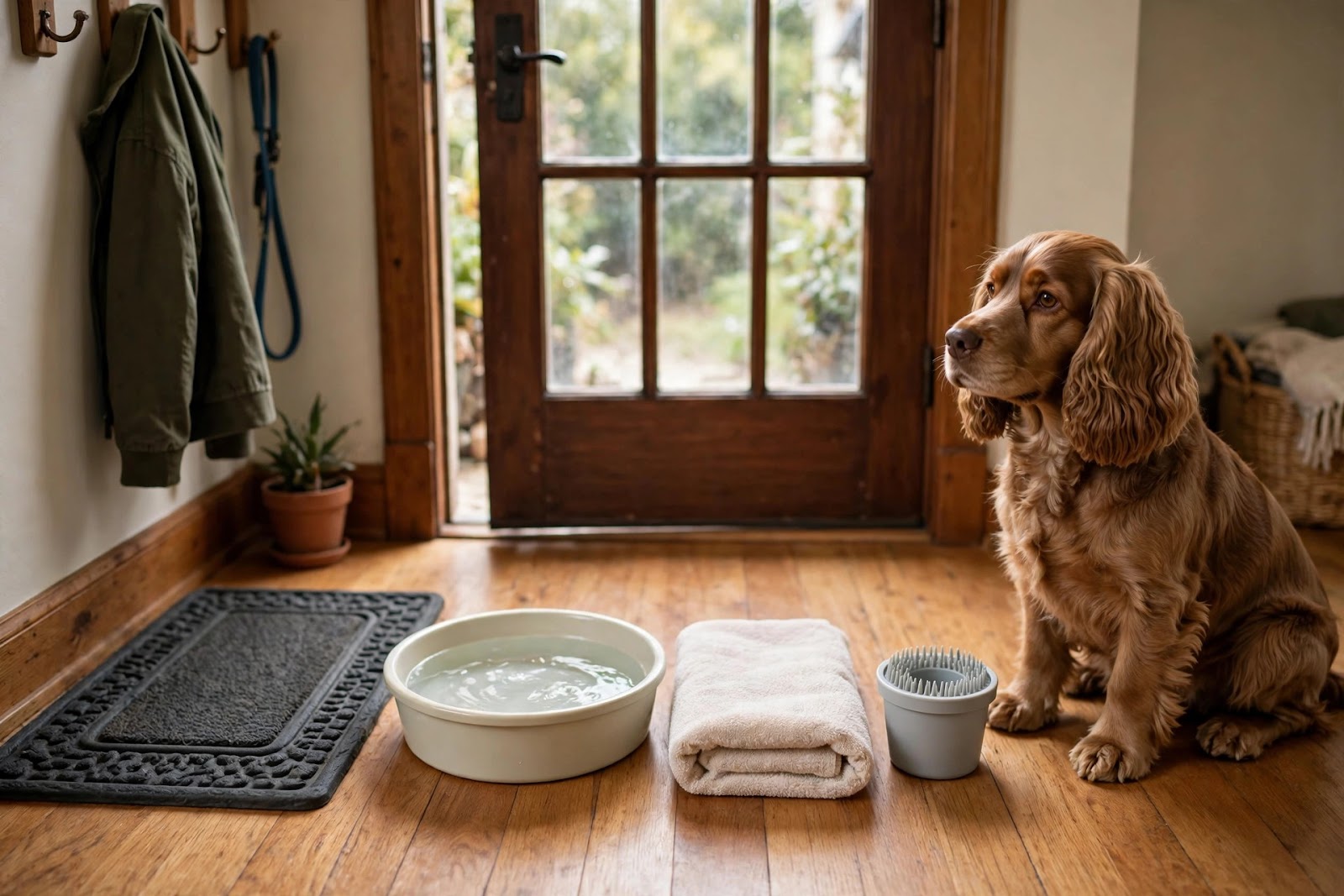
I started with the mat. I'd been using a thin little rug by the back door, the kind that slides around and does nothing. I replaced it with a big, heavy, rough-textured doormat, the kind with deep ridges that actually scrape mud off paws. It cost me about twelve pounds at a garden centre, and it was the best twelve pounds I've spent on dog stuff in years.
Size matters more than looks. The mat needs to be big enough for all four paws at once, with room for the dog to take a step or two on it. Mine is about ninety centimetres long and sixty wide. Milo can stand on it, turn around, and still be on the mat. If the mat is too small, two paws land on the floor, and you're back where you started.
I put a second mat inside as well, a soft absorbent one, right behind the rough one. The rough mat does the scraping. The soft mat does the drying. Milo steps from one to the other, and by the time he reaches the wood floor his paws are mostly clean and mostly dry. Mostly is enough. Perfect isn't the goal. Good enough at the door beats perfect after the fact, every time.
The mats need to stay put. A mat that slides is worse than no mat, because the dog learns not to trust it. I stuck a cheap non-slip pad under each one, the rubber mesh kind you cut to size. Total cost was under five pounds. They haven't moved since.
The towel station
Next came the towels. Before the routine, my dog towels lived in a cupboard down the hall, which meant that by the time I'd fetched one, Milo had already crossed the kitchen. Now there's a hook by the back door with two towels on it, always. One in use, one in the wash. That's the whole system.
I use old bath towels, cut in half. A full bath towel is too much for paws and it takes forever to dry. A half towel is just right: big enough to wrap a paw, small enough to hang up and dry by the next walk. I keep three or four in rotation. When one gets too stiff or too stained, it becomes a car towel and a new one takes its place.
The trick with the towel is the order. I dry the front paws first, then the back paws, then the belly if he's been lying in wet grass. Front paws first because that's what the dog expects after a few days, and routine is what makes a dog relax. The first time I did it, Milo danced around and tried to grab the towel. The tenth time, he stood still. The fiftieth time, he lifted each paw when I touched it. Dogs learn patterns fast when the pattern never changes.
I don't rub hard. Quick, firm pats work better than scrubbing, and they're kinder on the skin between the toes, which is where mud hides and where sore spots start. I check between the toes as I go, just a quick look. Twice now I've found a small stone wedged in there, and once a thorn. Two seconds of looking saved us a limp and a bad mood.

The paw wash for the really bad days
Some days a towel isn't enough. After a walk on a muddy field in February, Milo's legs look like he's been wading in chocolate. That's when the paw wash comes out. It's a small plastic tub, the kind you'd use for washing up, filled with a few inches of lukewarm water. I keep it by the back door with a jug next to it.
I dip one paw at a time, swish it gently, lift it out, and towel it dry. Four paws takes about ninety seconds once you get the hang of it. The water goes cloudy fast, which tells you how much mud was about to end up on your floor. I tip it down the outside drain and rinse the tub. Done.
Some people buy a special paw-washing cup, the kind with soft bristles inside. I tried one. It worked fine, but honestly the tub is easier to clean and holds more water, and I didn't want another gadget to store. If your dog hates having paws dipped, the cup can be gentler because you twist it on rather than dunking. Either way, the point is the same: water at the door, not mud on the rug.
One warning from my own mistake: don't use hot water. I did it once in a rush, straight from the kettle mixed with cold, and it was too warm. Milo yanked his paw out and wouldn't let me near it for a week. Lukewarm, the temperature you'd wash your own hands in, is right. Test it on your wrist first. It takes three seconds and it keeps the trust intact.
In winter I add one more step, and it's the one I wish someone had told me years ago. After walks on gritted pavements, I rinse his paws even when they don't look dirty. Road salt and grit sting cracked skin, and dogs lick it off, which is worse. A quick rinse, a quick dry, and we're done. It takes a minute and it has saved us more than one sore paw.
Teaching the wait
None of this works without the wait. The mat, the towels, the tub — they're all useless if the dog charges past you into the house. So the wait is the real skill, and it's the one I spent the most time on.
I started inside, with the back door closed. I asked Milo to sit, opened the door a crack, and closed it again when he moved. No shouting, no grabbing his collar, just the door closing. He figured it out in one evening: moving makes the door close, waiting makes it open. Dogs are quick when the rule is clear and the reward is obvious.
Then I moved the wait to the mat. Door opens, Milo steps onto the mat, and I close the door behind us. He waits on the mat while I dry his paws. Then I say "okay" and he goes. That word matters. It needs to be the same word every time, said in the same calm voice. I use "okay" because it's short and I say it like I mean it. Some people use "free" or "go on". Pick one and stick to it.
The first week, he broke the wait constantly. He'd wait for two paws and then bolt. I didn't chase him. I just called him back to the mat and started again. Chasing a wet dog through the house is a game to a dog, and it's a game you will lose. Calmly starting over is boring, and boring wins.
By week two, he waited for all four paws. By week three, he was lifting his paws for the towel without being asked. I gave him a small treat at the end of the routine for the first month, a single biscuit, every time. Then I faded it to every other time, then to sometimes. Now the routine itself is the habit, and the treat is just a bonus on rainy days. If your dog is food-mad like mine, keep the treat tiny. The point is the praise and the release word, not a second dinner.
What about guests and kids?
The routine gets tested most when other people come in. A guest opens the back door, Milo charges out to say hello, and the whole system falls apart. I fixed this with a simple rule: nobody opens the back door except me. It sounds strict, but it's the only way the routine survives. Guests use the front door. Kids in the family know the rule too. If someone else lets the dog out, they also have to do the paw routine, and most guests suddenly lose interest in opening that door at all.
If you have kids, teach them the towel part first. It's the easiest job and kids love having a dog job. My niece, who's eight, is now the official paw-dryer when she visits. She takes it very seriously, which means Milo takes it seriously too. Dogs read the energy in the room. A calm kid with a towel gets a calm dog.
The other test is the morning rush. You're late, the dog needs a quick garden trip, and the routine feels like a luxury you can't afford. That's exactly when you need it most, because a rushed dog is a muddy dog. I keep a pack of pet wipes by the door for those mornings. They're not as good as a towel and water, but they're fast: one wipe per paw, thirty seconds, done. They live in the same spot as the towels so I never have to hunt for them.
Keeping the kit clean
A mud routine only works if the kit itself is clean. Towels go in the wash twice a week in my house, more in wet weather. I wash them hot, with no fabric softener, because softener coats the fibres and stops them soaking up water. A towel that doesn't absorb is just a damp rag, and it smears mud around instead of picking it up.
The mats get shaken out every day and hosed down once a week. The rough mat traps a shocking amount of dirt in its ridges. I bang it against the garden wall, hose it, and leave it in the sun to dry. The soft mat goes in the washing machine once a week. If a mat starts to smell, it goes in the wash that day, no debate. A smelly mat is a mat the dog won't stand on, and I don't blame him.
The tub gets rinsed after every use and left upside down to dry. Standing water in a tub by the door goes slimy fast, and nobody wants that smell in their hallway. Once a month I give it a scrub with washing-up liquid and leave it in the sun. It takes five minutes and it keeps the whole station from turning into a swamp.
The mistakes I made
I made plenty. The first was buying a mat that was too small and too pretty. It looked lovely in the hallway and did nothing at all. Pretty mats are for front doors with no dog. Back doors need ugly, heavy, grippy mats. Buy the ugly one.
The second mistake was shouting. When Milo bolted past me with muddy paws, I shouted his name, and he ran faster. Of course he did. Shouting sounds like excitement to a dog. The day I stopped shouting and just stood still with the towel, he stopped running. Calm is contagious, in both directions.
The third mistake was doing the routine only on muddy days. The dog can't learn a routine that appears and disappears with the weather. We do it every single time he comes in from the garden now, even on dry sunny days when his paws are clean. It takes twenty seconds on a dry day. That daily practice is what makes the muddy days easy. If you only practise when it's hard, you'll never get good at it.
Why it matters more than clean floors
Here's what I didn't expect: the routine changed our walks. Because coming home stopped being a stressful scramble, I stopped dreading wet days. We go out more in the rain now. Milo gets more exercise, I get more fresh air, and the house stays clean. A small fix at the door unlocked a better week for both of us.
It also changed how Milo feels about coming home. Before, coming in meant being grabbed, wiped, and scolded. Now it means standing on his mat, getting his paws dried, getting a biscuit, and hearing his release word. He trots to the mat on his own now. Last week he came in from the garden, walked straight to the mat, and lifted his front paw before I'd even picked up the towel. I stood there for a second, towel in hand, genuinely proud of the pair of us.
If your hallway looks like a mud map after every walk, don't buy a bigger mop. Build a small routine at the door instead. Start with a mat big enough for four paws. Add a towel on a hook. Practise the wait for a week. That's it. You don't need a wash station, you don't need special gear, and you don't need a perfectly trained dog. You need the same three minutes, in the same spot, every single time.
Three minutes at the door, or forty minutes with a mop. I know which one I'd pick, and so does Milo. He just didn't know how to tell me until I gave him a mat to stand on.


