The chicken bone was on the pavement outside the fried chicken shop, and Milo saw it half a second before I did. One moment we were walking along nicely, the next my 31kg golden retriever was diving like a rugby player, and I was doing that thing dog owners do where you shout "no no no" while being dragged three steps behind your own dog. I got to him in time, prised the bone out of his mouth, and stood there on a busy pavement feeling like the worst owner in the world while Milo looked at me like I'd stolen his dinner.
That was the day I decided to teach "leave it" properly. Not the half-hearted version I'd been doing, where I'd wave a treat and say the words and hope for the best, but the real thing: a command that works when there's a chicken bone on the ground, a dropped sandwich in the park, and a whole pizza box tipped over by the bins. Six weeks later, Milo walked past a sausage roll on the pavement and didn't even slow down. I nearly cried. Here's exactly how we got there.
Why "leave it" matters more than "sit"
Sit is cute. Stay is useful. But "leave it" is the command that keeps your dog safe on an ordinary street. Dogs explore the world with their mouths, and the world is full of things they shouldn't eat: chicken bones, discarded food wrappers, dropped pills, bits of chocolate, mouldy bread, things I don't even want to identify. A dog who will drop something on command is a dog who can walk through a town centre without you having a panic attack every twenty metres.
I'd known this for ages. What I hadn't done was train it properly. My version of "leave it" was me holding a treat in my hand, saying the words, and giving him a different treat when he looked away. That works in your kitchen. It does not work on a pavement next to a chicken bone, because a chicken bone is about a hundred times more exciting than a biscuit in your kitchen. The gap between kitchen training and street reality is where most "leave it" training falls apart, and it's where mine fell apart too.
The other problem was me. I kept using "leave it" for everything: the food on the ground, the cat across the road, the interesting smell, the other dog's ball. The words became background noise. Milo heard "leave it" so often that it meant nothing at all. The first thing I had to fix was my own habit of saying it twenty times a day and expecting it to work on the twenty-first.
Week one: the boring kitchen version (that actually matters)
I started again from scratch, in the kitchen, with the door closed and nothing interesting going on. I put a boring biscuit on the floor, covered it with my hand, and waited. Milo sniffed my hand, pawed at it, nudged it, and eventually looked up at me, and the second he did, I gave him a piece of chicken from my other hand. Not the biscuit. The chicken. That's the deal with "leave it": the thing on the floor is never the reward. The reward always comes from you, and it's always better than the thing on the floor.
We did this for five minutes a day, three times a day, for a week. Short sessions, always ending while he was still keen. By day three, he was looking at me the second I put the biscuit down. By day five, I could put the biscuit on the floor uncovered, say "leave it" once, and he'd turn his head to me like a professional. It was about forty repetitions of the same boring little game, and that's what training actually is.
The mistake I made in week one: I got cocky on day four and tried it with a piece of cheese, which is Milo's favourite thing in the world. He stared at the cheese, stared at me, and then ate the cheese. I laughed, because it was genuinely funny, but it taught me something important: train with boring things first, and only make it harder when the easy version is solid. Cheese is a week-three problem, not a day-four problem.
Week two: moving the game outside
In week two, I took the game to the garden. Same biscuit, same hand, same chicken reward, but now there were smells and birds and the neighbour's cat watching from the fence. Milo was worse in the garden, which I expected. New place, new distractions, old habits wobbling. We went back to covering the biscuit with my hand for two days, and by the end of the week he was doing it uncovered on the patio too.

Then I added movement. I'd drop a biscuit a metre ahead of us on a walk around the garden, say "leave it" as we approached, and reward him with chicken when he walked past it. The first time, he walked straight over and ate it. The second time, he hesitated. The third time, he looked at me. By the fifth repetition, he was walking past the biscuit like it was a piece of litter, which, to be fair, is what it was.
Here's the detail that made the difference: I never said "leave it" twice. Once, calmly, and then I waited. If he didn't respond, I didn't repeat myself louder. I just stepped between him and the biscuit, waited for him to look at me, and rewarded that. Repeating a command teaches your dog that the first one doesn't count. Saying it once and then helping him succeed teaches him that the first one is the one that matters.
Week three: real food on real pavements
Week three was the scary one, because we took it to the street. I started on our quiet road early in the morning, when there wasn't much rubbish about. I'd spot something on the pavement ahead, a bit of dropped bread or a crisp packet, and I'd say "leave it" before Milo got to it, then reward him with chicken the second he turned to me. Timing is everything here. If you say it after he's already got his nose on the thing, you're too late. You have to catch the moment before the dive, when his ears go up and his pace quickens.
I also started carrying better treats on walks. Not his usual kibble, but the good stuff: tiny pieces of chicken and the dried liver treats he goes mad for. On the street, the reward has to beat the rubbish, and kibble doesn't beat a sausage roll. Liver does. This is the bit people skip because it feels like cheating, but it's not cheating, it's just being realistic about what you're competing with.
The big test came on a Thursday, outside the same fried chicken shop where the whole thing started. There was a bone on the pavement, in almost exactly the same spot. Milo saw it, his head went down, and I said "leave it" once. He stopped. He looked at me. I gave him liver, we walked on, and I stood on that pavement grinning like an idiot. Six weeks of boring kitchen games, and it worked on a real chicken bone on a real street. That's when I knew we'd actually done it.
The park test (and the sandwich incident)
The park was the next level, because the park has everything: picnics, dropped sandwiches, bins that overflow on sunny days, and other people's dogs dropping treats. I took Milo to the park on a lead for the first week of park training, and I kept the sessions short, ten minutes of walking and practising, then a game of fetch as the reward for the whole session.
The sandwich incident happened on day four. Someone had left half a sandwich on a bench, and Milo spotted it from about five metres away. He pulled towards it, I said "leave it", and he stopped, but I could see his whole body vibrating with the effort of it. I gave him a jackpot: five pieces of chicken, one after another, and then we walked away. He looked back twice.
That's the thing about "leave it": you're not teaching your dog that the thing on the ground is boring. You're teaching him that looking at you is more rewarding than the thing on the ground. That means you have to pay well, every time, especially in the early weeks. If you stop paying, he'll stop playing. I still reward Milo every single time he leaves something on a walk, months later. The reward is sometimes just a piece of kibble and a "good boy", but it's never nothing. Never let the payment stop.
What to do when it goes wrong (because it will)
It went wrong plenty of times, and it still does occasionally. Last month, Milo picked up a bread roll in the park before I could say anything, and he swallowed it in about two seconds flat. I felt that familiar flash of panic, checked him over, and he was fine, just pleased with himself. Dogs are fast. You will not win every time. What matters is what you do next.
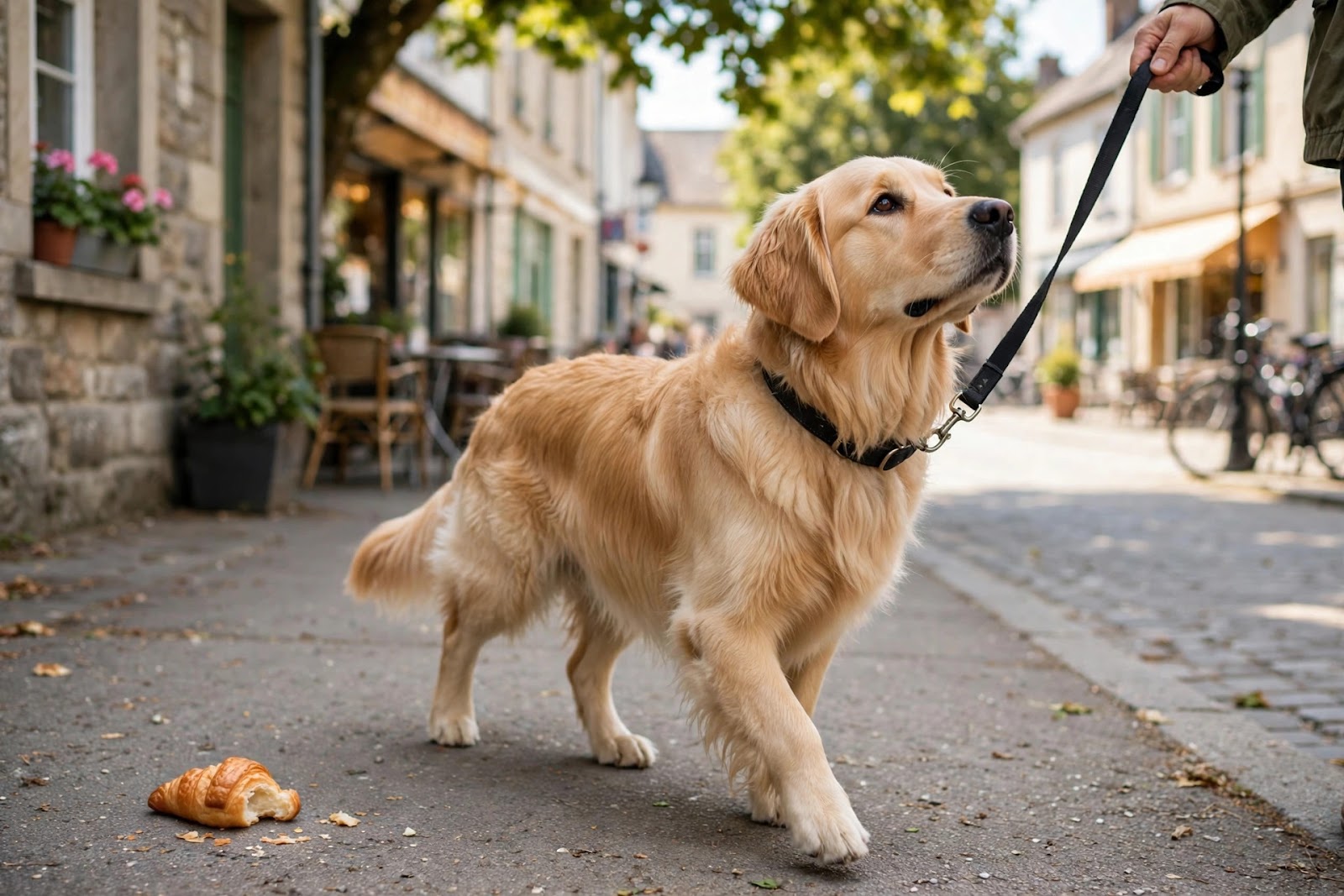
If he picks something up, don't chase him and don't shout. Chasing turns it into a game, and shouting makes him swallow faster. Walk calmly towards him, ask for a "drop it" if you've trained one, or trade him: hold out a piece of chicken and let him decide that the trade is worth it. If it's something dangerous and he's already got it, stay calm and get him to the vet if you're worried. Panicking helps nobody, least of all the dog.
The other thing that goes wrong: you say "leave it" when he hasn't learned it yet, in a situation that's too hard, and he ignores you. That's not him being stubborn. That's you asking for too much too soon. Go back a step, make it easier, and build up again. Training is a staircase, not a lift. Every time I got frustrated with Milo, it turned out I'd skipped a step, not that he'd forgotten the lesson.
Getting the whole household saying the same thing
One thing that nearly undid our progress was my brother visiting for a weekend and using completely different words. He'd say "no, drop that" and "ah ah" and "oi" all in the same walk, while I was saying "leave it" once, calmly. Milo was confused, my brother was frustrated, and by Sunday Milo had started ignoring both of us. It took three days to get back to where we'd been on Friday.
So we had a family meeting, which sounds grand for a two-word command, but it worked. Everyone in the house now says "leave it", once, in the same calm voice, and everyone carries treats. My brother keeps a little bag of kibble by the front door for walks, and he pays Milo just like I do. Consistency across people matters as much as consistency across days. If one person lets the dog eat the dropped chip and another person says no, the dog learns that the rules depend on who's holding the lead, and that's a lesson you don't want him learning.
The kids in our street learned it too, in their own way. There's a boy of about eight who always wants to give Milo a biscuit when we pass, and I taught him to hold it flat in his palm and say "leave it" with me before handing it over. Dogs learn faster when the whole world around them is speaking the same language.
The everyday version, months later
Months later, "leave it" is just part of our walks now. Milo sees something on the pavement, I say the words once, he looks at me, I pay him, we carry on. It's so routine that I barely notice it anymore, and that's the point. The best training disappears into everyday life until you can't remember when it wasn't there.
If you're starting this with your own dog, here's my honest advice. Start in the kitchen, with something boring, and pay better than the thing on the floor. Move outside slowly, garden before street, quiet street before busy street. Say it once. Carry the good treats. And expect it to take weeks, not days, because the version that works on a chicken bone is built from dozens of boring repetitions in your kitchen, and there's no shortcut past those.
The other thing I'd say: train it before you need it. I trained it after the chicken bone incident, when I was already scared. If I'd trained it when Milo was a puppy, calmly, over a few weeks, I'd never have had that panicked moment on the pavement at all. If your dog is young, or you've just brought a rescue home, start this week. Future you, standing on a pavement next to a chicken bone, will be very grateful.
Milo still notices everything on the pavement. He's a retriever; his nose is his job. But now he notices it, checks with me, and carries on. That little check-in, that look up at my face, is the whole point. It's not just a command. It's a conversation: I see something interesting, and I'm asking you whether it's mine. And most of the time, the answer is no, but the chicken in your pocket says yes to something better.


