The Night Milo Would Not Sit Still
The first week Milo lived with us, our evenings felt like a storm that never quite broke. He is a rescue, a lanky tan mix with ears too big for his head and a past I will never fully know. The shelter said he was about two, found wandering near a market, and sweet with people. All true. They did not say he had never learned how to do nothing. Every evening at six, right when I wanted to sit down with a cup of tea, he would pace the rug, nose the sofa cushions, steal a sock, drop it, steal another sock, and stare at me like I was the one being weird.
I tried what most people try first. I told him to lie down. I pointed at the floor. I bought a fancy calming chew that cost more than my lunch and did nothing at all. He would flop for ten seconds, sigh like a tired old man, then spring up again to investigate the fridge. It was not naughtiness, I could see that much. He just had no idea what I wanted from him, and no place in the house that clearly meant rest.
What a Mat Actually Means to a Dog
A mat is not magic. It is a small, clear deal: this spot, this texture, this corner of the room means settle down and stay there until I say otherwise. Dogs love clear deals. The mat gives them a job they can actually do, instead of a vague order like be calm, which means nothing to a dog. When Milo steps onto his mat now, his whole body changes. His shoulders drop. His breathing slows. He knows the script.
The trick, and it took me weeks to accept this, is that you are not teaching the dog to love a piece of fabric. You are teaching him that good things happen in one exact spot, over and over, until the spot itself starts to feel safe. That is why the mat has to stay in the same place at first. Move it around the house in week one and you have taught him nothing except that mats appear at random.
Picking the Right Mat (Mine Was Almost Wrong)
I started with a thick memory-foam bed that looked lovely in the shop. Milo hated it. It was too soft, too warm, and it slid across the wooden floor every time he stepped on it. He would put one paw on it, feel it move, and back off like it had bitten him. Fair enough. I would not lie on a raft either.
What worked was a flat woven rug mat, about 60 by 90 centimetres, with a rubber grip underneath. It cost very little, it stays put, and it is cool enough in summer. The size matters more than the brand. Your dog needs room to lie on his side with his legs stretched out, not curled up like a cat. If the mat is too small, he will hang half off it and never truly relax. If it is too big, it stops being a clear spot and becomes just more floor.
Wash it before you start. New mats smell of factory and plastic, and a nervous rescue dog notices that. I washed Milo's twice, let it dry in the sun, and rubbed an old T-shirt I had slept in over it. Sounds odd. It worked. By the time we started, the mat smelled like our house, not a warehouse.
The First Three Days: Treats on the Mat, Nothing Else

Here is the part I wish someone had told me plainly: for the first three days, do not ask for anything. Do not say lie down. Do not say stay. Just make the mat the best place in the house. Every time Milo so much as glanced at the mat, a treat landed on it. One paw on it, another treat. He sniffed it, treat. He stood on it for two seconds, three treats in a row, one after another, so staying felt better than leaving.
I used tiny soft treats, the kind you can break into pieces the size of a pea. Big biscuits slow everything down because the dog spends a minute crunching and forgets why he is there. I kept a small tub of treats on the side table, out of his reach but close to my hand. Sessions lasted five minutes, no more. I set a timer on my phone. Five minutes, then the tub went away and we did something else entirely.
By the end of day two, Milo was walking over to the mat on his own and looking at me expectantly. That is the moment most people rush. I nearly did. I wanted to add the word settle right away and start making him wait. I am glad I waited one more day. Day three, he started lying down on the mat without being asked, just to see if treats would appear. They did. That is the whole foundation: the dog chooses the mat because the mat pays.
Adding the Word, and the Lie-Down
On day four I added a word. I chose settle because it sounds calm and I could say it softly. Sit, down, place, bed, mat — any word works, honestly. Pick one and never change it. Dogs do not do synonyms. I waited until Milo stepped onto the mat, then said settle in a low, easy voice, and treated him the second his belly touched the mat. If he stood up again, no fuss, no scolding. I just waited. He would wander off, come back, and we would try again.
The lie-down part took patience. Some dogs drop like a sack of potatoes. Milo did a slow, suspicious fold, one leg at a time, like he was testing whether the floor would hold him. I treated the moment his elbows touched the mat, not a second later. Timing is everything here. Treat late and you have rewarded standing up again. Treat early and you have rewarded hovering. I kept my hand low, near the mat, so the treat landed on the mat and not in the air above it. Treats in the air teach jumping. Treats on the mat teach settling.
Within a week he would lie down on the word settle about eight times out of ten. The other two times he would stare at me, weigh his options, and then lie down anyway when I stayed quiet. Silence helped more than repeating the word. Repeating a cue five times teaches a dog that the first four do not count. I said it once, then I waited, arms folded, looking bored. Boredom, it turns out, is a great training tool.
Stretching the Wait, One Breath at a Time
This is where most mat training falls apart, mine included the first time I tried it years ago with a different dog. People go from two seconds to two minutes in a single session and then wonder why the dog gives up. The rule that saved us: add time in tiny steps, and pay for every step. Two seconds of lying down, treat. Five seconds, treat. Ten seconds, treat. If he broke at fifteen seconds, I did not sigh or correct him. I just went back to five seconds, paid well, and tried ten again later.
I also learned to treat him while he was still lying down, calmly, between his paws, instead of calling him off the mat to collect a treat. Calling him off teaches him that leaving is the reward. Dropping the treat between his paws teaches him that staying is the reward. Small difference, huge result. By the end of week two, Milo could settle for three or four minutes while I sat on the sofa with a book. Not perfectly, not every time, but often enough that I could see the shape of our evenings changing.
The other thing that helped was teaching a release word. I use okay, said brightly, which means you are free now. Without a release word, the dog has to guess when the job is over, and guessing dogs get up early. With one, he can relax fully because he knows I will tell him when we are done. I always release him before he breaks on his own. If I think he has about a minute left in him, I release at forty-five seconds and make a small fuss of him. Ending on a win beats ending on a failure every single time.
The First Real Test: Dinner Time
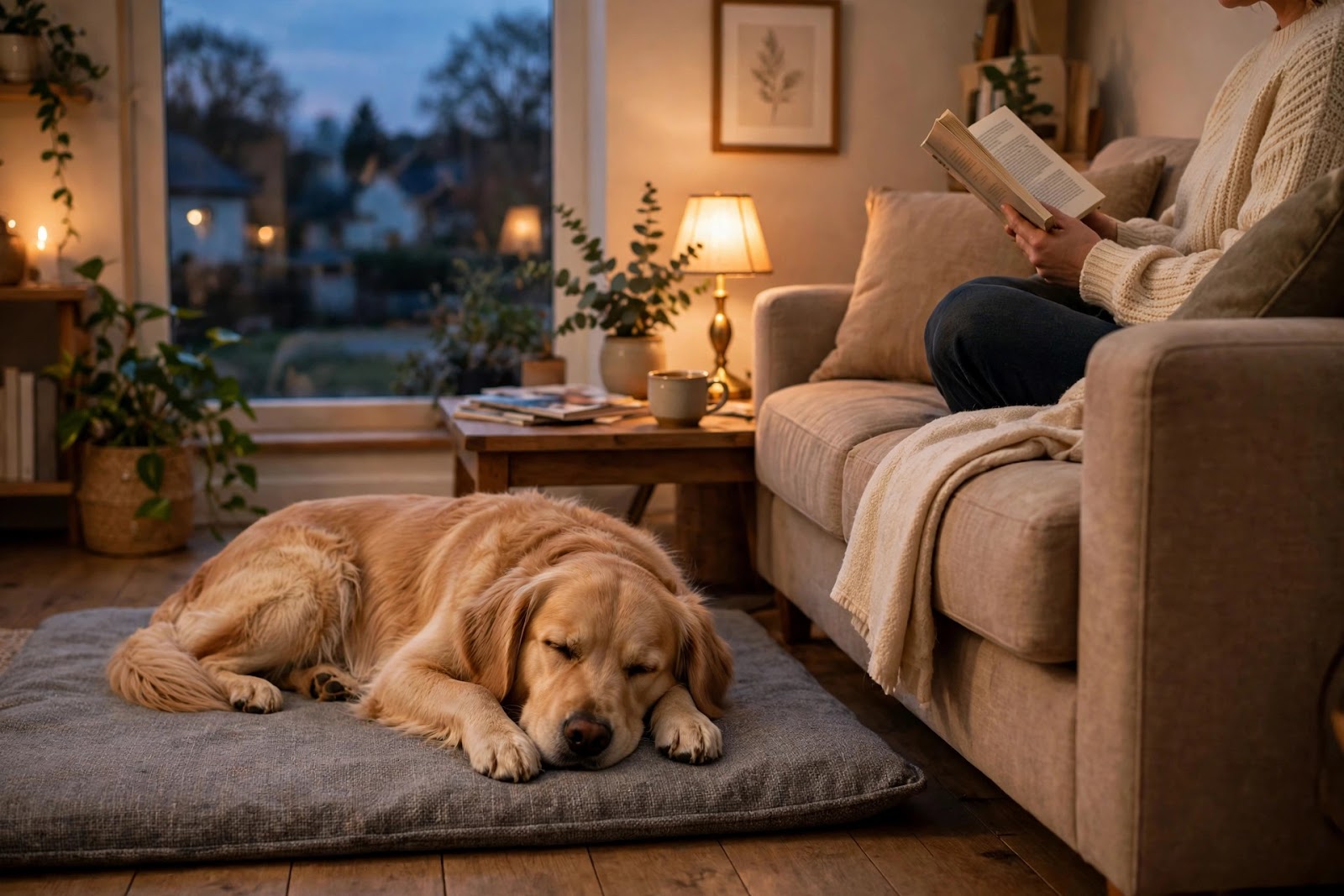
Our first real test came on a Tuesday. I was cooking, the kitchen smelled of garlic and chicken, and Milo was doing his usual orbit of the worktops, nose up, tail going. In the old days I would have shut him out of the kitchen or tripped over him four times. That night I pointed at the mat, said settle, and held my breath. He walked over, circled once, and lay down. I tossed him a treat from the chopping board. Two minutes later he was still there, chin on his paws, watching me with the long-suffering look of a dog who knows dinner is coming but not for him.
He lasted eight minutes. Then a piece of onion hit the floor and all bets were off. I laughed, because eight minutes was a small miracle, and I had been dropping food on purpose near the mat anyway — not on it, near it, so staying close paid better than begging at my feet. Within a fortnight he was settling through whole meals. My favourite part is the sigh he does now when he lies down, a big dramatic exhale, like a man settling into his favourite chair after a long day. I take it as a compliment.
Moving the Mat (and the Mistakes I Made Doing It)
After three solid weeks in the living room, I got confident and moved the mat to the kitchen during dinner. Mistake. He stared at it like a stranger. Of course he did. To him, mat-in-the-living-room and mat-in-the-kitchen were two different things. I had to start again, almost from scratch, in the new spot: treats for looking, treats for stepping on, then the word, then the wait. It went faster the second time — two days instead of two weeks — but it still needed doing.
That taught me the real lesson about this training: dogs do not generalise the way we do. A mat by the sofa is not the same as a mat by the back door. Each new spot needs its own short round of practice. I did the kitchen, then the hallway for when guests arrive, then a spot on the patio for summer evenings. Each move got quicker. By the fourth spot he walked to the mat, lay down, and looked at me like, yes, I know this game now.
The other mistake I made was using the mat as a punishment. Once, after he had barked at the postman for a solid minute, I marched him to the mat in a huff and told him to settle. He went, but he went stiff and unhappy, and for two days after that he avoided the mat entirely. I had poisoned it. A mat must never be where a dog goes when he is in trouble. It is the good place. If I need him out of the way when I am annoyed, I use a different room, not his mat. It took a week of extra treats to win the mat back. Lesson learned, and not repeated.
What Changed in Our Evenings
It is hard to explain how much one small habit changed our house. Before the mat, evenings were a negotiation. I would sit down, Milo would start his rounds, and by eight o'clock I felt like I had spent the whole evening managing a toddler. Now, at about half past six, he walks to his mat on his own, does his big sigh, and settles. I read. He dozes. Sometimes he snores, a soft rattling snore that makes me smile every single time.
Visitors notice it too. My neighbour came round last month and said, he is so calm now, what changed? Nothing dramatic. Just a mat, a tub of tiny treats, and three weeks of five-minute sessions. I did not fix Milo. He was never broken. I just finally gave him a clear answer to the question every rescue dog seems to ask in a new home: where do I go when nothing is happening? Now he knows. The mat. And when nothing is happening, the mat pays, in treats at first, and later in something better — a quiet house, a calm dog, and an evening that belongs to both of us.
If You Start Tonight, Start Small
If you take one thing from our story, make it this: start tonight, but start small. Put the mat down. Put a treat on it. Do nothing else. Five minutes, then stop. Do the same tomorrow. Do not worry about the word, the wait, or the guests at the door yet. Those come later, and they come easily once the mat itself means something good.
Pick a mat that stays put. Keep treats tiny and close by. Treat the dog on the mat, not off it. Add time in seconds, not minutes. Release him before he gives up. And never, ever use the mat when you are cross. That is the whole method, really. No gadgets, no apps, no expensive course. Just a mat, some patience, and a rescue dog who finally knows where rest lives in your house. Ours is in the corner by the sofa, slightly worn now, with a faint tea stain on one edge. Milo would not trade it for anything. Neither would I.


