The night Rusty came home from the shelter, I put a brand-new crate in the living room, lined it with a fluffy blanket, dropped a treat inside, and waited for him to walk in like the happy dogs in the videos. Rusty took one look at the metal bars, backed into the corner of the room, and shook. Not a little tremble. A full-body shake, ears flat, tail tucked so tight it nearly disappeared. He slept on the kitchen tiles that night, pressed against the wall, and I sat on the floor with him until two in the morning wondering what on earth I'd done wrong.
Nothing, as it turned out. Rusty had spent months in a shelter kennel, and a metal box with a door didn't feel like a bedroom to him. It felt like the place he'd just escaped from. Teaching him to love his crate took nearly two months, and it worked only when I stopped trying to convince him and started letting him decide, one tiny step at a time, that the crate was the safest, comfiest spot in the house. Today he naps in it with the door wide open, by choice, while the sofa sits empty ten feet away. That still makes me smile.
First, forget everything the videos show
Most crate training videos show a confident puppy trotting into a crate for a treat in about ninety seconds. If your dog does that, wonderful, enjoy it. If your dog is a rescue, or nervous, or has any history with confinement, those videos will make you feel like a failure, and that feeling makes you rush, and rushing is exactly what breaks crate training.
The first thing I changed was the crate itself. I moved it out of the busy hallway and into a quiet corner of the living room, where Rusty could see us but wasn't in the traffic. I took the door off entirely for the first two weeks. A door that can't close can't trap you, and for a nervous dog, that matters more than any treat. I covered the top and three sides with a light blanket, leaving the front open, so it felt like a den instead of a cage. Inside went a thick bed, not the thin pad that came with the crate, and one of my old sweatshirts, unwashed, because my smell seemed to calm him.
Then I did nothing. I just left it there. Treats appeared near it, then just inside the entrance, then a little deeper, over days, not hours. Rusty would stretch his neck in, grab a treat, and back out like he'd stolen something. I never pushed him, never lured him further than he wanted to go, never closed the door. Some days he ignored the crate completely, and I let him. Patience felt painfully slow, but every time he chose to go near it on his own, the crate got a little less scary.
Meals: the turning point
The real turning point was meals. Once Rusty would happily step inside to grab a treat, I started feeding him just inside the crate entrance, door still off, bowl where he could eat with his back end sticking out if he wanted. Over a week, I moved the bowl a few inches deeper every couple of days. Nobody made a fuss about it. No ceremony, no cheerleading. Just dinner, in the crate, same as always.
By the third week, Rusty was walking all the way in for meals without thinking about it, and he'd linger after eating, sniffing his bed, sometimes lying down for a minute. That's when I put the door back on, but left it open, tied to the side so it couldn't swing shut by accident. A swinging crate door slamming behind a nervous dog can undo weeks of work in one second. I tied it with a bit of cord, and it stayed tied for another fortnight.
Then came the first closed door, and I did it wrong the first time. I closed it while he was eating, thinking he'd barely notice. He noticed. He finished eating, turned around, saw the closed door, and panicked, scrabbling at the bars. I opened it immediately, no scolding, and we went back to door-open meals for three days. The second attempt, I closed it for literally ten seconds while he was licking the last of his dinner, then opened it before he even looked up. Ten seconds, then twenty, then a minute. Slow is fast with a nervous dog. Every boring, uneventful repetition was a deposit in the bank.
The games that made it fun
Once Rusty was comfortable eating in the crate, we turned it into a game, and games changed his feelings about it faster than food alone. The simplest one: I'd toss a treat into the crate, say "crate," and when he went in to get it, I'd say "yes" and toss another treat in. Then I'd call him out, treat him outside, and repeat. In, out, in, out. The crate became a place where treats rained from the sky, and more importantly, a place he could always leave. Dogs who know they can leave stop fearing being stuck.
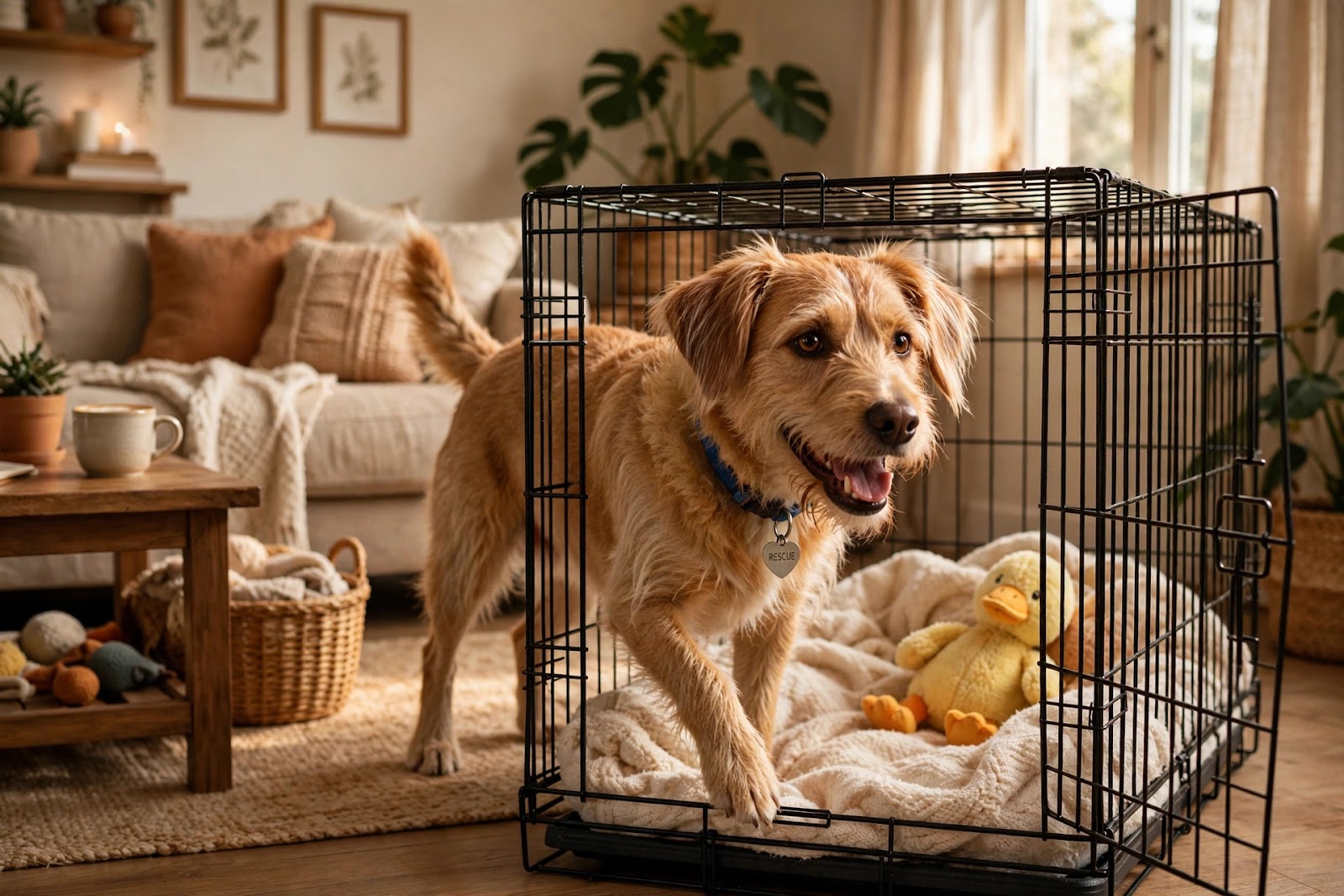
We also used long-lasting chews, but only in the crate. A stuffed chew toy or a safe long chew appeared in the crate and nowhere else, so the crate became the only place in the house where that particular good thing happened. I was careful with this, though. A chew that's too hard or too small can be a hazard, so I picked ones suited to Rusty's size and I stayed nearby, especially at first. The point was a happy association, not a babysitter.
Another game that helped enormously: the "go to your crate" cue, taught backwards. Instead of pointing at the crate and hoping, I waited for Rusty to wander in on his own, then said the word "crate" as he did it, then treated him. Word follows action, not the other way around. Within a week he was trotting in on the word alone, tail up, expecting good things. That cue is now one of the most useful things he knows, especially when workmen come to the house or the front door needs to stay open.
The rules I wish I'd known on day one
There are a few rules that, once I followed them properly, made everything else easier. First: the crate is never a punishment. Never, not once, not even when you're frustrated. The second you shove a dog into a crate after bad behaviour, the crate becomes the naughty place, and you've just poisoned the whole project. When Rusty chewed my shoe in week four, I took a deep breath, put the shoe away, and gave him a chew toy in the kitchen. The crate stayed innocent.
Second: don't crate a dog who hasn't had exercise and a toilet break. A tired, empty dog settles. A wired, bursting dog paces and whines, and then you start thinking the crate is the problem when the real problem is an unmet need. Rusty's evening crate time always follows a walk and a garden trip, never precedes them.
Third: whining is information, not defiance. Early on, Rusty whined a few times when the door closed, and my instinct was to ignore it completely, because that's what a lot of advice says. But there's a difference between a dog grumbling as he settles and a dog in genuine distress, panting, drooling, scrabbling at the door. The first settles in a minute or two. The second means you've gone too far, too fast, and you should open the door and go back a step. Learning to tell those apart took time, but it saved us from turning crate time into a trauma.
The setback that nearly broke it
Just when I thought we were done, a thunderstorm hit at midnight, and Rusty, who was sleeping in his crate with the door open, woke in a panic and wedged himself behind the sofa. He wouldn't go near the crate for three days after that. Not because of the crate, but because the crate was where he'd been when the storm scared him, and dogs link places to feelings very efficiently.
I didn't force it. We went back to treats near the crate, meals at the entrance, and a few nights where he slept on his bed next to the crate instead of inside it. By the end of the week he was back in, and this time he stayed through a smaller storm, tucked into his bed, a bit tense but not panicked. Setbacks aren't failures. They're information about where your dog's confidence actually ends, and the recovery is often faster than the original training because the good associations are still underneath.
That storm also taught me to think about crate placement during scary events. Now, on firework nights or stormy evenings, Rusty's crate gets an extra blanket over the top, a long chew, and a radio playing low nearby. He has a safe den, and we've learned to make it even safer on the nights he needs it most.
How long should a dog stay in a crate?
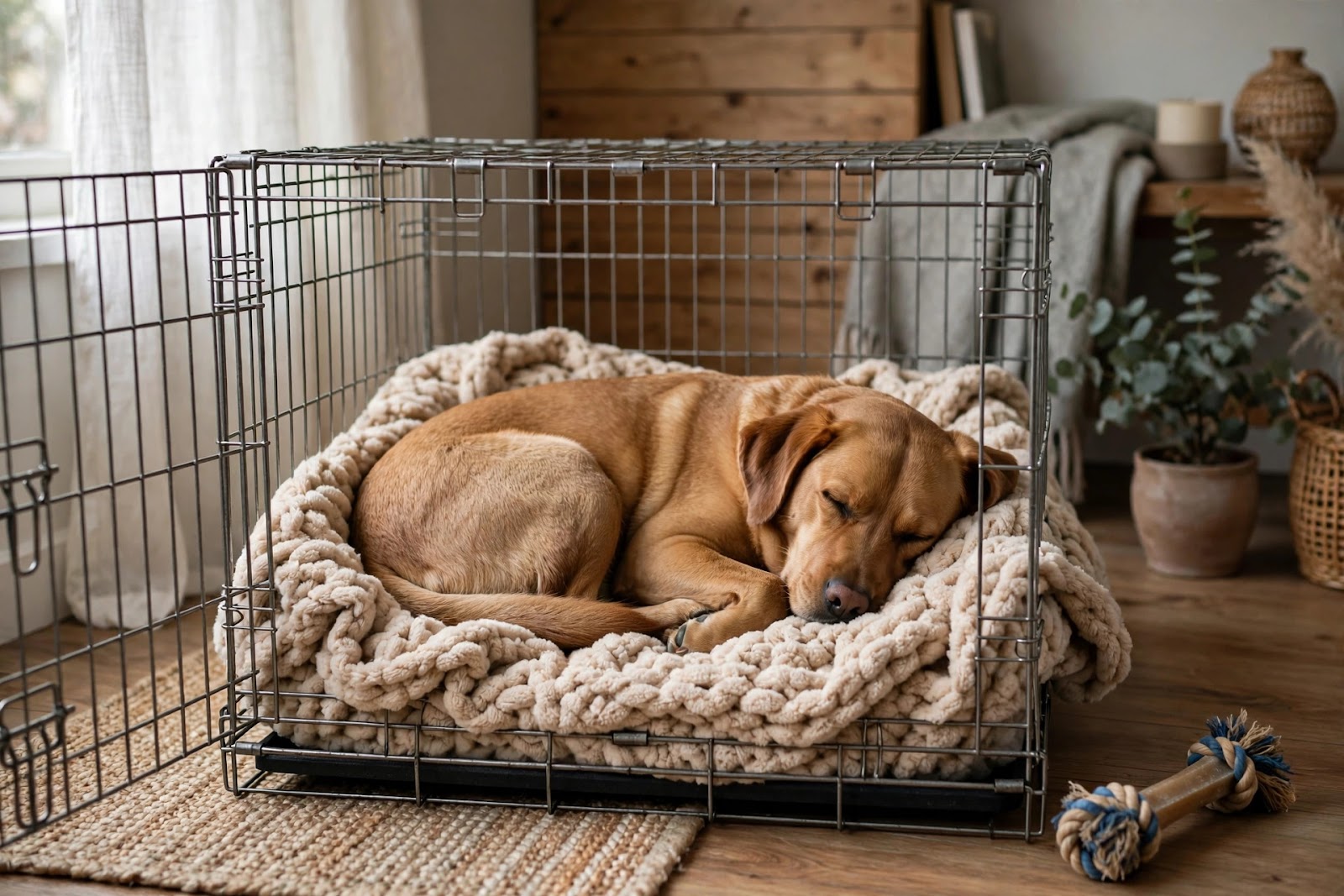
This question comes up constantly, and the honest answer is: less than people think, and never as a substitute for company, exercise, or training. Rusty uses his crate mostly by choice now. He naps there in the afternoon, sleeps there at night with the door open, and goes in on cue when the house is chaotic. On a normal day, the door is closed for maybe an hour or two total, usually when someone's working at the front door or we're eating a big family meal and he'd rather not be underfoot.
Puppies and young dogs need even shorter stretches, with frequent breaks, and no dog should spend most of the day crated. If your lifestyle means the dog would be crated for eight hours, a crate isn't the solution. A dog walker, daycare, or a rethink of the routine is. The crate works beautifully as a bedroom and a safe space. It works terribly as a storage box, and dogs know the difference.
What it looks like now
These days, the crate is the least interesting thing in our house, and that's the highest praise I can give it. Rusty wanders in after his evening walk, circles his bed three times, exactly three, and flops down with a sigh. Sometimes he drags a toy in with him. Sometimes he sleeps with his nose poking out of the door. When guests come over, he often retreats there on his own, because it's his spot, and guests know to leave him alone when he's in it. That last rule matters: a crate only stays a safe space if it's respected as one. Nobody reaches in to drag him out, nobody pokes at him through the bars, and kids in our house know that crate time is do-not-disturb time.
If you're standing where I stood on that first night, with a shaking dog and a crate that feels like a mistake, here's what I'd tell you. Slow down. Take the door off. Let the dog choose. Feed meals in it, play games around it, and never use it as a punishment. Measure progress in weeks, not days, and celebrate the small wins: a nose inside the door, a paw over the threshold, a full meal eaten inside without a second thought.
Rusty didn't learn to love his crate because I trained him brilliantly. He learned because I finally stopped rushing him and let the crate prove itself, one treat, one meal, one peaceful nap at a time. Give your dog that same patience, and there's a good chance you'll end up with what we have now: a dog who walks into his crate, sighs happily, and wonders what all the fuss was about.
A quick word on size, because it matters
One thing I got wrong at the start was crate size. The first crate I bought was huge, because I thought bigger meant kinder. Rusty hated it. It felt exposed, not cosy, and he slept curled in one corner as far from the door as possible. When I swapped to a crate just big enough for him to stand up, turn around, and stretch out comfortably, he settled much faster. Dogs are den animals. A snug space feels safe. A cavern feels like somewhere you could be ambushed.
Measure your dog, not your guilt. Standing height, length from nose to tail base, and then check the manufacturer's guide. If your dog is still growing, a crate with a divider panel lets you expand the space as they grow, without buying twice. And whatever size you pick, keep the inside simple: a bed, a safe chew, water nearby but not necessarily inside overnight unless your vet or trainer suggests it, since a spilled bowl in a crate just means a wet, unhappy dog at 3 a.m.
Get the size right, keep the door open at first, and let the crate earn its reputation. Rusty's crate is his favourite spot in the house now, and it got there one quiet, patient day at a time.


