The Night My Sister Said It Out Loud
We were sitting on my sofa watching a film when my sister wrinkled her nose and said, "It smells like dog in here." Not in a mean way. Just a fact, delivered the way sisters deliver facts. I'd been living with Milo for two years and I couldn't smell a thing. That's the thing about dog smell: you go nose-blind to your own house within weeks, and it takes a visitor to tell you the truth. I laughed it off that night. Then I spent the next month sniffing my own sofa like a weirdo, asking friends to be honest with me, and working out what actually gets rid of dog smell versus what just covers it up with a different smell for an hour.
Here's the honest result, after a lot of trial and error and one very expensive candle that did nothing: you can get a house with a dog to smell like a house without a dog. It takes a routine, not a miracle product, and it takes about twenty minutes a week once the routine is in place. The sofa, the car, and my coat were the three worst offenders, so that's where I started, and that's what this article is about. No magic sprays. Just what worked, what didn't, and the order to do it in.
First, the Dog Himself (Because the Sofa Isn't the Source)
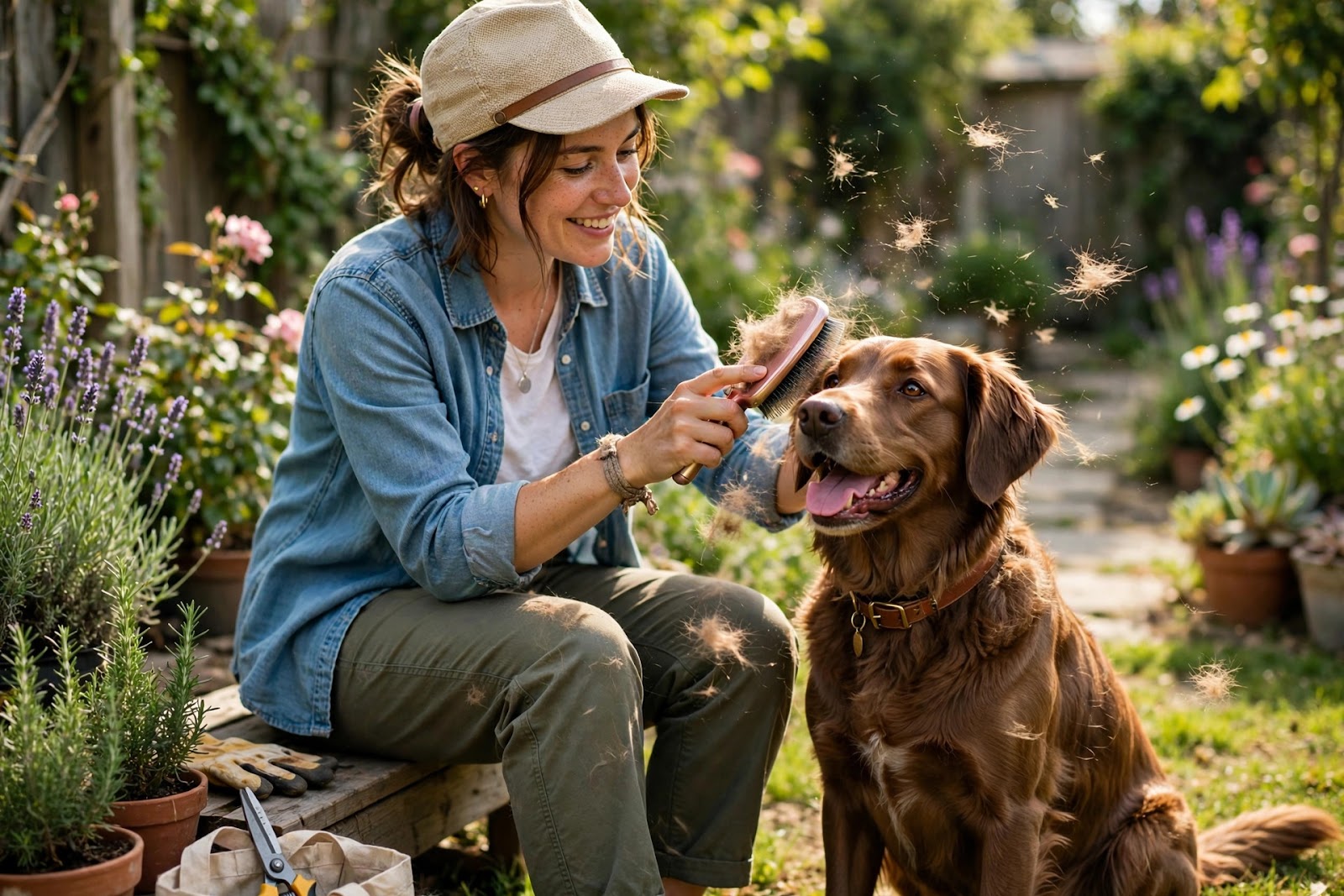
I spent my first week spraying the sofa and wondering why the smell came back in a day. Then it clicked: the sofa wasn't the source. Milo was. He was the thing that smelled, and everything he touched just borrowed it. So the first fix was him, and it was embarrassingly simple. I started brushing him properly, twice a week, for ten minutes, outside in the garden. The amount of loose hair and dead skin that came off was horrifying, and the smell difference in the house within a week was obvious. A dog that isn't brushed is a dog wearing a coat of old hair and skin oils, and that coat is what your sofa is picking up.
I also changed how I bathe him. I used to bath him whenever he smelled, which was about once a month, and I'd use whatever shampoo was on offer. Now I bath him every three to four weeks with a proper dog shampoo, and I rinse him twice as long as I think I need to. The rinse is the secret. Shampoo left in the coat goes stale and smells worse than the dog did before the bath. I rinse until the water runs completely clear and the coat squeaks slightly between my fingers. Then I towel dry him properly instead of letting him drip around the house, because a damp dog shaking himself dry on the sofa is undoing all your work in one enthusiastic minute.
The other thing that made a surprising difference: his ears and his paws. Milo's ears get a bit waxy, and waxy ears smell. A quick wipe with a damp cloth once a week, just the outer ear, nothing poked inside, sorted it. And his paws get wiped every time we come in from a wet walk, because muddy paws mean muddy sofa. None of this is glamorous. All of it is the actual answer. If you only do one thing from this article, brush your dog twice a week. It's the highest return for the lowest effort, and your dog will love you for it.
The Sofa: Where I Finally Won
My sofa is fabric, grey, and it had absorbed two years of Milo. The first thing I did was take the covers off, which sounds obvious, but I'd never actually done it. I'd been spraying the covers while they were on the sofa, which is like trying to wash a shirt while you're wearing it. The covers went in the washing machine on a normal cycle with a cup of white vinegar in the rinse. The vinegar smell disappears as it dries, and it takes the dog smell with it. I know it sounds like one of those internet tips that doesn't work. It works. I do it once a month now, and the covers come out smelling like nothing, which is exactly what you want. Smelling like nothing is the goal.
For the parts I couldn't take off, I used bicarbonate of soda, and this is the one product I will actually recommend by name, because it's about a pound a box. I sprinkled it generously over the sofa arms and seat cushions, left it for four hours while Milo and I went to the park, then vacuumed it up with the upholstery attachment. The first time I did it, the smell difference was immediate. Not covered up. Gone. I do it every fortnight now, and it takes five minutes of actual effort plus waiting time. Leave it longer if you can; overnight is even better if you have somewhere else to sit.
The vacuum itself mattered too. I was using a vacuum with a full bag and a clogged filter, and wondering why the sofa still smelled after vacuuming. A vacuum with a full bag just blows warm, doggy air around the room. I empty it after every dog-related clean now, I wash the filter once a month, and I vacuum the sofa twice a week with the upholstery tool, not just the floor head. The floor head doesn't get into the seams where the hair and the smell collect. Get into the seams. Get under the cushions. Get down the back where the remote controls and the old treats live. That's where the smell hides.
One more sofa thing: I bought a washable throw and put it over Milo's favourite end of the sofa. He sleeps there every evening, so that's where the smell concentrates. The throw goes in the wash once a week, and the sofa underneath stays clean. It cost twelve pounds and it has saved the sofa. If your dog has a favourite spot, cover that spot, not the whole sofa. Target the problem, not the furniture.
The Car: A Smaller Space With a Bigger Problem
The car was worse than the sofa, because it's a small sealed box and Milo goes in it after muddy walks. The first time I really noticed it was a hot day in June. I opened the car door and the smell hit me like a wall. I tried air fresheners, and they just made it smell like a dog wearing cheap perfume. The fix was the same as the sofa, just smaller and more thorough.
I started by taking everything out of the car. Not just the obvious stuff. Everything. The boot liner, the seat covers, the floor mats, the random blanket, the bag of spare leads, the old towel. All of it got washed or shaken out. Then I vacuumed every surface, including under the seats and down the sides of the seat runners, where a truly impressive amount of hair and biscuit crumbs had collected. Then the bicarbonate of soda treatment on the seats and the boot carpet, left for a few hours, vacuumed off. The car smelled like nothing afterwards, and I nearly cried with relief.
Now the car has rules, and the rules are what keep it clean. Milo travels on a washable hammock-style seat cover, which catches the hair and the mud and goes in the washing machine once a week. He doesn't get in the car muddy anymore; he gets a towel rub at the park before we leave, which takes two minutes and saves the whole interior. And I leave the windows cracked open for ten minutes after a walk, when it's safe to do so, to air the car out instead of sealing the damp dog smell in. A damp dog in a sealed car is a smell factory. Air is free, and it's the best deodoriser there is.
The other car trick is the one I wish I'd known years ago: a small bowl of bicarbonate of soda left in the boot overnight, or a fabric bag of it tucked under a seat, absorbs smells passively. It's not a fix for a dirty car, but it's brilliant for maintenance once the car is clean. I also keep a spare towel and a packet of wet wipes in the boot at all times, because the best time to deal with a muddy dog is before he gets in the car, not after he's shaken himself all over the back seat.
My Coat: The One I Didn't Know Was the Problem

This one embarrassed me. I took my coat to the dry cleaners because it smelled faintly of dog, and the woman behind the counter didn't even blink. "Dog owner?" she said. "We get a lot of these." My coat had been absorbing Milo every time he jumped up at me, every time I carried him, every time I sat on the floor with him. And because I wore it every day, I couldn't smell it at all. My coat was walking around telling everyone I had a dog, and I had no idea.
The fix was simple once I knew. My dog-walking coat and my nice coat are now two different coats. The walking coat is a waterproof jacket that can go in the washing machine, and it gets washed once a week in winter and once a fortnight in summer. The nice coat never goes near the park. It sounds obvious written down, but I wore one coat for everything for two years, and the difference after separating them was immediate. If you only own one coat, get a cheap waterproof over-jacket for dog walks. It costs less than one dry-cleaning bill and it saves your good coat.
For the walking coat itself, the same vinegar trick works. A cup of white vinegar in the wash, or a soak in water with a splash of vinegar before washing, takes the dog smell out of waterproof fabric that normal detergent leaves behind. And hang it to dry outside when you can, because fresh air does more for a smelly coat than any spray. I also keep a separate pair of dog-walking shoes by the door, because shoes track the smell in just like coats do, and muddy shoes by the radiator are a smell all of their own.
What Doesn't Work (My Honest List)
Let me save you the money I wasted. Plug-in air fresheners don't remove dog smell, they just add a second smell, and in a small room the combination is worse than either one alone. Scented candles are the same, plus they're a fire risk with a waggy tail in the house. Fabric sprays that promise to "eliminate odours" mostly mask them for an hour and then the dog smell comes back, because the source is still there. And the expensive enzyme sprays are brilliant for accidents and sick, genuinely, but they're overkill for general dog smell, and using them on your whole sofa every week is like using a fire extinguisher to light a candle.
The other thing that doesn't work is cleaning in the wrong order. I used to vacuum first and then wonder why the smell stayed. Now I know: brush the dog, wash the covers, bicarb the fixed parts, then vacuum. The order matters, because each step removes the source for the next one. Spraying a dirty sofa is like putting perfume on without showering. It doesn't work, and everyone can tell.
And a warning, because I learned this the hard way: be careful with any cleaning product around your dog. Some air fresheners, essential oils and plug-ins are genuinely harmful to dogs, and some floor cleaners leave residues that dogs lick off their paws. I use plain white vinegar, bicarbonate of soda, and a dog-safe floor cleaner, and that's it. If a product doesn't say it's pet-safe, I don't use it where Milo walks, sleeps or eats. His nose is about ten thousand times more sensitive than mine, and what's a pleasant scent to me can be overwhelming or even dangerous to him. When in doubt, leave it out.
The Routine That Keeps It Gone
Here's the whole routine, the one I actually stick to, because it fits into a normal week. Monday: brush Milo for ten minutes in the garden. Wednesday: vacuum the sofa and the rug with the upholstery tool. Friday: wash the sofa throw and the car seat cover. Once a month: covers off the sofa, vinegar in the rinse, bicarb on the fixed cushions, car deep clean. That's it. About twenty minutes a week, plus the monthly hour. The house smells like nothing, visitors stop wrinkling their noses, and I stopped being the person who panics when someone comes round unannounced.
The real lesson from all of this is that dog smell isn't a single problem with a single product. It's a chain: the dog, the sofa, the car, the coat, the shoes, the rug. You have to work along the whole chain, and you have to do it regularly, because a dog keeps being a dog every single day. But once the routine is in place, it's easy. The hard part was admitting the house smelled in the first place, and I have my sister to thank for that. She was right. It did smell like dog in here. It doesn't anymore.


