There was a month last spring when my bank balance and my dog's dinner collided head-on. I'd just had a slow freelance month, the rent had gone out, and I was standing in the pet aisle staring at a bag of kibble that cost more than my weekly food shop. My golden retriever, Milo, sat by the trolley looking up at me like I had it all under control. I did not.
Here's the thing nobody tells you when you bring a dog home: the food bill never stops. Toys wear out, leads get chewed, but food is every single day, twice a day, forever. And when money gets tight, the dog still needs dinner. That month forced me to figure out how to feed Milo properly without spending money I didn't have, and honestly? Some of what I learned that month made his diet better, not worse.
I'm not a vet and I'm not a canine nutritionist. I'm just an owner who had to get practical fast. Everything below is what I actually did, what it cost, and where I went wrong along the way. If your dog has a health condition or a special diet from your vet, follow that first. This is for healthy dogs and owners watching every pound.
The week I actually wrote down what I was spending
The first thing I did was stop guessing. I grabbed a notebook and wrote down every dog-food purchase for two weeks: the kibble, the treats, the dental sticks, the random pouch of wet food I bought because Milo looked bored. The total made me wince. I was spending about £68 a month, and a chunk of it was stuff he didn't need at all.
The dental sticks were the worst offender. They cost nearly £9 a pack and lasted four days. The fancy training treats were £6 a bag. And I'd been buying wet food as a topper most nights, another £12 a month, mostly because I felt guilty serving dry kibble on its own. Milo, for the record, had never once complained about dry kibble. The guilt was mine, not his.
So I set a target: £40 a month for everything food-related. Not because £40 is some magic number, but because it was what I could actually afford that month without dipping into money I needed elsewhere. Having a real number changed every decision after that. Instead of "is this good for him?" I started asking "is this worth it at this price?" Those are different questions, and the second one is much more useful when money is tight.
The kibble switch that saved me £18 a month
The biggest saving came from the kibble itself. Milo had been eating a mid-range brand at £42 for a 12kg bag, which lasted about five weeks. That worked out to roughly £36 a month. I spent an evening comparing labels in three different shops, and what I found surprised me: a different brand at £28 for a 12kg bag had almost the same first ingredients, the same protein percentage on the label (26% versus 27%), and the same feeding guide for a dog his size.
I switched him over slowly, a week of mixing the old and new, a little more new each day. He had one soft stool on day three and then nothing. No drama at all. That switch alone saved me about £14 a month, and Milo genuinely couldn't tell the difference. His coat stayed shiny, his energy stayed the same, and his weight held steady at 31kg, which I checked on the vet's scale a month later.
The lesson I took from that: the price on the bag is not a quality score. Read the label. Look for a named meat or meat meal as the first ingredient, a protein percentage that suits your dog's size and activity, and a feeding guide that makes sense. If you're unsure, ask your vet at your next routine visit what protein level suits your dog. Don't pay for a pretty bag and a famous name unless the label earns it.
One mistake I made here: I bought the cheapest bag in the shop first, the £16 one, and tried it before doing the label check. Milo ate it fine for two days and then started leaving half his bowl. The protein was only 18%, it was mostly maize, and the feeding guide told me to give him nearly twice as much to hit his daily needs. Cheap per bag, expensive per meal. I gave the rest of that bag to a neighbour whose dog liked it, and I learned to compare cost per day, not cost per bag.
Cost per day is the only number that matters
This is the bit that changed everything for me. Two bags can cost £15 apart and the expensive one can still be cheaper to feed, because you feed less of it each day. Here's my actual math for Milo, a 31kg dog eating about 350g a day of his current kibble:
The £28 bag holds 12kg. At 350g a day, it lasts 34 days. That's 82p a day. The old £42 bag also held 12kg, and at the same daily amount it also lasted 34 days. That's £1.24 a day. Same bowl, same dog, 42p a day saved. Over a month, that's about £13. Over a year, more than £150.
I worked this out on my phone calculator in the aisle, and I still do it every time I try a new food. Bag price divided by days it lasts. If a bag lasts 34 days, divide the price by 34. That's your real number. Write it on a sticky note if you have to. It stops the shelf-price trick from working on you, because the shelf price is the one number that doesn't matter.
The toppers I stopped buying (and the one I kept)
The wet-food topper was the hardest habit to break, because it felt like love. A spoonful of wet food on top of the kibble, Milo's tail going, me feeling like a good owner. But at £1.10 a pouch, five nights a week, that was £22 a month for a garnish.
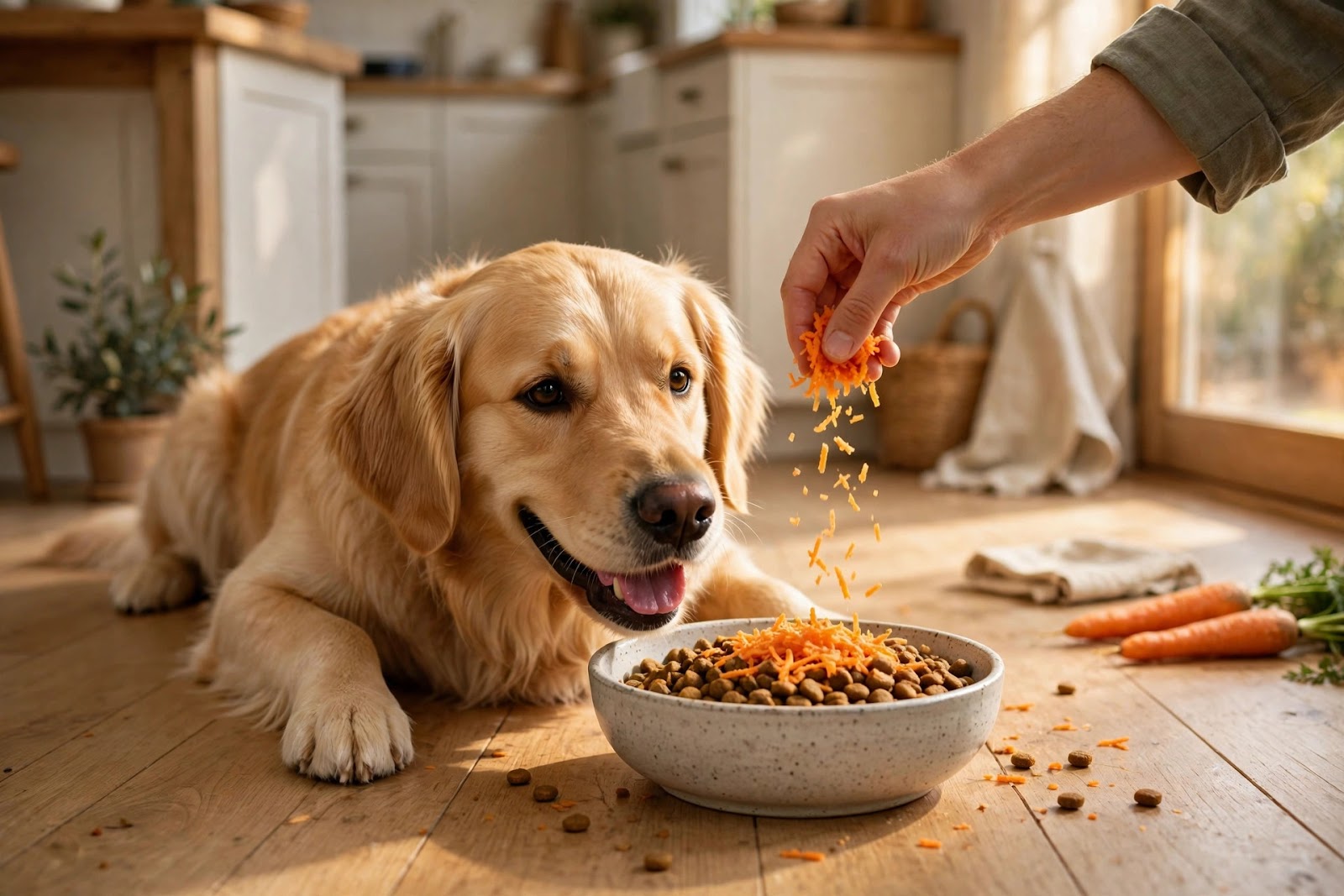
I replaced it with things I already had. A spoonful of plain cooked rice mixed through his kibble. A little warm water poured over the dry food, which makes it smell stronger and softens it slightly; Milo eats it faster with water than he ever did with the pouches. Half a grated carrot a few times a week, which costs pennies and gives him something to crunch. A spoonful of plain yoghurt on Sundays, his one fancy day.
The carrot story deserves a mention, because the first time I tried it I gave him a whole raw carrot and watched him carry it to his bed like a prize, chew it for ten minutes, and leave orange bits all over the rug. Now I grate it. He eats it, the rug stays clean, and a bag of carrots costs 60p and lasts a fortnight. That's the kind of swap that adds up without feeling like a sacrifice.
I did keep one topper: a tin of sardines in spring water, once a week, split across two meals. A four-pack costs £2.20 at my supermarket, so that's about 55p a week. He loves it, his coat looks great, and it's the cheapest "treat meal" I found. I drain the water off first. The first time I didn't, he wore most of it on his chin.
Treats: the bag that lasts a month instead of a week
Training treats were my second-biggest leak. The little branded bags were £5 or £6 and gone in a week, because when you're training a dog you go through treats like water. I switched to making my own, and it's the single best money-saving thing I do for Milo now.
Once a week I boil two chicken breasts, chop them into tiny pieces, and freeze them in small bags. Two breasts cost about £2.50 and last the whole week, including training sessions and the odd bribe when the postman knocks. I also keep a bag of his own kibble in my coat pocket and use that as training treats on walks; he's just as happy to work for a piece of kibble outside as he is for a fancy biscuit, because outside, everything is exciting.
Here's the trick that took me too long to learn: a treat does not need to be big. It needs to be quick to eat. A pea-sized piece of chicken works exactly as well as a whole biscuit, and Milo will do five sits for five tiny pieces where he'd do one sit for one big one. Smaller treats, more reps, same happy dog, and the bag lasts four times as long.
The one thing I still buy: a bag of plain dried liver treats for recall training, because nothing else gets Milo to sprint back to me across a field like liver does. That bag is £4 and lasts a month because I only use it for recall. Every treat has a job now. If it doesn't have a job, I don't buy it.
What I stopped doing on the weekly shop
I used to wander the pet aisle every week and come home with something extra: a new chew, a different flavour of biscuit, a bag of something on offer that Milo didn't need. The offers were the trap. Two-for-one on treats he eats in a day is not a saving, it's just twice the spending.
Now I shop for Milo once a month, on the same day I do my big shop, with a list. Kibble, carrots, chicken breasts, sardines, yoghurt. That's the list. If something isn't on it, it stays on the shelf. The monthly trip also means I notice the price changes, and twice now I've caught a price jump on his kibble and switched to a different shop for the month.

I also stopped buying the multipack dental chews entirely. Milo gets a raw carrot most days, which keeps him busy for a while, and his teeth get checked at his routine vet visits. The £9 a pack chews were doing a job a 15p carrot does nearly as well in my experience, and Milo prefers the carrot. I know that sounds too simple, and I was sceptical too, but his last vet check had no complaints about his teeth, and my wallet noticed the difference immediately.
The mistake that cost me £30 and a weekend
I have to be honest about the one time my budget push went too far. I found a bulk deal online: a 15kg bag of a brand I'd never heard of, £22, free delivery. I ordered two bags without checking the label properly. When they arrived, the first ingredient was "cereals", the protein was 17%, and the feeding guide said Milo would need nearly 500g a day.
I tried it anyway, because I'd already paid for it. Milo ate it, but he was hungry an hour later, he was doing enormous poos twice as often, and by day four he was picking at his bowl and looking at me like I'd betrayed him. I did the math: 500g a day meant the 15kg bag lasted 30 days, so it cost 73p a day, barely cheaper than his proper food, and he was miserable on it. I gave the second bag to a local shelter, where it got used happily, and I went straight back to his usual kibble.
The lesson cost me £30 and a weekend of guilt. A bargain that makes your dog hungry isn't a bargain. Cost per day only works when the food actually satisfies your dog and agrees with his stomach. If he's begging an hour after dinner or his stools go loose, the food isn't working, whatever the price says.
The routine that works now, every month
Six months on, our monthly food spend sits at about £38, and Milo is doing brilliantly. His weight is steady, his coat is glossy, and he still does his happy spin at dinner time. Here's the routine in full, because I know people like the exact version, not the vague idea.
First week of the month: one 12kg bag of kibble, £28. One pack of chicken breasts for treats, £2.50. A bag of carrots, 60p. Four tins of sardines, £2.20. A tub of plain yoghurt, 90p. Total: about £34. The rest of the month needs nothing except topping up carrots and the odd extra chicken if we've done a lot of training. That £34 covers him for the month, and I know it will, because I've done it six times now.
I also keep a small emergency stash: half a bag of kibble in a sealed tub, just in case I can't get to the shops one week. That stash has saved me twice, once when I was ill and once when the car broke down. It's not fancy. It's just boring, practical planning, and it's the sort of thing I wish someone had told me to do in the first month of owning a dog.
What I'd tell a friend who just got a dog and is worried about the cost
If you're standing in that pet aisle right now, doing the same mental maths I was doing, here's what I'd actually say. Start with the label, not the price. Work out the cost per day, not the cost per bag. Treats can be tiny and homemade. Toppers can come from your own kitchen. And don't let guilt spend your money for you; your dog does not know what the bag cost, he only knows whether dinner arrives on time and tastes good.
Feeding a dog well on a tight budget is not about finding the cheapest possible food. It's about finding the food your dog does well on, at the best price you can get it for, and cutting the extras that were never doing much in the first place. Milo eats well, I sleep better, and the money I saved paid for his new lead, his vet visit, and a weekend away for both of us. That feels like a win worth sharing.
And Milo? He still sits by the trolley in the pet aisle, looking up at me like I have it all under control. These days, I mostly do.


