There is a special kind of embarrassment reserved for being dragged down a busy pavement by your own dog while strangers pretend not to watch. I know it well. For the first year I had Biscuit, a border collie mix with opinions about everything, our walks through town looked less like a stroll and more like a waterskiing accident. He'd see a pigeon, a bus, another dog, a crisp packet moving in the wind — anything, really — and off he'd go, with me attached to the other end of the lead like a tin can tied to a wedding car.
I tried the usual fixes. I tried stopping dead every time he pulled, which worked for about three steps before he forgot. I tried turning around, which turned our walk into a strange dance on the pavement. I tried a shorter lead, a longer lead, and a lead I bought online that promised "instant loose-lead walking" and delivered nothing of the sort. What eventually fixed it wasn't a gadget or a single trick. It was a slower, duller, more patient approach — and a change in what I was actually rewarding.
First, sort out the gear (it's not the whole answer, but it helps)
Biscuit walked on a collar for his first year, and every pull put pressure straight on his neck. He coughed when he lunged, which I hated, and I hated it more once I realised the coughing wasn't stopping him. I switched to a well-fitted harness — the kind with a front clip and a back clip — and had him measured properly at a pet shop. The fitting took five minutes and cost nothing. The harness didn't magically stop the pulling, but it stopped the coughing, it gave me better steering, and it meant I could work on training without worrying I was hurting him every time he lunged at a squirrel.
Lead length matters more than people think. The retractable lead Biscuit started on was part of the problem: it taught him that pulling makes the lead longer, which is exactly the lesson you're trying to unteach. I moved to a plain, fixed lead of about two metres. Long enough for him to sniff and wander a little, short enough that I wasn't managing a tangle around every lamppost. On busy streets I hold it with both hands loosely, one hand near my hip, and I keep my arms relaxed. Sounds trivial. It's not — a tense arm telegraphs tension straight down the lead, and a dog who feels tension pulls against it.
One more gear note: treat pouch. Not your pocket, not a plastic bag, a proper pouch that clips to your waistband and opens with one hand. Busy-street training lives or dies on how fast you can reward, and fumbling in a coat pocket for a squashed treat while your dog is already lunging at a delivery bike is a losing battle. I use small, soft treats he can swallow in a second — little chicken pieces or the soft training bites from the pet shop. Crunchy biscuits take too long to chew, and by the time he's finished, the moment you wanted to reward is gone.
The real problem: I was rewarding the wrong moments
Here's the uncomfortable truth I had to face. Every time Biscuit pulled me toward something interesting — a dog across the street, a patch of grass, a person who might say hello — and eventually got there, pulling had worked. He pulled, he arrived. That's a reward, whether I meant it or not. Dogs repeat what works. My stopping-and-starting didn't matter, because the overall pattern was still "pull hard enough, long enough, and you get where you want to go."
The fix was boring and it was slow: I started rewarding the lead going slack, not the dog doing something impressive. On a quiet side street, I'd walk a few steps, and the instant the lead loosened — even for half a second — I'd mark it with "yes" and give a treat at my knee. Not ahead of me, not from my hand stretched out in front, at my knee, so the good place to be was right beside me. We did this for weeks before I expected anything on a busy road. Ten minutes a day, on the quietest street I could find, building a habit in a place where Biscuit could actually think.
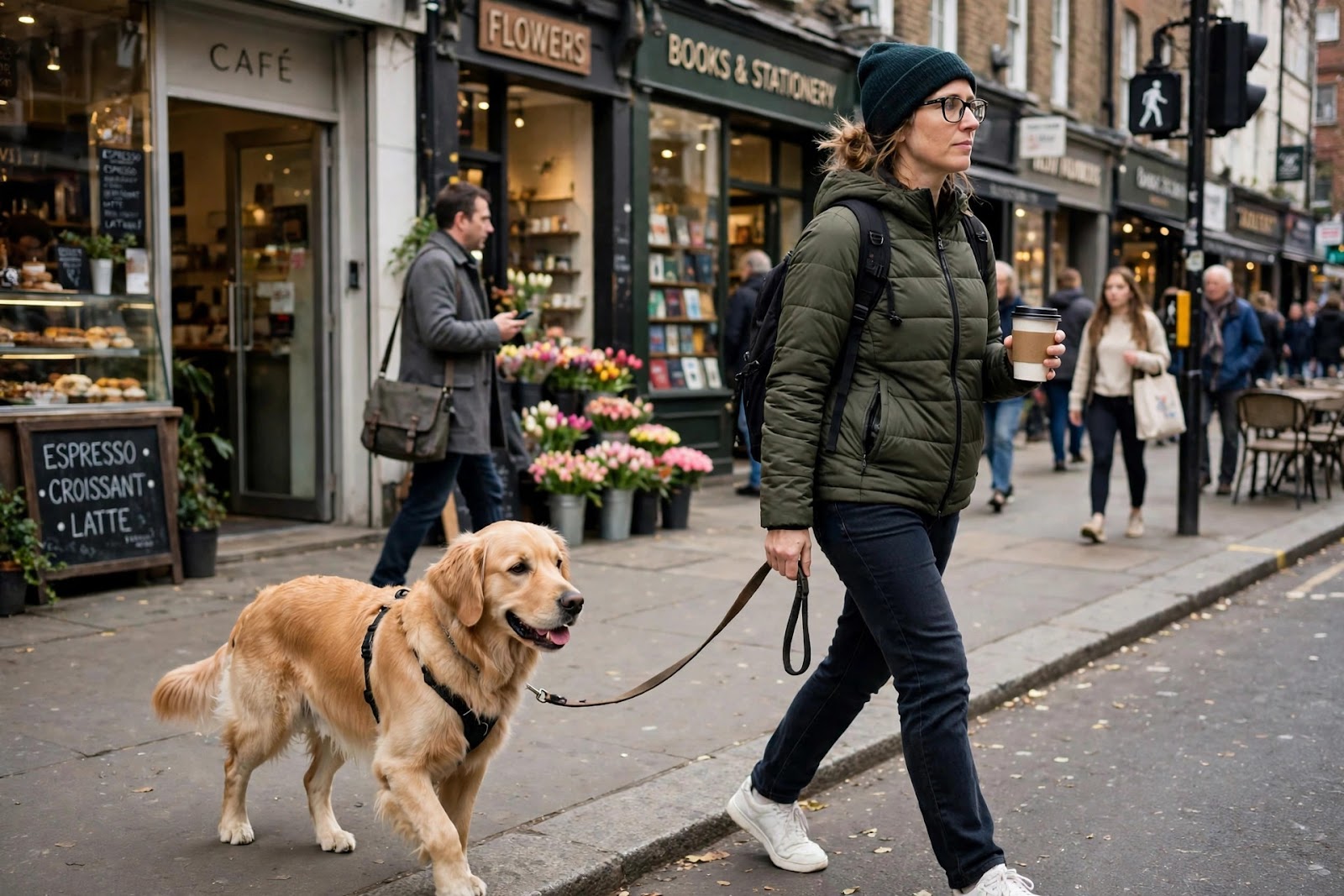
This is the part most people skip, and it's the part that matters most. You cannot train a new skill in the hardest environment first. A busy high street at five in the afternoon, with buses, bikes, dogs, prams, and a man selling flowers, is the final exam. You don't start there. You start in your garden, then your street, then a quiet park path, then a moderately busy road — and you only move up when the easy version is genuinely easy, not when you're bored of it.
The "be a tree" myth, and what I did instead
Everyone tells you to "be a tree" — stop dead when the dog pulls, wait until the lead slackens, then move. I did this for months, and on Biscuit it mostly produced a dog standing at the end of a taut lead, staring at a pigeon, waiting for me to give up. The problem was that stopping punished the pull without teaching an alternative. He knew what not to do. He didn't know what to do instead.
What worked better was a combination: when he pulled, I stopped — but I also changed direction before he got frustrated, turning us calmly back the way we'd come, and then rewarding him the moment he caught up and the lead went slack. The turn gave him a job (follow me) instead of just a dead end (stand still and fume). Over time, I needed fewer turns and fewer stops, because he started checking in with me on his own. That check-in — a glance up at my face mid-walk — became my favourite thing to reward. Every glance got a "yes" and a treat, because a dog who looks at you is a dog who's thinking about you, not just about the pigeon.
I also learned to read the street the way Biscuit does. If I can see a dog coming round the corner, I cross the road early or step into a driveway and let the other dog pass at a distance, rewarding Biscuit for watching calmly. That's not cheating. That's setting him up to succeed. The owners who insist on walking straight into every confrontation and then get angry when their dog reacts are making the same mistake I made for a year: testing before teaching.
Busy streets need their own training plan
Walking a dog down a high street is a different skill from walking them in a park, and it deserves its own practice. I started doing short "town trips" with no destination — five minutes in and out of one busy stretch, then home. No errands, no pressure to get anywhere, just practice. We'd walk one block, I'd reward every few steps of slack lead, we'd turn around and come home. Biscuit got used to buses and crowds in tiny doses, and I got used to handling him without the stress of also trying to buy milk.
A few street-specific habits made a real difference. First, I keep Biscuit on the side away from the road — my left, with me between him and the traffic. It took a week of luring him back to that side with treats, but now it's automatic, and it means a sudden lunge goes toward a shop window, not toward a bus. Second, I slow down at corners and junctions instead of striding round them blind; most of Biscuit's worst lunges happened when a dog or a cyclist appeared suddenly round a corner, and a two-second pause gives both of us a chance to see what's coming. Third, I taught a "this way" cue — just those two words, said cheerfully, followed by a turn — so I can redirect him without yanking the lead or shouting his name over traffic noise.
The hardest street scenario for us was other dogs on narrow pavements. There's nowhere to go, the dogs are close, and Biscuit's excitement spikes. My solution is unglamorous: I step off the pavement into a gateway or a shop doorway, put Biscuit behind me, and feed him treats steadily while the other dog passes. Dog trainers call this "treat streaming" and I call it the only thing that kept our walks civilised for six months. Over time, the distance Biscuit needed shrank, and now he can pass most dogs on a normal pavement with a glance and a treat. The dogs he still can't pass calmly? We still step aside. That's not failure. That's knowing your dog.
The week it finally clicked
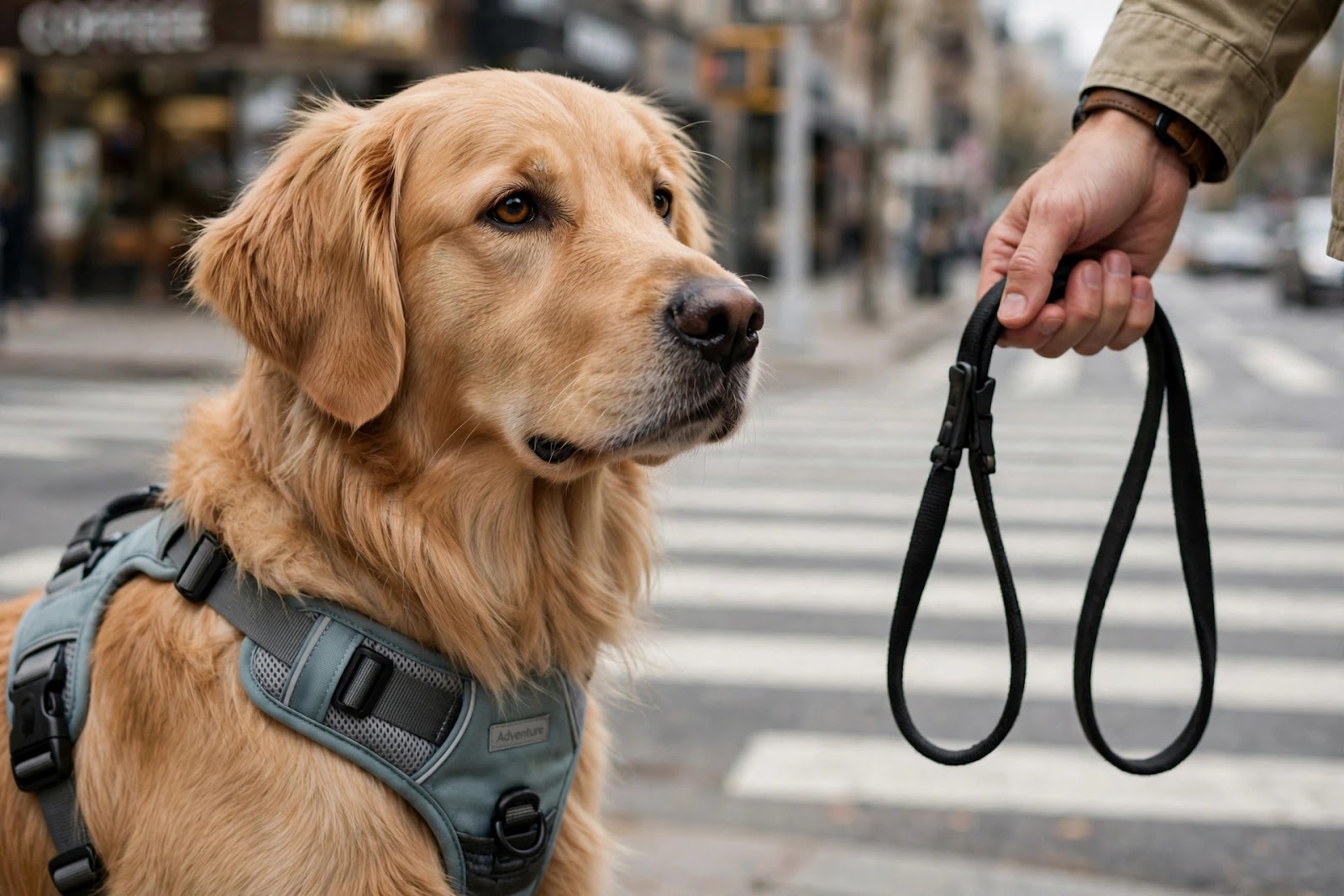
About four months into the slow approach, something shifted on an ordinary Tuesday. We were walking down our high street — the same one where he'd once dragged me past three shops chasing a cat — and I realised I'd been walking for two whole minutes without thinking about the lead at all. It was slack. He was trotting beside me, sniffing a wall, glancing up at me now and then, and I was just... walking. Like a normal person with a normal dog. I actually laughed out loud, and a woman coming the other way gave me a look.
It didn't click all at once, of course. There were still bad days after that — rainy days when he was full of beans, days when a loose dog ran up to us and all the training went out of the window for ten minutes. But the baseline had changed. The default was now a loose lead, and the pulling was the exception instead of the rule. That's what progress looks like with a puller: not perfection, but a new normal with occasional relapses.
If I could go back and tell year-one me one thing, it would be this: stop looking for the trick and start counting the rewards. I kept a rough tally for a while — how many treats for slack-lead walking per walk — and on good weeks it was fifty or sixty. That's a lot of chicken. It's also the price of a habit. Dogs learn by repetition, and a loose lead is a habit you build one rewarded step at a time, not a command you install once.
A realistic busy-street routine
Here's the routine I'd hand to anyone starting from scratch. Week one and two: quiet streets only, ten minutes a day, reward every slack moment at your knee. Week three and four: add one moderately busy road, keep the sessions short, and cross the road or step aside before your dog goes over threshold — don't wait for the explosion. From week five: short town trips with no errands, building up the length gradually. Throughout: harness and fixed lead, treat pouch on your waist, "yes" as your marker word, and a check-in glance rewarded every single time.
And the stuff to avoid: don't use a retractable lead on busy streets, don't let your dog greet every dog and person (it teaches them that every stranger is a reward for pulling toward them), don't train when you're in a rush (your tension goes straight down the lead), and don't expect a straight line of progress. Biscuit's worst week came right after his best week, and I nearly gave up. I'm glad I didn't, because the dog who once towed me down the high street now walks past the flower stall, the bus stop, and the pigeon gang with his lead hanging in a loose U-shape — and most days, I don't even notice it anymore. Which is exactly the point.
What about the days it all falls apart?
Let me be honest about something the training videos skip: some walks are just bad, and no technique fixes them in the moment. Biscuit had a day last winter when a firework went off two streets away, a loose terrier charged at us from a garden gate, and then a cyclist nearly clipped us on the pavement — all within five minutes. He was a shaking, pulling mess by the end of it, and so was I. We went home early. I gave him a chew, I made tea, and we tried again the next morning like nothing had happened. And the next morning was fine.
That is the part nobody puts in a headline: a bad walk is not a ruined dog. Training is an average over weeks, not a score for one outing. If your dog pulls terribly on a day when the street is full of fireworks, bin lorries, and off-lead dogs, that tells you about the day, not about your dog's future. Go home, lower the difficulty next time, and rebuild from a quieter street. The owners who quit loose-lead training usually quit after a bad week, convinced it isn't working — when in fact the bad week is often right before the good one, because the dog is testing whether the new rules are real or just a phase.
I keep a simple rule for myself now: if two walks in a row go badly, I drop back a level for three days. Quieter street, shorter walk, more treats. It's boring and it works, because it stops a slump from becoming a spiral. Biscuit doesn't need me to be a perfect trainer. He needs me to be a consistent one — same rules, same rewards, same calm voice, whether we're on an empty lane or outside the busiest shop in town. The lead went slack when I stopped chasing a quick fix and started trusting the slow one. Yours will too, one rewarded step at a time, even if today is one of the pulling days.


