Every spring, my house used to look like a golden retriever had exploded in it. Fur on the sofa. Fur in the butter dish. Fur woven into my black work trousers no matter how many times I ran a lint roller over them. I vacuumed every other day and still found little golden tumbleweeds rolling across the hallway floor by evening.
I blamed the dog. That was unfair. Milo wasn't doing anything wrong — he was just shedding, the way double-coated dogs do when the weather turns. The problem was me. I brushed him when I remembered, which meant once a fortnight if I was being honest, and I used whatever brush happened to be in the drawer.
Then one April, a groomer friend watched me wrestle Milo for ten minutes and said something that changed everything: "You're not brushing too little. You're brushing wrong." She showed me a two-minute routine, and I mean that literally — I timed it. Two minutes, once a day, and within three weeks the fur situation in my house dropped by what felt like eighty percent. I'm not exaggerating the timing, because I set a timer on my phone the first week just to prove her wrong.
The mistake I kept making
Here's what I used to do. I'd grab a brush, sit Milo down, and rake through his whole coat in one long session, maybe fifteen minutes, usually on a Sunday. He hated it. He'd squirm, I'd press harder to get through the tangles, and we'd both end up annoyed. By Wednesday the fur was back everywhere anyway.
The groomer explained why. A double coat sheds a little every day, not in one weekly avalanche. Brushing once a week just lets seven days of loose fur pile up, and then you spend ages dragging it out of a coat that's already matted underneath. Short and daily beats long and weekly. It's the same logic as wiping a kitchen counter every evening instead of scrubbing a month of grime on a Sunday.
Also, I was using the wrong tool. The stiff wire brush I owned was designed for short coats. On Milo's thick double coat it skimmed the top layer and left the loose undercoat exactly where it was — which is to say, all over my furniture.
The two-minute routine, step by step
Here's the routine, exactly as I do it now. I keep the brush by the back door, next to the lead, so there's no excuse and no hunting through drawers.
First, thirty seconds with a slicker brush, working in the direction the fur grows, starting at his neck and moving down his sides. Light pressure. If the brush snags, I stop and work that spot gently with my fingers instead of yanking through it. Milo learned fast that this part doesn't hurt, which is half the battle.

Second, one minute with an undercoat rake, same direction, same gentle pressure. This is the tool that actually catches the loose undercoat before it lands on my sofa. I do his chest, his sides, and the fluffy trousers on his back legs, because that's where the worst shedding hides.
Third, thirty seconds with my hands. I just run my palms over him, feeling for any mats behind his ears or under his collar. If I find one, I tease it apart with my fingers right then. A mat you catch today is a two-second job. A mat you ignore for a week becomes a grooming appointment.
That's it. Two minutes. I do it while his breakfast soaks — I feed him kibble with a splash of water, and the five minutes it takes to soften is my brushing window. Tying it to something I already do every day is the only reason the habit stuck. Every "system" I tried before that needed its own time slot died within a fortnight.
What changed, honestly
The first week, nothing dramatic happened. I filled the brush a few times and thought, well, at least Milo seems happier. By the second week, I noticed the hallway tumbleweeds were gone. By the third, I was vacuuming twice a week instead of every other day, and the sofa throw — the one I'd given up on and covered with a blanket — actually looked clean enough to sit on without the blanket.
There's a second benefit I didn't expect. Milo now walks to the back door and sits down when he sees me pick up the brush. Two minutes of calm attention every morning turned into our thing. He's a calmer dog on walks, I think, because his day starts with something pleasant instead of me rushing around ignoring him until the lead comes out.
One honest caveat: this doesn't stop shedding. Nothing does, and anyone selling you a supplement or a shampoo that promises a fur-free house is selling you a story. Milo still sheds. The difference is that the loose fur now ends up in the brush and the bin instead of on my clothes, my car seats, and my dinner.
The gear that actually matters
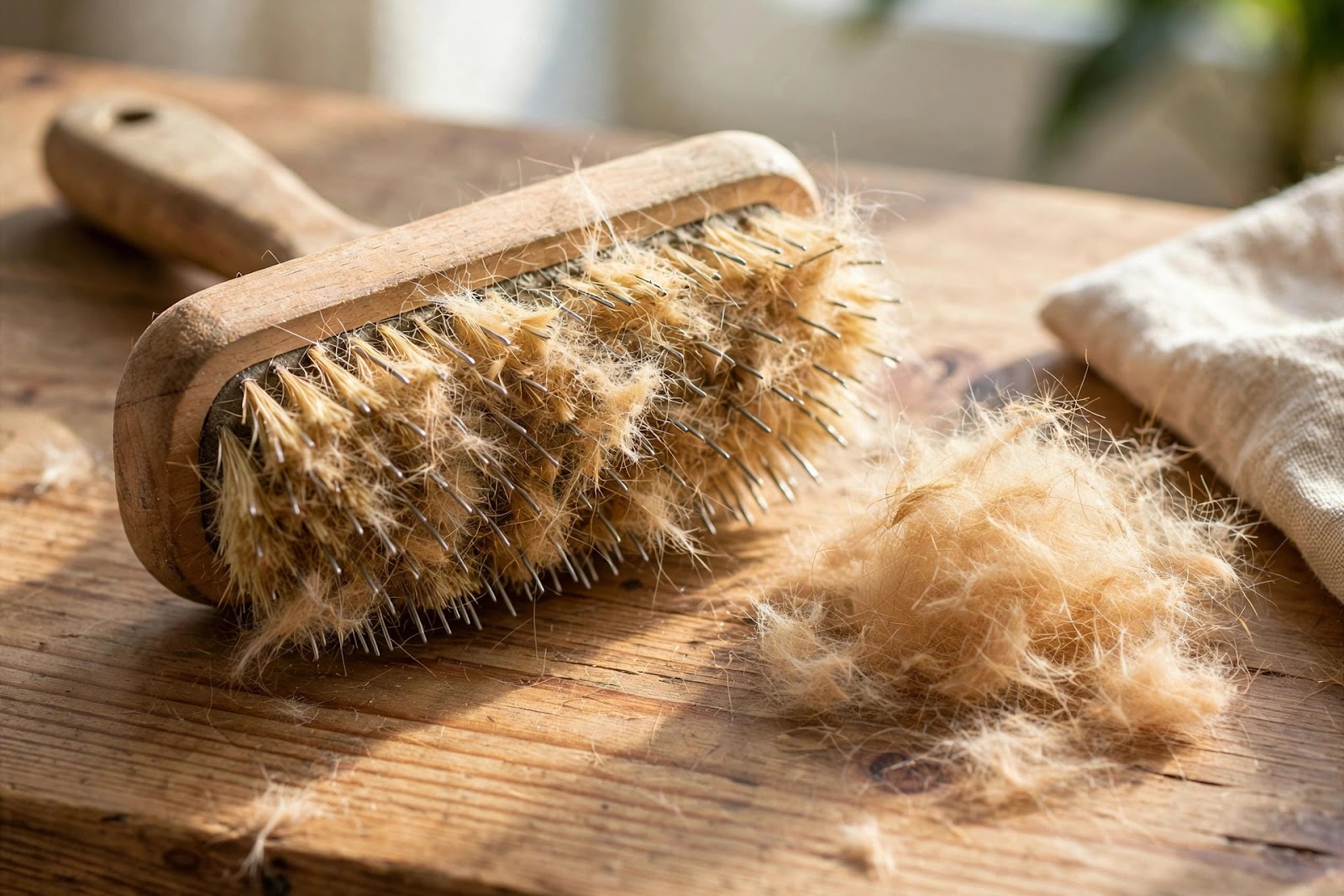
You don't need a drawer full of tools. I use two: a slicker brush (mine cost about nine pounds from a pet shop, nothing fancy) and an undercoat rake. That's the whole kit. I clean the brush after every session — thirty seconds with a comb to pull the fur out — because a clogged brush just pushes fur around instead of collecting it.
What about baths? I bathe Milo roughly once a month, or after he's rolled in something unspeakable, whichever comes first. A bath does loosen a lot of fur, so I always brush him the day after a bath too, when the coat is fully dry. Brushing a wet coat is a mistake I made exactly once; it pulled, he yelped, and I felt terrible.
If your dog hates being brushed, start smaller than small. One stroke, then a treat, then done. Seriously. The first time I tried this routine on a friend's rescue collie, we did three strokes total on day one. By day five she was leaning into the brush. Dogs decide fast whether something is safe, and they remember.
The seasonal calendar nobody gave me
Milo sheds all year, but there are two peaks: spring, when he drops the heavy winter undercoat, and autumn, when the summer coat thins out for the winter one. During those peak weeks I brush twice a day, still just two minutes each time, morning and evening. It sounds like more work, but it's actually less fur overall, because the loose coat never gets a chance to build up.
In winter, once a day is plenty. In high summer, I brush every day too, because heat seems to loosen things up and Milo swims more, which mats the fur behind his ears if I'm lazy. The routine flexes with the season, but the rule stays the same: short, daily, and tied to something I already do. The moment brushing becomes a separate chore I have to remember, it starts slipping, and the tumbleweeds come back.
I also keep a cheap lint roller by the front door now, for the last-minute check before I leave the house. It's not part of the routine, it's the safety net. The routine does the real work; the roller just catches the one hair I missed.
When to get help instead
Most shedding is normal and seasonal, heaviest in spring and autumn. But if you notice bald patches, sore skin, or a sudden change in how much fur is coming out, that's a conversation for your vet, not a blog post. I'm a dog owner sharing what worked in my living room, not an expert, and I know where that line is.
Same goes for mats that have tightened against the skin. Don't cut them out with scissors — it's frighteningly easy to nick skin hiding under a mat. A groomer can sort it in minutes.
So that's my whole system. Two minutes, once a day, tied to breakfast, with the right two tools. My house isn't fur-free — I own a golden retriever, let's be realistic — but it's the difference between living in a fur coat and living in a house that happens to have a dog in it. And honestly? The morning brushing is now my favourite two minutes of the day.


