The doorbell used to be my least favourite sound in the house. Not because I disliked visitors. Because the second it rang, my dog Biscuit turned into a small, barking tornado by the front door, and I turned into the person apologising while holding a leash with one hand and a coffee mug with the other.
The worst of it happened last spring. My sister came over with her toddler, and Biscuit shot past me the moment I cracked the door open. Nobody got hurt, but the toddler cried, my sister's bag went flying, and I spent the rest of the visit feeling embarrassed. That evening, I decided we needed a plan that didn't rely on me wrestling a 20-kilo dog in the hallway.
The plan was a mat. Just a mat, a spot by the door, and a job for Biscuit to do when people arrived: go there, lie down, stay there until I say otherwise. It took us about five weeks to get it reliable, and it changed how guests arrive at our house completely.
Picking a mat that actually means something
Here's the part most people skip: the mat has to be different from every other rug and blanket in your home. If your dog already naps on three identical throws, a fourth one won't mean anything special.
I bought a flat, non-slip bath mat in dark blue, about 60 by 90 centimetres. Big enough for Biscuit to lie down fully stretched out, small enough to carry to a friend's house later. It lives rolled up in the hallway cupboard when we're not training, which sounds fussy, but it keeps the mat special. When the mat comes out, Biscuit knows work is about to happen, and work means treats.
Don't buy a fluffy bed for this job. A raised bed or a doughnut bed makes the "lie down" part harder to see, and dogs tend to circle and rearrange fluffy things for five minutes. Flat is better. Boring is better. The mat is a place, not a toy.
Step one: the mat pays, every single time
For the first three days, I didn't ask Biscuit to do anything except notice the mat. I put it on the living room floor, and every time he so much as glanced at it, a treat landed on the mat. Step on it? Treat on the mat. Sniff it? Treat on the mat. He figured out within one session that this blue rectangle was basically a vending machine.
Then I waited for more. I only paid for two paws on the mat, then four paws, then a sit on the mat, then a down. Each step took a session or two, and I kept sessions to five minutes, twice a day. Short beats long here. A tired, bored dog stops learning and starts chewing the mat, which is exactly what happened on day four when I pushed a session to fifteen minutes. Lesson learned.
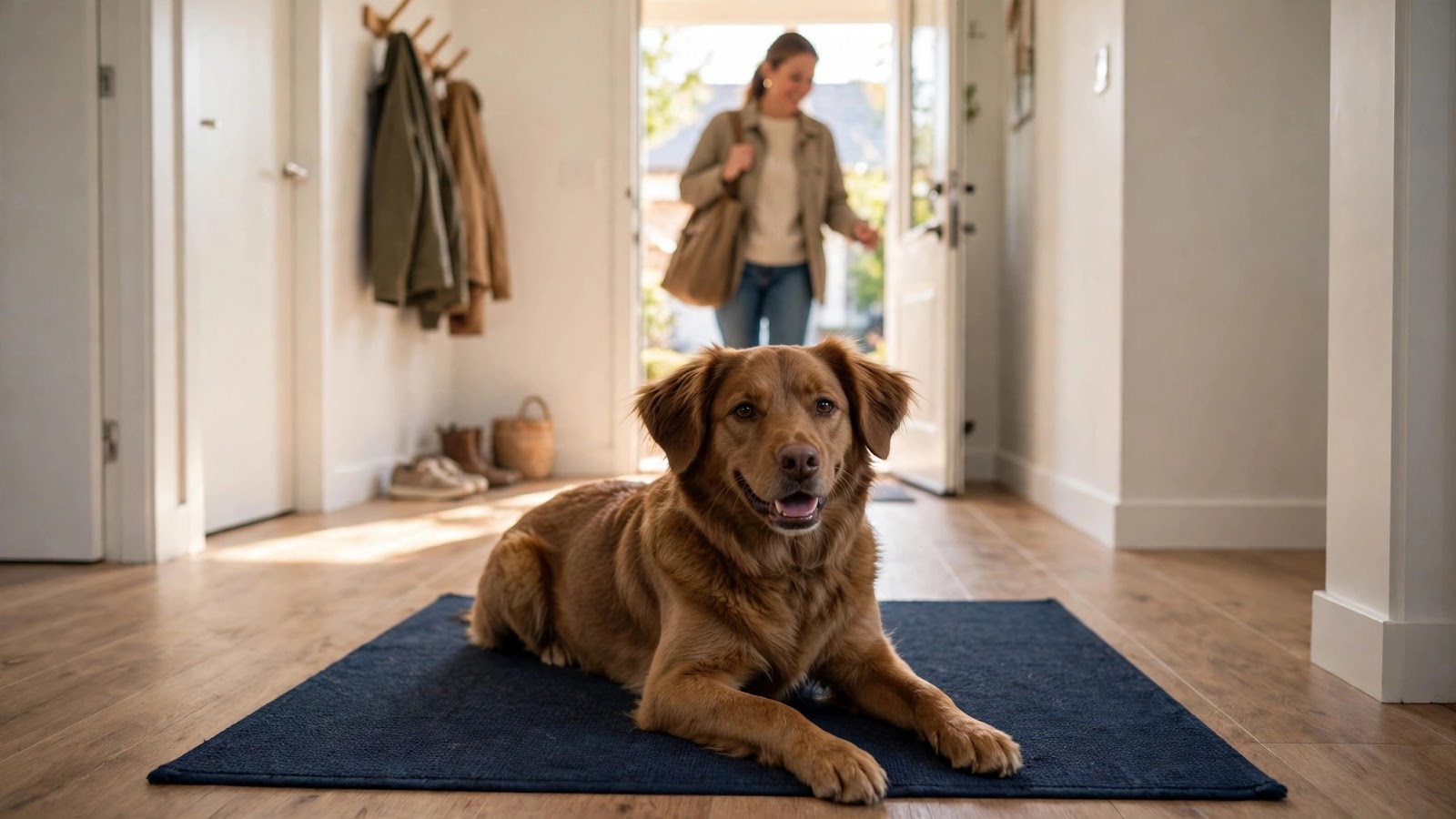
Once he was running to the mat and lying down on his own, I added the words "go to your mat" just before he did it. Say the cue before the behaviour, not during it, or you'll spend weeks shouting the words at a dog who hasn't decided to move yet. Within a week, I could point at the mat from across the room and he'd trot over and flop down like he'd invented the idea himself.
Step two: staying there is a separate skill
Going to the mat is the easy half. Staying there while exciting things happen is the real training, and you have to build it in layers. I started by standing one step away and paying him every two seconds for staying put. Then every five seconds. Then I took one step back, then two, then walked to the kitchen and back.
If he broke position, I didn't scold him. I just walked him calmly back, no drama, and made the next round easier. Getting up isn't defiance; it usually means I raised the difficulty too fast. The one time I got annoyed and raised my voice, he went straight to hiding behind the sofa, and we lost a whole day of progress. Calm resets beat corrections every time.
The release word matters as much as the stay. I use "okay, free" with a little hand wave, and I always, always release him before he releases himself. If he learns that getting up on his own ends the game, he'll do it whenever he feels like it. Ending on my word, followed by a treat or a quick game, keeps the mat a good deal for him.
Step three: add the doorbell, one ring at a time
Here's where most mat training falls apart. People train in a quiet living room, then expect it to survive a real doorbell, a real visitor, and a real pizza delivery driver. You have to rehearse the hard parts in small doses.
I started by playing a doorbell sound on my phone at low volume while Biscuit was on his mat. Treat, treat, treat. Then I rang our actual doorbell from inside the house while my partner stood at the door. Then my partner knocked. Then she opened the door and stood there doing nothing. Each new version got ten easy repetitions before I made it harder.
Only after that did we invite a real guest: my neighbour, who I had warned in advance. The rules for guests are simple and non-negotiable. Ignore the dog completely until he's settled on the mat. No eye contact, no "oh, who's a good boy," no reaching out to pet him while he's bouncing. The first time my neighbour walked in and ignored him, Biscuit looked genuinely offended. Then he remembered the mat pays better than jumping on strangers, and he went and lay down.
What the real routine looks like now
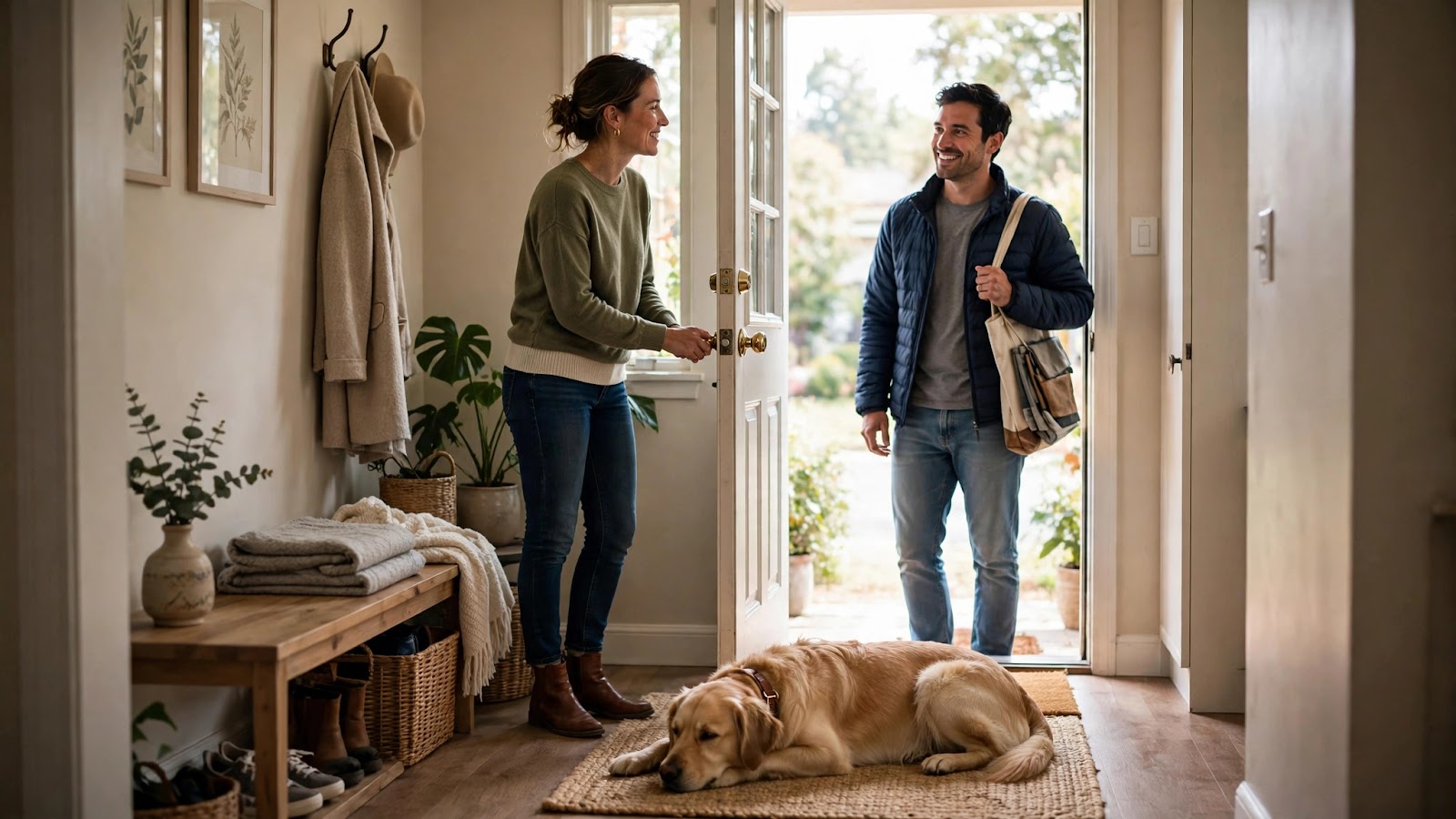
These days the sequence is automatic. Doorbell rings, I say "go to your mat," Biscuit trots over, and I open the door with both hands free. He stays there while the guest comes in, takes off their shoes, and sits down. Then I release him, and he greets people like a normal, polite dog instead of a missile.
It isn't perfect. If three people arrive at once, or if someone squeals and crouches down to hug him, he'll still break sometimes. That's fine. I walk him back, we reset, and nobody makes a big deal of it. A routine that works eight times out of ten is a massive upgrade from a routine that worked zero times out of ten.
One more rehearsal made a real difference: practising with different kinds of guests, not just the same calm neighbour. A friend who talks loudly, a friend who arrives with a dog of his own (kept in the garden for that visit), a delivery driver who only stays thirty seconds. Each new person was a fresh test, and each one taught Biscuit the same lesson in a new wrapper: whoever comes through that door, your job stays the same. The delivery drivers were actually the best practice, because they were short, frequent, and Biscuit learned that most door events end quickly and boringly.
Two things made the biggest difference, and neither was a fancy technique. First, the mat moved to its permanent spot by the front door only after the training was solid in the living room. Second, I kept a jar of small treats right by the door for the first two months, so I never had to leave Biscuit unsupervised to go hunting for rewards.
The mistakes I see most often
People send the dog to the mat only when guests are already at the door, so the mat becomes a predictor of chaos. Use it at calm times too. Send your dog to the mat while you watch television, while you cook, while nothing is happening. The mat should mean "settle and good things happen," not "brace yourself."
People also ask for too long a stay too soon. If your dog can hold a mat stay for thirty seconds in a quiet room, asking for five minutes with a visitor in the hallway is a fantasy. Build duration at home first, then add one distraction at a time. Slow is fast with this training, genuinely.
And please, don't use the mat as a punishment spot. If you march an overexcited dog to the mat with an angry voice after he's jumped on someone, you've just taught him that the mat is where bad things happen. He'll start avoiding it, and you'll wonder why the training "stopped working."
If you're starting this week, here's my honest timeline. Week one: the mat pays for existing. Week two: a reliable "go to your mat" in a quiet room. Weeks three and four: duration plus doorbell sounds plus one calm helper guest. Week five onward: real guests, with the treat jar by the door. Some dogs go faster, some slower, and neither pace means anything about your dog's intelligence.
We still practise, by the way, even now that it works. Once a week I'll ring the doorbell myself, send him to the mat, and pay him like it's the first week all over again. Skills fade if you never use them, and a two-minute refresher is cheaper than rebuilding the whole habit from scratch after a month of guests opening the door to chaos.
Biscuit still runs to his mat when the delivery driver knocks, and he still looks at me with that smug "where's my treat" face. I'll take it. A dog with a job to do at the door is a dog who doesn't need to invent his own job, and his invented jobs were always worse.


