I've bought four harnesses for Biscuit. The first rubbed a bald patch behind his front legs. The second slipped sideways every time he pulled toward a squirrel. The third looked perfect in the shop and then rode up around his neck on the first proper walk. The fourth one, the one he wears now, fits because I finally stopped guessing and measured him properly.
Here's the thing nobody tells you in the pet shop: dog sizes on packaging are mostly fiction. "Medium" means something different to every brand, and a dog can be a medium in the chest and a large in the neck, or the other way round. The size chart on the back of the packet is only useful if you know your dog's actual numbers, and most of us walk in without them.
This is the process I wish someone had handed me before harness number one: measure at home, try on calmly, adjust in the right order, and test on a real walk before you throw the receipt away.
Measuring: three numbers, five minutes, one helper
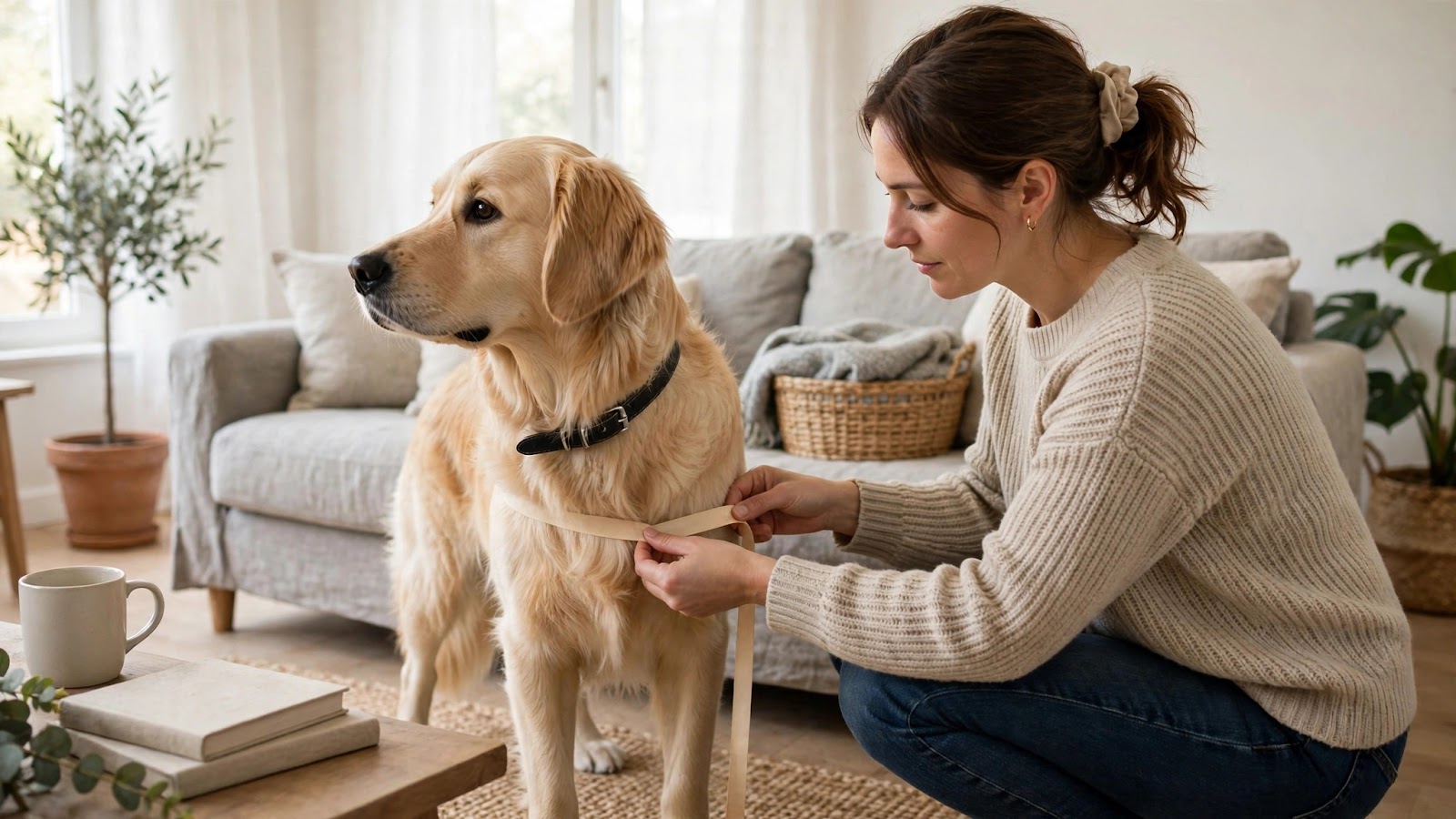
You need three measurements. First, the chest girth: the widest part of the ribcage, just behind the front legs. Second, the neck: around the base of the neck, where a collar would sit loosely, not up by the ears. Third, the back length if the harness has a back panel: from the base of the neck to the base of the tail.
Use a soft fabric tape measure, the kind from a sewing kit. If you don't have one, a piece of string and a ruler do the same job. Measure while your dog is standing square, all four paws on the floor, not sitting or lying down. Biscuit's numbers came out as 68 centimetres around the chest, 42 around the neck, and his back length was 48. Write them on your phone before you go shopping, because you will forget them the moment a shop assistant starts talking.
A helper makes this ten times easier. One person feeds small treats in a steady stream while the other wraps the tape. If your dog wiggles, don't chase him with the tape measure. Wait for a still moment, take the reading, and pay him. Two calm minutes beat ten minutes of wrestling, and you'll get a truer number anyway because a tense dog holds his breath and puffs his chest out.
One more thing: measure over the coat your dog actually walks in. If Biscuit wears his harness over a thick winter coat, that changes the fit. And if your dog is still growing, or tends to gain a few kilos in winter, leave room in the adjustment straps rather than buying exactly to today's number.
Choosing a style before you fall in love with a colour
There are two main shapes, and the difference matters more than the brand. A step-in harness, where the dog steps his front paws into two loops and it clips on the back, is brilliant for dogs who hate things going over their heads. Biscuit used to duck and back away from overhead harnesses, so step-in was the obvious pick for us.
An over-the-head harness, with one loop for the neck and one strap around the chest, usually gives a more secure fit for strong pullers and escape artists, because there's less slack to wriggle out of. The trade-off is the head-through moment, which some dogs hate. If your dog freezes or snaps when you lift a harness over his head, don't fight it. Pick the style he'll actually let you put on without a wrestling match, because a harness that stays in the cupboard fits nobody.
Front-clip versus back-clip is the next choice. A back clip, on top of the shoulders, is the everyday default and fine for dogs who walk politely. A front clip, on the chest, turns a dog gently sideways when he pulls, which helps while you're training loose-lead walking. Biscuit's current harness has both clips, and I use the front one on busy streets and the back one on quiet trails. If you buy one with both, you get to change your mind later for free.
The try-on: what a good fit actually looks like
Put the harness on indoors, somewhere calm, and let your dog wander around the house in it for ten minutes. A dog who freezes, walks sideways, or flops onto the floor like a drama student is usually reacting to a new sensation, not necessarily a bad fit. Give him treats, let him move, and judge the fit once he's walking normally.
Then run the checks. The two-finger test is the classic for a reason: you should be able to slide two fingers flat under every strap. Less than that and it's too tight. More than that and it's loose enough to slip or chafe. Check the neck opening first. On Biscuit's third harness, the neck strap sat right against his windpipe area, and he coughed every time he pulled. The right neck fit sits on the chest bones and shoulders, not high on the throat.
Next, look at the armpits. The chest strap should sit at least two finger-widths behind the front legs. If it rubs right in the armpit crease, you'll get the bald patches and soreness I saw with harness number one. Watch your dog walk toward you and away from you. The harness should stay centred. If it rotates to one side, one strap is looser than the other, or the shape is wrong for his body.
Finally, do the escape test in the garden, not on the street. Gently encourage your dog to back up while you hold the lead. A well-fitted harness stays put. If he can reverse out of it in three seconds, and some dogs absolutely can, that harness is a liability near traffic no matter how nice it looks.
Adjusting in the right order

Most harnesses have three or four adjustment points, and adjusting them in a random order is how you end up chasing your tail. Here's the order that works. First, the neck, so the front of the harness sits in the right place on the chest. Second, the chest girth, so the body of the harness is snug but not tight. Third, any belly or back straps, to even out the fit. Then recheck the neck, because tightening the chest usually shifts the front.
Adjust in small moves, a centimetre at a time, and recheck the two-finger test after each one. Biscuit's current harness took me three evenings of tiny tweaks before it sat perfectly, and I kept finding that the left side needed to be a touch looser than the right because his body isn't perfectly symmetrical. Dogs aren't either. That's normal.
One detail people miss: adjust with the lead attached and a little tension on it. A harness fits differently when it's just sitting on a standing dog versus when the dog is actually pulling gently forward on a walk. I do the final check at the front gate, lead on, Biscuit leaning toward the pavement like he always does, and that's when I know the real fit.
Signs the fit is wrong (and what to do)
Rubbing or hair loss behind the front legs means the chest strap is too far forward or too tight. A harness that rides up over the shoulders means the chest strap is too loose. Coughing or gagging when the dog pulls usually means pressure on the neck, and that's a stop-and-fix problem, not a wait-and-see one. If your dog suddenly refuses walks he used to enjoy, check the harness before you assume he's being stubborn. Dogs don't fake sore armpits.
Check the fit every month, by the way. Dogs change shape. Biscuit put on two kilos one winter, and his harness went from perfect to snug without me noticing until I did the two-finger test and couldn't get a finger under the chest strap. Puppies are worse. A growing puppy can outgrow a harness in six weeks, so check weekly and budget for two or three sizes in the first year.
If you're shopping in a store, take your dog with you and try before you buy. A good shop will let you walk him up and down the aisle, and some will even let you take it for a quick spin outside. Online shopping is fine too, but only from sellers with a clear returns policy, because even with perfect measurements, some shapes just don't suit some bodies. I kept the receipt and the tags on Biscuit's current harness until the third walk, and that's the rule I'd pass on to anyone: three real walks before you commit.
And wash it. A muddy, stiff harness chafes more than a clean, soft one. I wash Biscuit's in a laundry bag on a cool cycle every couple of weeks, and I check the stitching and clips while it's drying. A frayed strap or a cracked buckle is a retirement notice. Replace it before it fails on a walk, not after.
The harness Biscuit wears now cost less than the fancy one that rubbed him raw. It isn't the prettiest one we tried, and the colour is a boring dark green. But I can put it on in twenty seconds without a fuss, it stays centred on his body, the straps clear his armpits, and he walks out the door like a dog who forgot he's wearing anything at all. That's the whole test, really. The best harness is the one your dog doesn't notice, that you can trust near a road, and that still fits after a month of real walks. Measure first, try on second, and keep the receipt until the third walk. Your dog's armpits will thank you.


