Here's a confession that took me an embarrassingly long time to make: I spent almost a year buying premium training treats at roughly $9 a bag, then I watched my sister bake a whole batch of better ones in twenty minutes from stuff she already had in the fridge. I'd been cutting store-bought treats into quarters with kitchen scissors because my trainer kept saying "smaller, smaller," and my sister just looked at me like I was doing taxes by hand.
Training treats aren't really a shopping category. They're a kitchen habit. Once you start making them, you'll wonder why you ever paid nine dollars for a bag of brown cubes that smell vaguely like cardboard.
Why homemade treats train better dogs
Store-bought treats are designed to survive on a shelf for eighteen months. That's their job — shelf stability, not motivation. A treat that motivates has to smell like something real, be soft enough to eat in one second flat, and be small enough that your dog isn't chewing for thirty seconds while the training moment evaporates.
That last point is the one nobody takes seriously enough. A training reward has a window of about two seconds. If the dog is still crunching a biscuit, you've lost the link between the behavior and the reward. Soft treats that vanish instantly beat everything else. This is the whole reason trainers go feral over things like string cheese and boiled chicken. They disappear. The dog stays in the game.
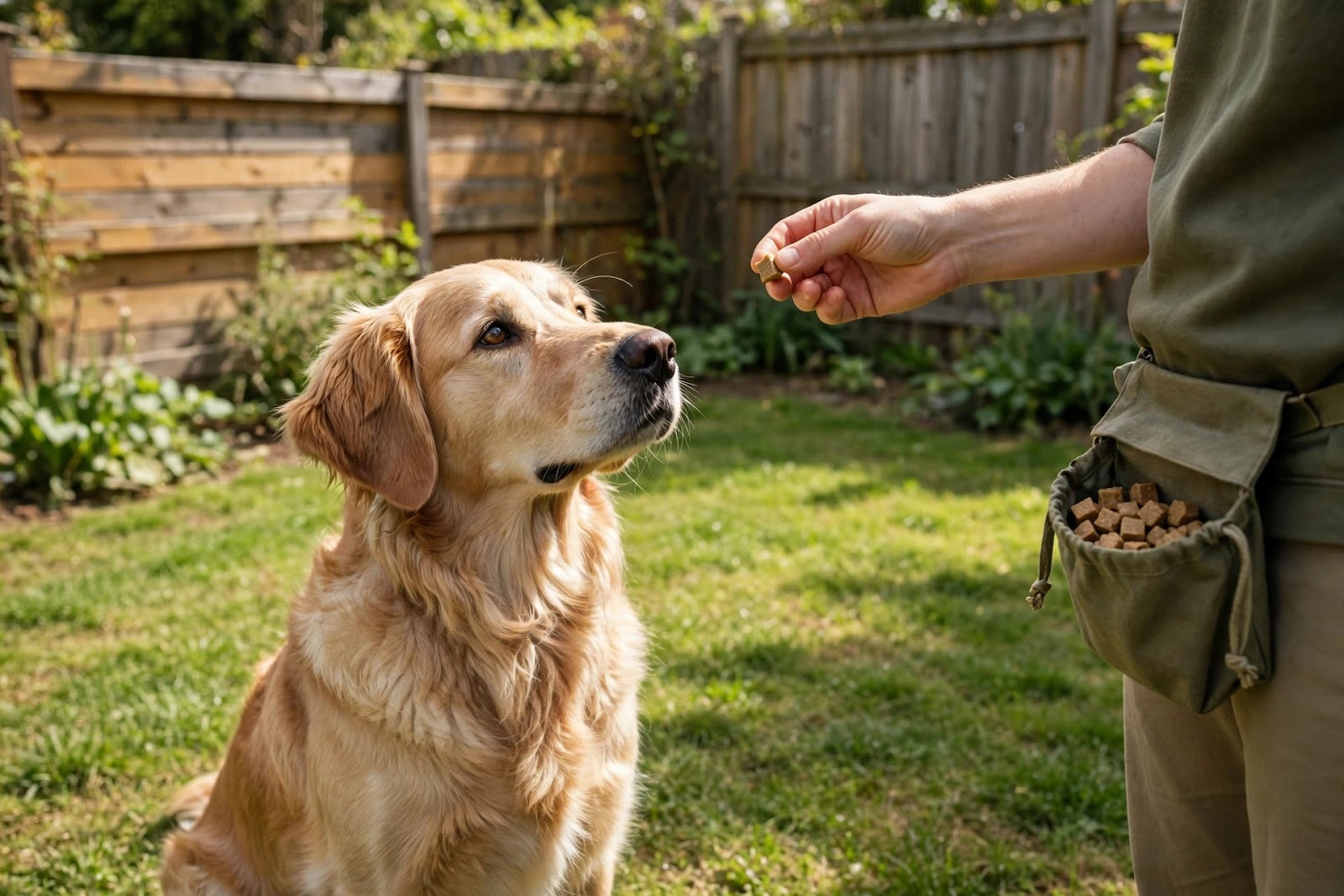
Homemade treats win on all three counts. They smell like actual food because they are actual food. You control the size. And they're cheap enough that you can be generous — which matters, because new behaviors need a high rate of reward.

The safety list: what stays out of the kitchen treats
Before we touch a mixing bowl, the short list of things that never go into dog treats. This is standard dog-owner knowledge, not a medical opinion: chocolate, cocoa powder, xylitol (it's in a lot of sugar-free peanut butters — check the label every time, not just the first time), grapes, raisins, onions, garlic powder in meaningful amounts, macadamia nuts, and anything with caffeine. Alcohol too, obviously.
Here's the one that bites people: xylitol hiding in peanut butter. Most regular peanut butters don't contain it, but the "sugar free" and "natural zero sugar" ones sometimes do, and brands change recipes. My rule is boring but effective — I buy the plain store-brand creamy peanut butter with two ingredients (peanuts and salt) and I use it for nothing but dog treats. If a label has ingredients I can't pronounce, the dog doesn't get it. Simple.
My peanut butter scare
The three ingredients that do all the heavy lifting
You don't need a pantry makeover. Ninety percent of the training treats I make come from three things: peanut butter, pumpkin puree, and oats. Everything else is a garnish.
Peanut butter is the value king. A 16-ounce jar costs a couple of dollars and yields something like 200 training treats. Pumpkin puree (plain, not the pie filling with spices) is the digestive-friendly binder — dogs love the smell and it makes treats soft. Plain rolled oats ground in a blender become oat flour, which is the gentlest, cheapest base there is.
The real MVP, though, is your oven and your freezer. Most of my treats are no-bake. Refrigerator treats have the texture advantage anyway — cold and soft is what dogs go crazy for.
Protein picks worth keeping around
Beyond the big three, the protein bench matters because smell drives motivation. Boiled chicken breast, diced to pea size, is the gold standard — boring to us, incredible to them. Hard-boiled eggs, chopped fine. A little canned tuna in water (not oil) drained well. Cheap deli turkey, torn into bits. My high-value rotation is chicken for hard behaviors (recall, leash manners) and oat-peanut butter bites for easy stuff (sit, name games). Two tiers. That's all the complexity you need.
Recipe one: The twenty-minute peanut butter oat bites
This is the recipe I make most often, and it's embarrassingly simple. No oven. One bowl. A spatula.
You need: one cup of plain rolled oats, half a cup of creamy peanut butter, a quarter cup of pumpkin puree, and a tablespoon of honey. Pulse the oats in a blender for about twenty seconds until they're rough flour — some texture is fine, even good. Stir everything together in a bowl until it holds. If it's too dry, add pumpkin a spoonful at a time. If it's too sticky, add a spoonful of oat flour.
Now the sizing trick. Spread the mixture on a cutting board to about half an inch thick, and press it flat. Then roll it out between two sheets of parchment and use a knife to score it into a grid — roughly pea-sized squares, about a quarter inch across. Yes, quarter inch. I know that looks comically small. It's the right size. The dog gets the flavor hit, swallows, and is instantly ready for the next rep. Then refrigerate the whole tray for at least an hour and snap the treats apart along the score lines.
One batch makes about 150 to 200 pea-sized treats. They keep in the fridge for a week in a sealed container, and they freeze perfectly for two months. I bag them in snack bags of 50 and keep one in the fridge, one in my treat pouch rotation, and the rest in the freezer. My dog has never once acted like the bagged stuff was better. Not once.
Why scoring beats rolling little balls
My first attempt, I rolled 150 individual balls. Took forty-five minutes and my palms hurt. Scoring a flat sheet takes three minutes. The treats are uniform, which matters because uniform treats mean a uniform reward — the dog never gets a "jackpot" giant ball that distracts her from the next rep. Jackpots have their place in training, but they should be deliberate, not accidents.
Recipe two: The soft chicken-and-pumpkin training drops
For high-value work — recall training, counter-conditioning, anything the dog finds genuinely difficult — nothing beats real meat. These take a bit more effort but dogs treat them like currency.
Boil one boneless chicken breast until cooked through, about 15 minutes. Let it cool. Dice it into true pea-sized pieces — I do this with a sharp knife and a cutting board, and it takes maybe ten minutes per breast. Here's the part people skip: dry the pieces. Spread them on a paper towel for a few minutes. Wet, slick chicken slides out of your fingers mid-reward and turns your treat pouch into soup. Dried pieces deliver cleanly.
Then toss them in a container with a couple of spoonfuls of pumpkin puree, just enough to coat. The pumpkin does two things: it makes each piece smell a little sweeter, and it adds a sticky tack that keeps the pieces from clumping into a solid brick in your pouch. Refrigerate for up to four days, freeze the rest.
Recipe three: Tuna training chips for the unmotivated dog
Some dogs are picky, or they're shut down during training, or they're just new to all of this and nothing is worth their focus. For those dogs, tuna is the cheat code.
Drain a 5-ounce can of tuna in water — really drain it, press it with the lid. Mix it with one beaten egg and half a cup of oat flour until it forms a dough. Spread it thin on a parchment-lined baking sheet, thinner than you think, maybe a quarter inch, and bake at 325°F (165°C) for 20 to 25 minutes until it's firm and the edges are getting crispy. Let it cool completely — it crisps up more as it cools — then snap it into training-sized pieces.
Warning: your house will smell like a tuna cannery. My dog started drooling in the hallway before the oven timer went off. Fair trade. These keep in the fridge for five days and they never last longer than that in my house anyway.
The calorie math (it's simpler than you think)
The standard guidance from veterinary nutrition folks is that treats should stay under about ten percent of a dog's daily calories. For a 40-pound dog eating roughly 800 calories a day, that's an 80-calorie treat budget. A pea-sized peanut butter oat bite is around 5 to 8 calories. A pea-sized chicken piece is more like 2 or 3.
On heavy training days, I don't do math in my head — I just cut the dog's dinner by about a quarter. The dog doesn't notice, because she got her calories as a hundred tiny thrilling moments instead of in a bowl. If your dog is gaining weight and you train a lot, this is almost always the fix. Simple, no drama.
The freezer bag system
I keep a gallon freezer bag system that's worth copying. Every Sunday, I check the stash: one bag of peanut butter oat bites, one bag of chicken drops, and if there's tuna chips, one bag of those. The bag I pull for the day goes in the fridge each morning. I label each bag with a Sharpie — recipe and date. Frozen treats go into the treat pouch frozen and thaw by the time we're walking. No mid-week cooking, no stale treats, no sad gas-station biscuit purchases because I ran out. It's the most organized I am about anything, honestly.
What actually improved my training
The treats themselves helped, but the real change was behavioral — mine, not the dog's. Because homemade treats were suddenly cheap and plentiful, I started rewarding more. I rewarded checking in on walks. I rewarded the sit before the door opened. I rewarded lying down during dinner. All the little good choices that bagged treats made me too stingy to mark, because each one cost me forty cents.
My trainer calls it "catching the good stuff." You can't catch much of anything if you're rationing a nine-dollar bag. When treats cost you pennies, generosity is easy, and generous trainers get fast dogs. That's the whole philosophy. The recipes are just plumbing.
One more thing: don't overthink this. The dog doesn't care if your treats look like treats. She cares that they appear, they smell good, and they vanish quickly. My first batch looked like brown confetti. The dog loved it. Perfectionism is the enemy of a well-stocked treat pouch.
The treat pouch setup that saves your sanity
Here's a detail nobody mentions: rotate two pouches. One in use, one in the wash — silicone pouches go in the dishwasher, and they need it, because chicken-juice residue goes rancid fast in a warm car. A pouch that smells funky is a training tool the dog stops trusting.
Training treats for tricky situations
Senior dogs and dogs with sore mouths need softness above all else. The peanut butter oat bites stay soft in the fridge, and you can mash them smaller with your fingers mid-session. For these dogs, skip the baked tuna chips entirely — crunching is work, and tired jaws quit training early.
For the genuinely picky dog — the one who turns away from chicken — go weirder. Freeze-dried liver crumbled into dust and mixed into the oat bites. A smear of plain cream cheese on a soft treat. Tiny cubes of baked sweet potato, which smell like nothing to us and like a miracle to some dogs. Picky is usually just a dog telling you the market rate is higher than you're paying. Raise the bid.
One last rule that took me too long to learn: never train on a full stomach. A dog that just ate dinner will look at your world-class tuna chips with total indifference. Train before meals, not after, and watch motivation triple overnight. It's the cheapest upgrade on this whole page.
Start with the peanut butter oat bites this weekend. Twenty minutes, one bowl. Your training sessions are about to get a lot more interesting.


