The first time I took Milo on a proper car trip, he drooled all over the back seat, panted nonstop for forty minutes, and then threw up on my sister's driveway. I sat there with a roll of paper towels thinking, well, that's the last road trip we're ever taking together. Which was a shame, because I wanted a dog I could take places, not a dog I had to leave behind every time I drove somewhere nice.
Two years later, Milo hops into the car himself, settles on his blanket, and sleeps through motorway journeys. Nothing magic happened. I just stopped expecting him to be fine with the car and started teaching him, in tiny steps, that the car was a good place to be.
The mistake I made at the start was going from zero to a forty-minute drive in one jump. Milo had only ever been in the car for short trips to the vet — which he disliked — so in his mind, car meant stressful place, and then a long journey confirmed it. I was basically asking a nervous dog to enjoy a marathon before he'd ever walked around the block.
Step one: the car does nothing
For the first week, the car didn't go anywhere. I opened the back door, put Milo's blanket on the seat, scattered a few treats on it, and let him sniff around. Engine off, doors open, no pressure. Some days he jumped in straight away. Some days he sniffed the bumper and walked off, and that was fine. I never lifted him in or shut the door on him while he was unsure. The whole point was that the car became boring, then interesting, then good — in that order.
By day five he was climbing in on his own and lying on the blanket waiting for treats. That's when I started sitting in the driver's seat with the engine running for a couple of minutes, still going nowhere. He looked at me like I'd lost my mind. Fair enough.
Step two: ridiculously short drives
The first real drive was around the block. Literally. Out of the driveway, left, left, left, home. About ninety seconds. Then treats, then out of the car, then a game in the garden. The message I wanted: car ride ends, good things happen, world doesn't end.
I built up slowly over three weeks. Around the block, then to the end of the street and back, then a five-minute drive to the park — and this part mattered, because the park is Milo's favourite place on earth. Driving to somewhere brilliant rewired the whole association. Car stopped meaning vet and started meaning adventure.
There were setbacks. One ten-minute drive to a pet shop, he drooled the whole way and looked miserable. I didn't push on to a longer trip that day. I went back a step, did two short happy drives, and tried the ten minutes again a few days later. Going backwards isn't failure; it's how you keep a nervous dog's trust.

The setup that actually works
Milo rides in the back seat, on a washable blanket, clipped into a crash-tested harness that attaches to the seatbelt. I tried a boot crate first and he hated the enclosed space, so the harness was our compromise. Whatever setup you choose, the dog needs to be secured — an unrestrained dog in a crash is a danger to everyone in the car, including the dog, and a loose dog wandering to the driver's footwell is an accident waiting to happen.
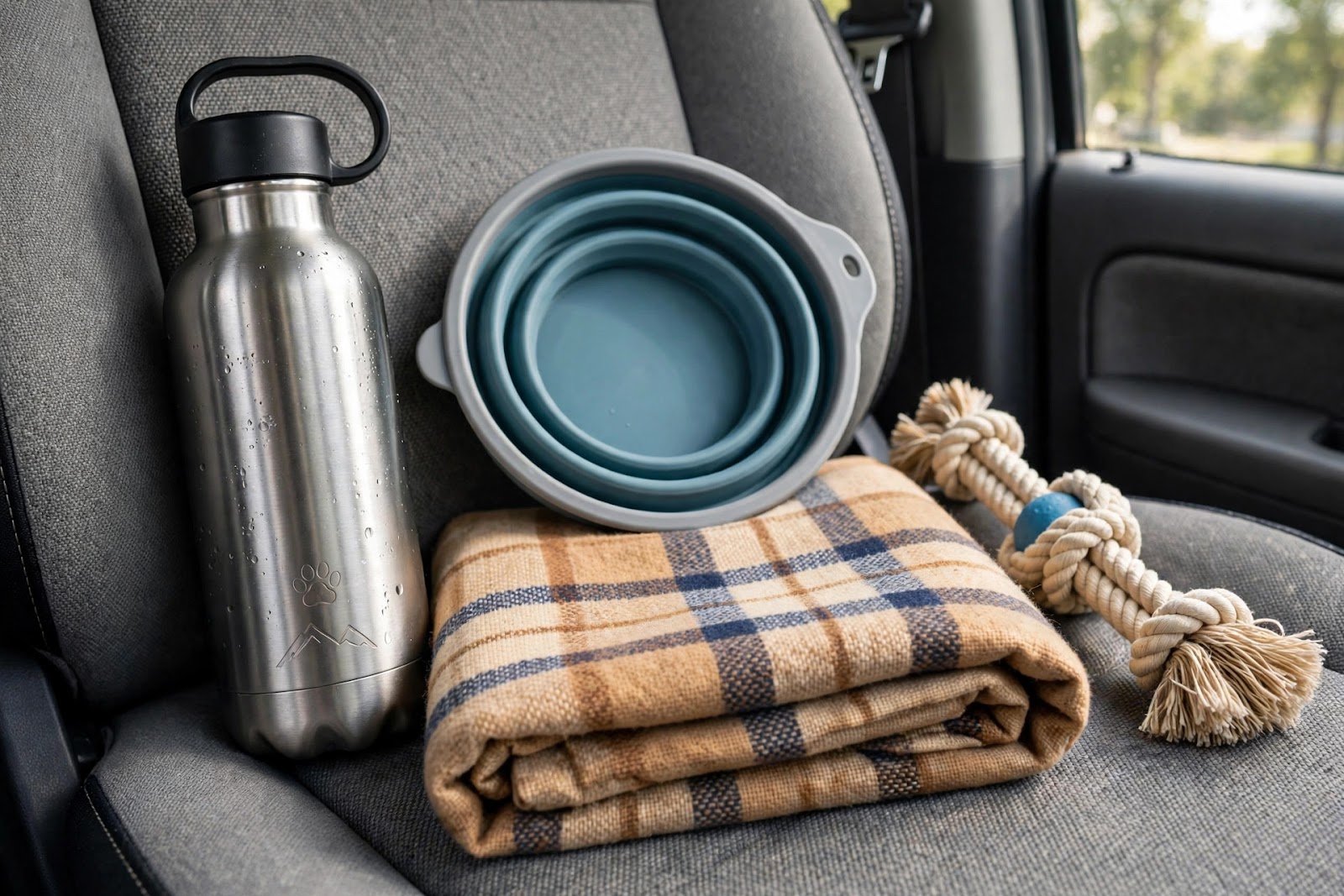
I keep a small kit in the car now: a bottle of water, a collapsible bowl, a spare blanket, paper towels (old habits), and a chew he only gets in the car. That car-only chew is a quiet trick. Milo now associates the car with the one treat he never gets at home, which means he actually looks forward to it.
Temperature is the unglamorous part nobody romanticises but everyone should respect. I never leave Milo alone in a parked car, not even for five minutes with a window cracked. Cars heat up shockingly fast, even on mild days, and "just popping into the shop" is how tragedies happen. If I can't take him inside, he doesn't come on that trip.
My pre-trip checklist now
Before any journey over half an hour, I run through the same checklist. Water bottle filled, collapsible bowl in the door pocket, blanket on the seat, harness clipped, chew in the glovebox, and a planned stop roughly every hour. I also check the weather at the destination — if it's going to be hot, we travel early or late, never in the midday heat, and I bring a frozen water bottle that melts slowly and doubles as extra drinking water.
I also learned to tire Milo out a little before a long drive. A twenty-minute walk or a game of fetch in the garden before we leave means he settles faster in the car instead of buzzing with unspent energy. A tired dog is a calm passenger. A wired dog is a back-seat DJ who won't stop requesting songs.
And I never, ever feed him a big meal right before a journey. Light meal three hours before, a few treats during stops, dinner when we arrive. His stomach and my upholstery both prefer it that way.
Motion sickness is real, and it fades
Milo's early drooling and vomiting turned out to be mostly motion sickness, which is common in young dogs. Most dogs outgrow it as their inner ear matures, and short, calm, frequent trips help more than rare long ones. I kept the car cool, drove smoothly, avoided winding roads for a while, and skipped feeding him right before trips — a light meal three hours before a journey, not a full bowl ten minutes before.
If your dog's sickness doesn't improve after a few months of gradual practice, or it's severe, talk to your vet. I'm not going to pretend a blog post replaces that conversation. I will say that for us, patience and short trips did what I thought only age would do.
Service stations and strange places
One thing I hadn't thought about until our first long trip: stopping places are weird for dogs. A motorway service station is loud, smells of petrol and fried food, and has lorries rumbling past. Milo's first stop, he refused to wee at all and just stared at a truck. I learned to find the grassy patch furthest from the pumps, give him five unhurried minutes, and not stress if he doesn't go. He usually goes at the second stop, once the novelty wears off.
I also carry a small bag with a spare lead, because the one time I forgot it, Milo had to do his business while I held his harness handle like a handbag strap. Not my finest moment. The spare lead lives in the car permanently now, along with the water kit, so I never have to remember it again.
The trip that proved it worked
The real test came last summer: a two-hour drive to the coast. I planned it like a military operation. Early start so it was cool, a stop every forty-five minutes at a layby with grass, water at every stop, and his blanket and chew in place. Milo slept for most of it. He woke up at the first stop, stretched, had a drink, and flopped back down. At the beach he went absolutely mad with joy, which was the whole point.
On the way home, in the dark, he sighed — that big dramatic dog sigh — and put his head on his paws. I nearly cried. Two years earlier this dog had thrown up on my sister's driveway, and now the car was just... his place. His mobile bedroom.
If your dog hates the car, don't write off road trips yet. Start with a parked car and a handful of treats. Make the next step so small it feels silly. The dog will tell you when he's ready for more, and the day he jumps in unprompted, tail wagging, you'll know every boring ninety-second drive around the block was worth it.


