The Chew Toy Aisle Is a Trap
Walk into any pet shop and you'll face a wall of chew toys, all claiming to be indestructible, and almost none of them are. I learned this the expensive way: a supposedly tough toy lasted eleven minutes with my dog, and the stuffing ended up across three rooms.
The problem isn't that dogs are destructive. It's that we buy the wrong toy for the wrong dog. A toy made for a small senior dog will not survive a young large breed, and a toy made for a powerful chewer can be too hard, or even risky, for a puppy's soft mouth. Size and age matter more than the word "tough" on the packaging.
Once I started matching the toy to my dog instead of to the marketing, the destruction stopped. Mostly. No toy is truly indestructible, and anyone who tells you otherwise is selling something.
Puppies: Soft Mouths, Sharp Teeth
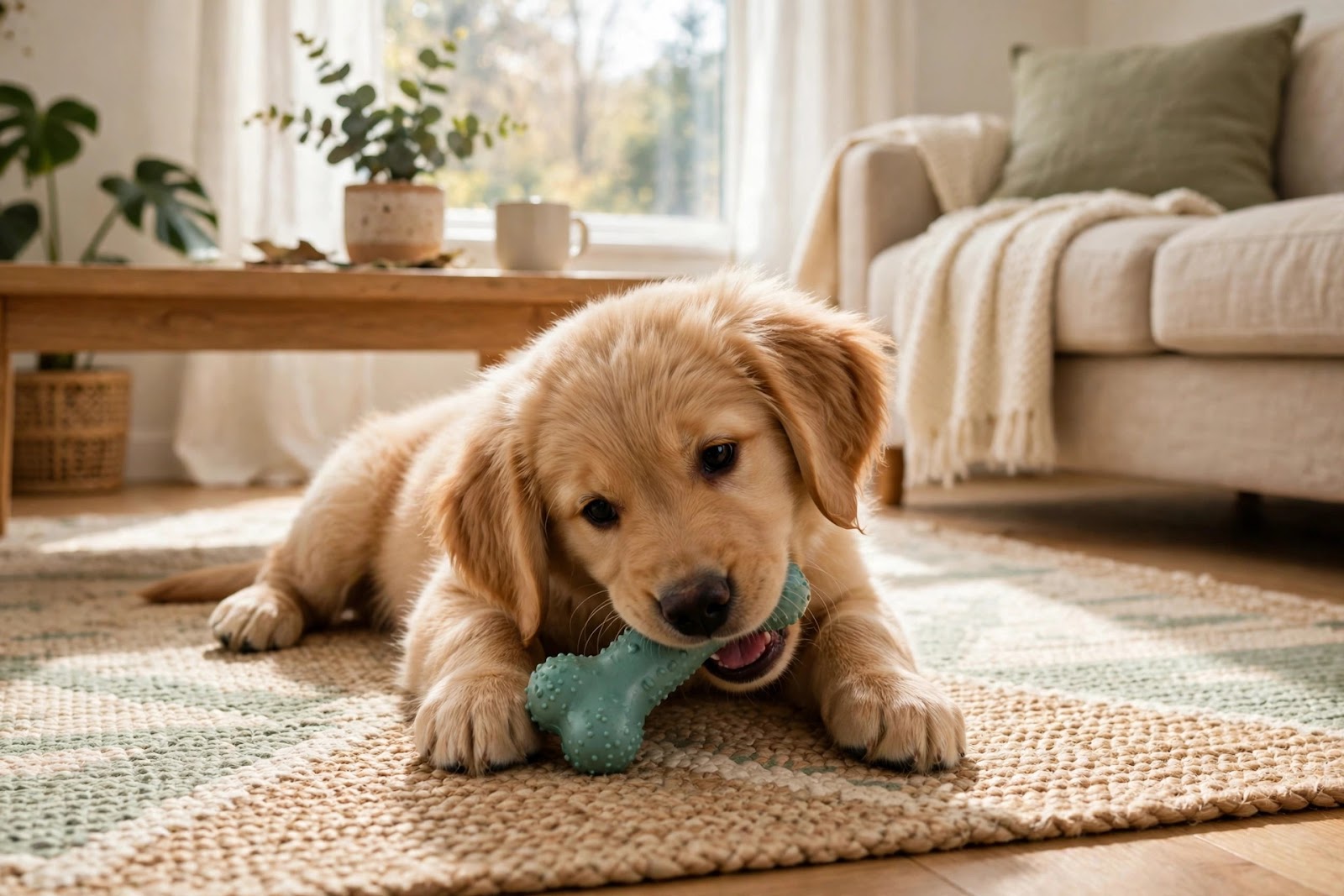
Puppies chew because they're teething, exploring, and learning what the world feels like in their mouths. Their jaws are weak and their teeth are still coming in, so hard toys are a bad idea at this stage. I made that mistake once with a hard nylon bone and a very unhappy puppy, and I won't repeat it.
Soft rubber toys are the sweet spot for puppies. They give under pressure, they bounce, and they can be stuffed with a smear of food to make them interesting. Freeze a stuffed rubber toy for an hour and it becomes a soothing teething toy as well, which is a lifesaver during the worst teething weeks.
Size matters even here. A toy should be too big to fit entirely in your puppy's mouth, but light enough that he can carry it around. If he can swallow it whole or squash it flat, it's too small. I check the size guide on the packaging, then I ignore it and hold the toy up against my dog's head, because real dogs don't read size guides.
Supervise puppies with every new toy, at least for the first few sessions. Watch how they chew: gentle gnawing is fine, but frantic shredding means the toy is too tempting or too weak, and it needs to come out before pieces come off.
Adult Dogs: Match the Toy to the Chew Style
Adult dogs fall into very different chewing styles, and this is where most people go wrong. A gentle chewer who mouths toys softly can happily use plush toys for months. A power chewer who clamps down and tries to destroy things needs thick rubber or a solid chew designed for strong jaws.
I'm a fan of the fingernail test for hard chews. Press your thumbnail into the toy: if it gives slightly, it's probably okay for most dogs. If it doesn't dent at all, it's very hard, and very hard things can crack teeth. My dog's vet once showed me the cracked tooth that proved the point, and I've been careful ever since. If you're unsure about a chew, ask your vet what hardness suits your dog.
For power chewers, look for toys with some give, thick walls, and no small parts, squeakers, or seams that invite peeling. For gentle chewers, softer toys are fine and often more fun, because they can actually carry them and toss them around. Buying a power-chewer toy for a gentle dog just gives him something heavy he ignores.
Rotate toys rather than leaving all of them out at once. I keep about half in a cupboard and swap them weekly. A toy that comes back after a week away feels new, and that novelty keeps my dog interested without me buying anything.
Senior Dogs: Comfort Over Toughness
Older dogs chew differently. Their jaws may be weaker, their teeth may be worn or missing, and they often chew for comfort rather than destruction. A senior dog doesn't need the toughest toy on the shelf. He needs something he can mouth gently without hurting himself.
Soft rubber, plush toys with reinforced seams, and lick mats all suit older dogs well. Avoid anything that requires real jaw strength, and avoid hard bones and antlers if your dog's teeth are already worn. The goal for a senior is gentle satisfaction, not a workout.
Weight matters too. A heavy toy that a young dog tosses around happily can be a chore for an older dog to carry. Light toys, easy grips, and toys that stay where he drops them are kinder on stiff joints.
What Wrecks Furniture (and How to Stop It)
Here's the honest part: dogs don't usually chew furniture because they're bad. They chew it because it's available, it smells like you, and it's more interesting than the toy you bought. A chair leg smells like the house. A brand-new toy smells like a factory.
The fix is boring and it works. Make the right thing rewarding and the wrong thing boring. When my dog was chewing a table leg, I didn't just take the toy away and scold him. I rubbed a bit of food scent on his rubber toy, played with it with him for five minutes, and praised him for choosing it. Then I blocked off the table leg with a piece of furniture for a week. He forgot about the leg, and the toy became the habit.
Bitter sprays can help as a backup, but they only work if the dog dislikes the taste, and some dogs genuinely don't care. Test it on a small spot first, and don't rely on it alone. Management plus a better alternative beats a spray every time.
Also, check whether the chewing happens when you're out. Boredom chewing and separation distress look similar but need different responses. If your dog only destroys things when left alone, that's a different problem than a dog who chews your shoes while you're sitting right there, and it's worth getting proper advice for it.
The Safety Check I Do Every Week
Every Sunday I pick up all my dog's toys and check them. I look for cracks, loose seams, missing squeakers, and pieces that are starting to peel off. Anything damaged goes in the bin, even if he loves it. A favourite toy that's falling apart is a choking risk, and no amount of sentiment is worth that.
I also check the size again as he grows or ages. A toy that was perfect for a puppy can become a swallowing risk for an adult dog who can now compress it, and a toy that suited an adult can become too hard for a senior. Toys aren't a one-time purchase. They're a moving target.
One more rule: no toy is unsupervised until it's proven itself. A new toy gets watched sessions for a week. If it survives a week of normal chewing without shedding pieces, it earns unsupervised time. If it doesn't, it either becomes a supervised-only toy or it goes.

Food Toys, Balls, and Tug Toys: A Quick Tour
Not every toy is a chew toy, and mixing up the categories helps. Food-stuffable toys, like hollow rubber toys you fill with kibble or a smear of soft food, are brilliant for dogs who get bored quickly, because the reward keeps changing. Freeze them in summer for a longer-lasting challenge, and always size them so your dog can't fit his whole jaw around them.
Balls are for fetching, not for chewing, and that's an important distinction. A tennis ball left with a dog who chews will shred, and the felt can wear teeth down over time if a dog gnaws on it daily. Use balls for play sessions, then put them away. A ball launcher or a solid rubber ball lasts longer for strong fetchers, and it's easier on your throwing arm too. Tug toys need handles you can hold safely and material that won't shred into strings on the first pull. Rope toys are popular, but a dog who unravels rope and swallows strands needs a different option, like a solid rubber tug or a flat fabric tug with reinforced stitching. Check tug toys after every session, because frayed rope is a hazard, not a toy.
Plush toys are comfort toys for most dogs, not chew toys, and that's fine. Some dogs carry a plush toy everywhere and never damage it. Others perform surgery on it within minutes. Know which dog you have, and buy accordingly. A plush toy with no squeaker and minimal stuffing is a safer bet for the surgeons, because there's less to swallow when the inevitable happens.
A Word on Bones, Rawhide, and Antlers
Natural chews sit in a different category from toys, and they deserve a separate decision. Cooked bones are a hard no in my house, because they can splinter, and splinters are not something I want to gamble with. Rawhide is another one I skip: some dogs chew it calmly, others gulp softened pieces, and I don't enjoy watching that gamble play out.
Antlers and hard nylon chews fall into the "check with your vet and watch closely" category for me. They last a long time, which is the appeal, but they are very hard, and hardness is what cracks teeth. If you do use them, size them generously, take them away once they wear down to a size your dog could swallow, and never leave a new one unsupervised.
My own rule is simple. If a chew makes me nervous while I'm watching, it doesn't stay in the house. There are plenty of safe rubber and food-stuffable options that keep my dog just as happy, and I sleep better for choosing them.
Buying Smart, Not Buying More
You don't need twenty toys. You need three or four good ones that fit your dog right now: one for chewing, one for fetching or tugging, one for stuffing with food, and maybe one comfort toy. That's it. Everything else is clutter that your dog will ignore in favour of your shoes.
When you're shopping, check three things before the price. First, the size range on the packaging, and whether your dog is at the top or bottom of it. Second, the material, and whether it gives under your thumbnail. Third, whether there are small parts, seams, or squeakers that your particular dog will target. My dog removes squeakers in under a minute, so squeaky plush toys are supervised-only in my house, no matter how cute they are.
Start with one toy, test it, and only buy more of what works. The cheapest toy your dog loves is a better buy than the most expensive toy he ignores. My dog's all-time favourite cost less than a coffee, and it's outlasted toys that cost ten times as much, simply because it fits his mouth, his jaw strength, and his way of playing.
Match the toy to the dog in front of you, not the dog in the advert. Your furniture will thank you.


